

This podcast is a proud affiliate of Libro.fm. By clicking on this banner, we may earn a proceed of any purchases you make, in which case, we thank you very much!
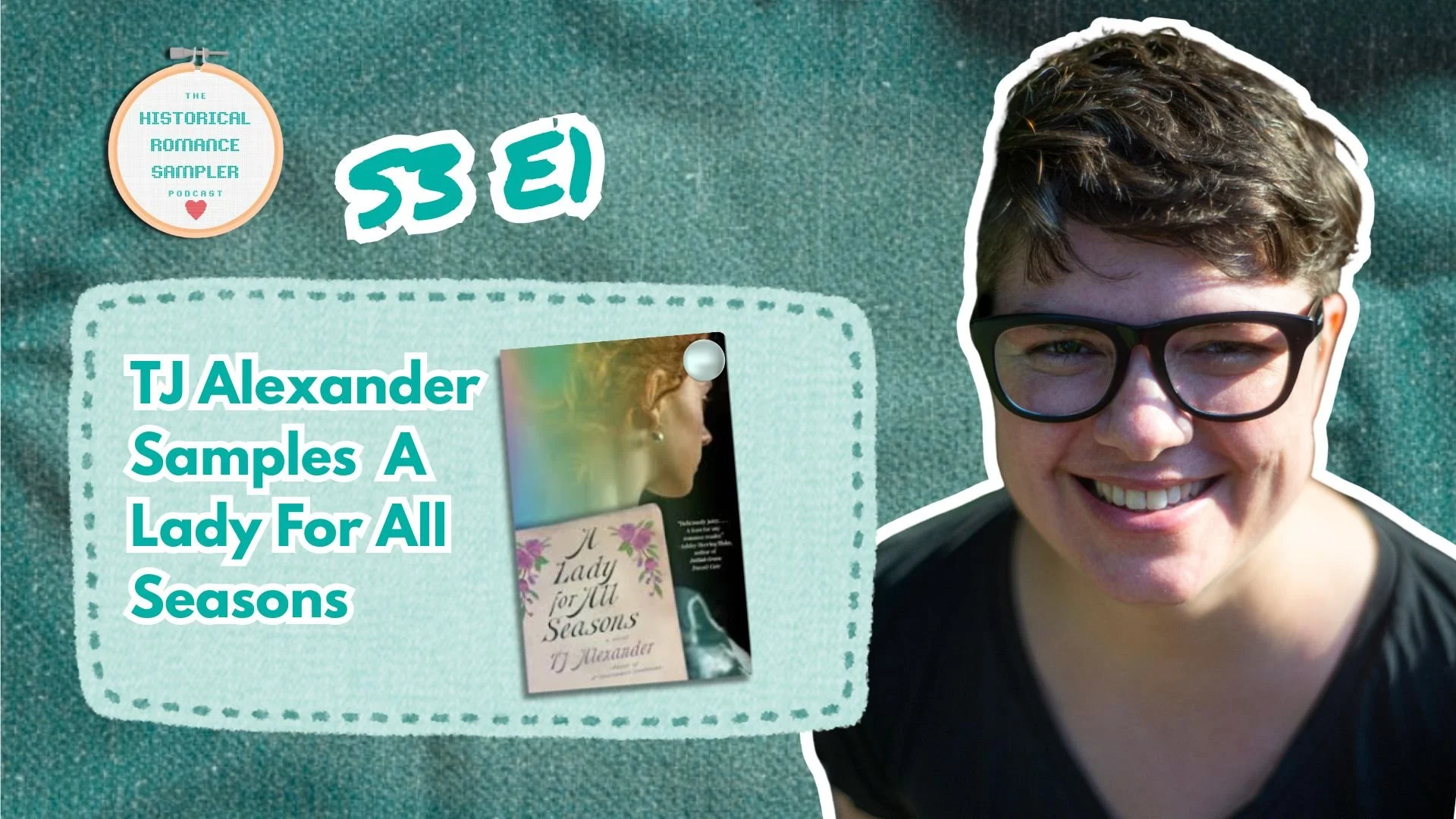
TJ Alexander Samples A Lady For All Seasons
Katherine Grant: Welcome to the Historical Romance Sampler. I am your host, Katherine Grant, and I am joined today by Lambda Literary Award finalist and USA today bestselling author TJ Alexander.
TJ Alexander: Hello!
Katherine Grant: TJ writes about queer love in contemporary and historical romances. Originally from Florida, they received their MA in writing and publishing from Emerson College in Boston, and now they live in New York City with their wife, cats, who you might spot in the background and various houseplant.
You first heard them last season on a special episode about book bans, and now they are back to talk fun things about their upcoming historic Romance. A Lady for All Seasons, tj, thank you so much for coming back to the podcast.
TJ Alexander: Thank you for having me. I'm glad we get to talk about fun things today.
Katherine Grant: Yes, so A Lady for All Seasons is coming out this march.
TJ Alexander: Correct. March 10th,
Katherine Grant: what should readers know about it?
TJ Alexander: So it is a sequel to my first Regency Romance a gentleman's gentleman, but you don't have to have read that to read and enjoy this one. A Lady for All Seasons is the story of Verbena Montrose who has to find herself a husband toot sweet to get out of the, from under the thumb of her pretty wretched family home life.
And she very quickly concocts a scheme by which she will fake marry a a gay man, a friend of hers who is also a character that we met in the first book Etienne, tailor extraordinaire, who is now coming up in the world financially and socially. She feels very good about this plan until she is alerted to the fact that a popular poet has been making thinly veiled illusions to the fake marriage plot in her popular poetry.
So Verbena goes to confront her and discovers that this is a very hot person. And while they forge an unlikely friendship, Verbena is not aware that her new friend Flora is also uncelebrated novelist, William Forsyth, a son of a minor noble family who also, because Flora cannot woo Verbena publicly,
in this other persona, William is shooting his shot. So it is a comedy of errors and misunderstandings and identities, and it follows our gang through Regency England and Wales.
Katherine Grant: That sounds lovely. There's something Shakespearean about that plot in a wonderful way. I can't wait to hear. And read it.
So you're reading a scene for us. Is there anything we need to know?
TJ Alexander: The only thing that that I will say about this excerpt is that it's pretty far into the book.
This is the beginning of chapter five. So just to set it up, this is after Flora has made the arrangement with Etienne to get fake married and has heard about Flora Witcombe poetry. So that's, that's where we are at now.
Katherine Grant: Awesome.
TJ Alexander: Flora Witcombe arrived at the Calliope late, but as she was always late, she did not think much of it. Luncheon had come and gone, which was bothersome. The cook they employed at the club was quite talented. She hoped she could wheedle a sandwich from him later. First, she needed a drink and some fresh gossip. As she handed her bonnet, gloves, and reticule over to the porter's tender care, she could hear the booming voices of her fellow members in the blue room discussing the latest news from Venice.
There was always a good quantity of gossip coming out of Venice or Paris or any number of continental cities. Every so often, someone in the region even found time to create some art. Flora turned to the oval mirror placed just behind the Porter Station and checked the fall of her chestnut curls. They were behaving for the moment, though the summer humidity would surely ruin their careful arrangement before the day was done.
Fortunately, unlike most ladies, Flora could simply remove her hair when it needed brushing. She floated into the blue room, so named for its various settees upholstered in Robin's egg velvet. A portrait of their society's founder hung above the mantlepiece done in the most lurid style.
Society was perhaps a generous way to define the little enclave. Membership was not strictly regulated to the upper classes. The artists and poets who found refuge in this club were both famous and unknown, high born and low talented, and suffice to say, the club welcomed all types. So long as a person's artistic credentials were apparent or could be vouched for, they had a place at the Calliope Club.
The lax atmosphere allowed women such as Flora, to appear alone un chaperoned and without fear. "Ah, Miss Witcombe."
Perhaps one fear. Flora turned to watch a man rise from his supine sprawl on a nearby armchair, his rosebud mouth stretched into a sardonic sort of smile. His gait as he crossed the room was a tad stilted,
his limp, barely noticeable in his specially designed boots. He was instantly familiar to Flora, though she could scarcely believe her eyes.
"How lovely to see you, Miss Witcombe," Lord Byron said. "It's been far too long." He took her hand and kissed it, his lips warm on the skin of her knuckles.
Flora's mouth thinned. "My Lord,"
she said severely retracting her hand. "What on earth are you doing here? And last I'd heard you were in Rome."
"It was Ravenna actually. Rome was ages ago." He tossed his head, his hair touched by candlelight. Several of the assembled guests, men and women alike, paused their conversations to stare. "A wonderful part of the world.
God spared no expense when he crafted it." He feigned some interest in a trinket on a nearby sideboard, thereby noting the people all around the room who were taking note of him. He was the sort of man who was awfully impressed with himself and always had been. Flora was wholly immune to Byron's charMiss
However, she was lucky that she did not feel any pull toward the great planet of his personality, though she did admire his work. Some of it, at least. His latest cantos were not as pleasing in her opinion as his earlier ones. "And you've decided to return to England at last?"
His departure some years ago had caused a stir, preceded as it had been by a string of scandals so lengthy that Flora could not keep them all straight. Suffice to say Lady Byron was probably correct to be furious. Byron winked. "Don't tell my creditors. I pop back for the summer," he said. "One longs for one's homeland
after so much time abroad." He paused to take a glass of sherry from a passing man servant. "I may have made some small trouble for myself in Ravenna, which desires time and distance to smooth over." Flora resisted the urge to roll her eyes, instead attempting to catch the servant's notice so that she might also have a drink.
She failed to do. " I assume you must not be too fearful of your creditors, your wife, or whatever you've escaped in Ravenna, if you're telling me all this," she said.
Byron gave her a knowing look. "Your assumptions, as always are practically fact, a little fodder for your poems perhaps to be published
well after I depart." He handed his glass of Sherry over to her, eyes bright.
Flora, accepted it and took a sip. "Yes, a few coins in my purse. And as much attention for your clandestine visit to England as you can stomach," she said, with dry amusement. "Honestly, my Lord, will you ever be capable of doing anything without drawing every eye to you?"
"God, I hope not," he said and held out his hand to accept another glass from a different man's servant. "Shall we seek out some privacy to test your theory? You could see for yourself how capable I am with only your eyes upon me." His gaze remained firmly on hers, the leer unmistakable.
Flora's rejoinder came easily.
"I believe I'll stick to collecting rumors. I have no desire to be at the center of them."
"Well, please do inform me if you ever change your mind." Byron sipped his drink in his self-satisfied manner until a slight buzz of conversation near the door caught his attention. Flora followed his gaze and saw standing in the doorway, clutching a fine reticule, a woman with the most beautiful red hair.
It spilled like lips of flame from its arrangement a top her head, a style that suggested careless abandon but that Flora knew from experience needed careful work to achieve. Her cream gown was tasteful without being too ostentatious, cleverly trimmed to look expensive without actually being so. Flora's trained eye could tell. The men of the club, and the afternoon's gathering was almost entirely
men as usual, whispered to one another, cast and glances at the Strange Woman. The few women feined boredom, though their furtive glances spoke the opposite. The porter appeared beside the new woman huffing and puffing as if he'd been delayed by some other task. "Miss verbena Montrose," he announced, "bearing a letter of introduction from longtime members, Mr.
And Mrs. Horace Chesterfield, who vouched for the quality of the lady's pastoral poetry." The whispers turned approving. Flora wondered how many of the men were recalling as she was now the tale of the midnight chase that had captured the collective imagination last year. This was the same Verbena Montrose who had been at the center of that and all for the benefit, Flora was certain, of ensuring that Chesterfield's elopement was a success.
Then of course, there were the most recent dealings with that tailor that had reached Flora's ears. How interesting that she was now here. Flora hadn't known her to be involved in the arts. She wondered if Miss Montrose had read Flora's latest pamphlet. Miss Montrose scanned the room with a keen intelligent eye.
Then her sharp gaze settled on Flora's face and stayed there, unblinking and filled with ire. Ah, so she had read the pamphlet. Flora weighed the value of an undignified escape through the window, but it was no use. Miss Montrose bustled across the room, hurdling toward Flora like a cannonball. Lord Byron strode ahead to meet her.
"Miss Montrose, how wonderful to know you. I'm Lord Byron, though you are likely already aware." Miss Montrose made no answer and met his gaze not at all, which flustered Byron more than anything else. Flora would've enjoyed it if Miss Montrose wasn't still marching toward her with a steely purpose. Byron nearly tripped over his own feet as he pantomimed guidance toward Flora. " May I introduce you to one of our more commercially successful woman poets, Miss Flora Witcombe?"
Before Flora could even open her mouth to offer a polite greeting, Miss Montrose snapped: "Miss
Witcombe, I would speak with you."
In the months that Flora had been publishing her society verses ,as she'd come to call them, never had a subject of her poems confronted her. Most were too embarrassed. A handful had sent letters dancing around the intent, but with sums of money enclosed that she could only imagine constitute a bribe.
Those sums were returned to sender with haste, accompanied by a brief note saying that there must have been some error and she had no need for such payment as she'd told her fellow club members many times. If Flora wanted to amass a fortune, she wouldn't have ever picked up a pen. It wasn't about money.
It was her art. And anyway, the sales of her tract supplemented by patronage supported her comfortably enough. It had not occurred to her that some subjects might leap directly to fisticuffs without first attempting to pay her, at least. Judging by Miss Montrose's stormy face, that was her desire. Lord Byron cleared his throat and offered some measure of protection.
"Ladies, perhaps we might all adjourn to the green room. I've been toying with some paltry lines of late and I would be most obliged if a feminine eye cast a glance over them."
"I should like to speak to Miss Witcombe alone," miss Montrose said, staring only at her. "If she's not otherwise engaged." Her regal chin tipped up into the air.
It was a lovely chin, quite strong, an ending in a sharp point. It put Flora in the mind of daggers. She steadied herself against the sudden and unwelcome urge to do something truly foolish. Part of her had always fostered an interest in the gothic and the thought of kissing the point of a dagger was to her resoundingly attractive.
Yet there was no time for such things when one was about to be ripped to shreds in the middle of the blue room. "By all means," Flora said, though her voice was in tatters. "Allow me." She lifted an arm to direct Miss Montrose and hoped her smile did not appear as watery as her insides felt. Miss Montrose swept by with a sniff. The lavender scent of her hair caressed Flora as she went by. Flora took a shuttering breath her eyes meeting Byron's briefly.
He looked equal parts pitying and jealous. She glowered at him in return. So that was that. That was our meet ugly.
Katherine Grant: Well, I thought it was very cute.
TJ Alexander: Thank you.
Katherine Grant: Thank you very much. It was very fun. Such a great voice that is just, you know, carrying me from one witticism to another. I have a lot of questions for you, but first we're gonna take a quick break for our sponsors.
Do you have a favorite bookstore? Mine is Kew and Willow. I was one of their original Kickstarter backers and I am always thrilled to have an excuse to go to Kew Gardens here in Queens to see what is new. Since I don't get there as much as I wish I did, I also love to use bookshop.org to support them. Bookshop.org is an online bookstore of print and eBooks. The magical thing is that when you check out, you get to choose a bookstore from their partners and a portion of your purchase goes straight into that bookstore's wallet. When I need to order a research book, you can bet I'm putting it towards the Kew and Willow account.
The Historical Romance Sampler is a proud affiliate of bookshop.org, which means if you make a purchase there after following the link in my link tree, the podcast also gets a slice of that money, which helps me do things like pay for my editing software.
Check out my link tree for official shopping lists of books featured on each season of the show and go book shopping to support your favorite indie bookstore and maybe your favorite indie Historical Romance podcast.
Do you love to read with your ears? I've got you covered. The Historical Romance Sampler is an official affiliate of Libro fm, the audio bookstore, where every dollar you spend helps support indie bookstores. They've got a great selection of romance audiobooks that you can purchase or listen to with credits as part of a monthly subscription.
Even better, I've created custom playlists featuring the Libro FM titles that you here first on the Historical Romance Sampler. Head on over via the link in my bio to shop the playlists.
And if you're signing up for the first time, use code HISTORICAL for an extra book credit.
Katherine Grant: I'm back with TJ Alexander, who just read a sample from A Lady for All Seasons, which is out March 10th, 2026. Pre-order it now. Or go get to your bookstore and get it. There was so much here. I have a list of questions that I prepared ahead of time, and then I had a lot of questions that came up just as I was listening.
Please. So let's start with the Lord Byron of it all.
TJ Alexander: Let's do it. Let's do it. Let's get to them. Let's get right down to them. Yeah. What do you wanna know?
Katherine Grant: How, how was it to add a real historical figure into your work? What was your approach to that? Did you do a lot of research? Did you just go from, you know, what he's given us in his writing?
And then also how do you feel about Lord Byron as a person?
TJ Alexander: I mean, I think, yes, it was, first of all, crazy for me to do, to put a real historical figure in this book because in a gentleman's gentleman the first book of this duology, I really was trying to kind of create its own little world, separate from I didn't do a whole ton of research, really.
I didn't feel married to historical accuracy in a way that I felt was not going to serve the story. I was just, I had a real chip on my shoulder about that in particular, because so many, regency romances in particular, but historical romances in general, like a lot of that historical accuracy that, these romance novels have, are kind of genre conventions that were invented by like early 1900s novelists who were sort of reviving the Regency era as a romantic setting and kind of just wholesale inventing things that they thought were like, cool. You know, a lot of the stuff about the Regency era and the aesthetics of it and the
Famous works of Georgette Hayer and, and her contemporaries were just really just fantasy. And were also coming from a place of deep, deep, bias and racism. So I was really trying to do something new. But then when it came to writing this book, I think Lord Byron was like
just a very brief, like I put him in the, in the pitch as a joke almost. I knew that my editor Anna Kaufman at vintage books, like we, we have sort of a similar sense of humor and I was like, and wouldn't it be funny if also like, Lord Byron was there for like a really funny, like quick cameo and she was like, oh yeah, that would be really funny.
Like, yeah. Okay. I love that. So. The scene that I just read was what was supposed to be the first and only like end of like that we see of Lord Byron. And somehow in this book, he became a real supporting character. Like his role kept just growing and growing to the point where I was like, oh, well, like logistically, I need someone to do this.
Well, it's gonna be. I guess he's, he's already there. Like, let's have him do this. You know, I need someone to like connect these, you know, red strings, uh, to make their character arc make sense. Who, who can they have that conversation with? Because they can't be honest about what's happening with any of these other characters.
'Cause that would spoil the, the, the whole plot. So Lord Byron was like stepping in for a lot of these like moments where I was just like, God, he's doing a lot of heavy lifting here. I realized that like, oh God, he's. He's a much bigger character than I thought he was going to be. So yeah, I read a lot of his writings, a lot of his letters, especially. Which, which are very interesting, like sort of looks into, I mean, not just his life, but just how things were done and communicated in high society.
Someone of his stature and someone from, that world. A lot of the book takes place in sort of the artistic world, the world of poets and writers in London and around Britain in this era. And it was, it was very useful to know, like, you know, what was happening with him because he was part of the whole romantic movement, a huge part of it.
And I, you know, I played myself really in having Lord Byron step into this book because as soon as he did, and I should have known better, as soon as he came onto the page, it was like, well, you can't get rid of him now. He's too big. You know, that line about the great planet of his personality. First of all, I had to look up like, would that even make sense?
Do people even know what planets did like back then? But like they did, don't worry about it. But he really had this gravitational pull of a life where so many different things that I needed to talk about in this book were things that had to do with his biography and his, his body of work. So I found it very
humbling to realize like, I can't just make one silly joke and then move on. Of course, I've gotta like do the real work, which is always very annoying. But then like Byron ended up having this like, character arc of his own in a way that if, you know, if you know anything about his, his life and, and how young he was when he died ends up I think being very poignant and very beautiful.
Katherine Grant: Well, he's a, he's a fun foil, at least in this scene, revealing you know, Flora and Verbena both just like being like, I'm not impressed by you. Like, that tells me so much about them and makes me root for them as someone who's like, Ugh, not Lord Byron.
Now, something else that came up in this scene. Well, first of all, the idea of poetry as gossip seems like very Byron esque and of that era. But something that was coming up even in this scene that I'm curious about is kind of like the ethics of gossip or the role of gossip in a community, and was that something that you thought about and how did you approach that as you were writing Flora's character?
TJ Alexander: Yeah, I knew gossip was going to be a big component of this plot because in the first book, a gentleman's gentleman, where Verbena is a side character, her function in that story is very gossip heavy. Like she's the person who sort of holds all the keys to the kingdom when it comes to knowing who's who and like the ins and outs of high society.
She's supposed to be like a, a woman who is making her way through the world and hoping to be successful in her machinations almost purely because she has an ability to collect and collate the gossip of the moment. So when the book, introduces both of these characters, we reestablish that, you know, that that is a big part of Verbena's, personal philosophy, that she is not above, wielding gossip to get what she wants and manipulating situations to her benefit.
And then she sort of runs up against Flora, who is doing the same thing, but like, you know, for creative purposes. She doesn't think she's hurting people. Like that's not something that occurs to her really. She's doing this to entertain and to you know, practice her art. And it, it's only upon meeting Verbena that I think she sort of comes to realize, like, oh, the people that I'm kind of
poking fun at in my poetry that I'm mocking. These people are like, some of them are are maybe not deserving of that. Maybe I shouldn't be putting certain people on blast in this way, you know, because that is very powerful. It's something that could very easily ruin somebody if somebody else were to make the connection about who is being referred to.
The issue is, is that Verbena and Flora are both operating on such a high level of like, you know, the, the conspiracy theory board. Like they're both so good at gossip that like almost no one else in of their acquaintance is a threat to them in the way that each other is. And so I think that's a big part of their mutual attraction at least in the beginning is realizing like, oh, this is someone who's operating on my level.
Hot, but also scary, you know?
Katherine Grant: Well, and that makes 'em hotter, right?
TJ Alexander: Yeah. It's hot to see somebody who's competent at what they do. And Verbena is very, very competent at gossip and society, and Flora is very, very competent at gossip and writing. So, I just, I loved melding those two things together.
Katherine Grant: Yeah.
Did you have to write poetry for this book?
TJ Alexander: I did badly. Very luckily, luckily, very blessedly, there was an editorial assistant who I think did a thesis on Regency romantic poetry and was like, oh, tj, do you want me to like, make some suggestions here and I was like, yes, please. Thank God. That is a huge problem that I think us writers run into constantly, is that we've written a character where we're like, she's the best at this.
And it's like, okay, you're gonna have to show us her doing that, and I'm like, oh no, I this. So yeah, it's a lot of fakey. But I got, I got around it a little bit because a lot of the poetry of Flora's that we end up seeing wr written out is like poetry that she has started
writing after meeting Verbena. So it's a lot different from the successful commercial poetry that probably sounded a lot better than what I ended up coming, coming up with. So, so plot wise, it was like not outside of the realm of possibility that like, well these poems wouldn't be like, you know, these are new and they haven't been workshopped yet.
Katherine Grant: Yeah, yeah. I'm always like, I'll show the discarded draft of what they wrote, which obviously be improved upon.
TJ Alexander: Obviously we don't have time to get into that. Yeah.
Katherine Grant: So you've talked a little bit about how, I mean, even the scene it came up with like in the club, there are, you know, successful artists, talented artists, people who are just there in this book as you explore themes of commercial versus maybe like, art for art's sake type of art, how much of that is exploring what was going on
in the regency period? And how much of that do you feel is kind of like reflecting or ruminating or processing your own experience today as an artist?
TJ Alexander: Well, I think that I was definitely through the Flora William character processing a lot of how, what, you know, I've been experiencing so far in my career in traditional publishing, that there is this push and pull of like.
Do you wanna make art or do you wanna make money? Because sometimes you can't do both, is the conundrum that we're faced with. And then the conundrum further is, and if you wanna make money, it's not gonna be very much, and if you wanna make money, there's no guarantee that that's gonna happen, you know?
So yeah, it's it definitely some feelings were getting processed there, especially like, so, you know, Flora William lives this dual life and is gender fluid and as William he's a very unsuccessful novelist. He's writing gothic romances and fiction. Which at the time would probably have been kind of frowned upon for a man to be doing because that was starting to get sort of thought of as a feminine sort of venture.
And and he's doing it because he loves it, but it's not getting him anywhere. He's not finding the success that he needs. And as a sixth son of a minor family, he's not going to be able to support himself with just those writings. So when he starts publishing poetry under Flora's name and that becomes super successful, he's sort of faced with this conundrum of like, he wants to produce art.
But she also like, you know, has to make a living. So like, which are we doing? And is there a way to do both? And then like, you know, she ends up focusing on the poetry. Is it the more successful creative venture? And, but sort of feels like that there's a missing part of her in that, in that William sometimes has to take a backseat in life.
She, she becomes the sort of persona that is taking the forefront. At their club, she's the one that becomes the member there, not him, because I think as he says later, there's no point in paying twice the dues for just one person. Like, which is so real, so real that that man has bills.
You know what I mean? There's a dissatisfaction at points that Flora experiences where like, it's not exactly what she wants to be doing all the time with her life. She's trying to find a way to have it all right. And it's really difficult in that era and in the current one, like it's never been easy for artists to survive and, we're working through some things 'cause we could not afford a therapist when we were writing this draft.
Katherine Grant: Well, now it's time to move into Katherine's quick questions.
Katherine Grant: If you had to use one of these words to describe your writing sensibilities, would you describe yourself as a realist, a comedian, or a fantasist?
TJ Alexander: Comedian. A hundred percent. A hundred percent. I think that comedy is the great root of all art. I mean it sincerely. I think that it's the hardest thing to write and write well. I think it's extremely easy to make somebody cry. We're all on the verge of tears most of our lives. If you think about it, everyone is like, one hair's breath away from getting emotional in a, in a you know, tragic sort of way.
I think that it's much harder to make somebody laugh.
Katherine Grant: Absolutely. All right. If you had to choose, would you add more real history or more romantic scenes to a story?
TJ Alexander: I mean, romantic scenes because the history setting that sort of, you know, the aesthetics and the, the, the, the little facts and all of those things.
Those are just there to prop up the story. And if the story is a romance, then you have to prioritize that.
Katherine Grant: If you were forced to do a genre blend story, what crossover genre would you choose?
TJ Alexander: Am I getting paid?
Katherine Grant: Yes. You're getting paid. You're, you're getting a a
TJ Alexander: I, did I do any of them
Katherine Grant: a nice deal?
TJ Alexander: If it's a nice deal, a two book deal, then like, yeah, I'm I'll, I do any of them. But but if it were like, up to me, I mean, I love a mystery. I grew up on mysteries. I would love to, to you know, if I had my druthers do something like that.
Katherine Grant: Nice. And finally, what does escapism mean to you?
TJ Alexander: Octavia Butler and, and so many other, like very, very smart writers have said that escapism at its very basic level is just the ability to imagine a different world, right? Which is what all fiction usually is, not always, but, but usually. And I think the idea of escapist literature has been imbued with this very negative connotation of like, well, you're not ready or willing to face the reality of our current world, and you need to escape into this fictional world.
And I chafe against that because I feel like my work, even though it is, obviously taking place in a world that is very different from our current one, especially these historical novels, I wouldn't call them escapist in in that sense, because I don't think that you're escaping from this world when you read a story like this.
I think you're looking at this world through a different lens. Like obviously as a person living in 2026, I'm writing these stories about trans people and gender non-conforming people and queer people in a way that is me trying to make sense of my life and my world. So I don't really think of it as escaping from anything.
If anything, I think it's confronting it, just from the side. We're trying to like go at it from a different angle because head on just is not working for us. It can't work that way, bud. So yeah, I don't call my books escapist. When I first was pitching a gentleman's gentleman, a lot of people were coming back to me with like, so this is like a, a fantasy romance? Like, it, it takes place in like an alternate history? And I was like, oh, no, no, no.
It's, it's just a, it's just a historical and this tendency for a lot of people, especially straight people, to think like, well, because we don't have any historical records of trans people, you know, being Earls or anything in the regency period, like this is, this is pure fantasy.
And I'm like, well, you don't know. How could you know?
Katherine Grant: Yeah.
TJ Alexander: I'm making it up. That's the whole point of fiction. Why do we have to have historical documentation to support our thesis statements here? That's not what I'm doing.
Katherine Grant: Lovely. I think that's really well said and interesting, so thank you for that.
TJ Alexander: Thank you.
Katherine Grant: All right. Well, unfortunately we have to wrap up. Where can listeners find you and A Lady for All Seasons as well as your other books?
TJ Alexander: You can find me on the internet. I'm on Instagram and Blue Sky and Tumblr for whatever reason, still at TJ Alexander nyc. And my website, tj alexander.com and you can find all my books there.
Katherine Grant: Tj, thank you so much for coming on. Listeners. I'm gonna put a link to TJ's website and books in the podcast show notes, so you can click on through through there.
And tj, thank you so much for coming on. I really appreciate it.
TJ Alexander: Oh, thank you for having me.
That's it for this week! Don't forget to subscribe to the Historical Romance Sampler wherever you listen, and follow us on Instagram and YouTube. Until next week, happy reading!