

This podcast is a proud affiliate of Libro.fm. By clicking on this banner, we may earn a proceed of any purchases you make, in which case, we thank you very much!
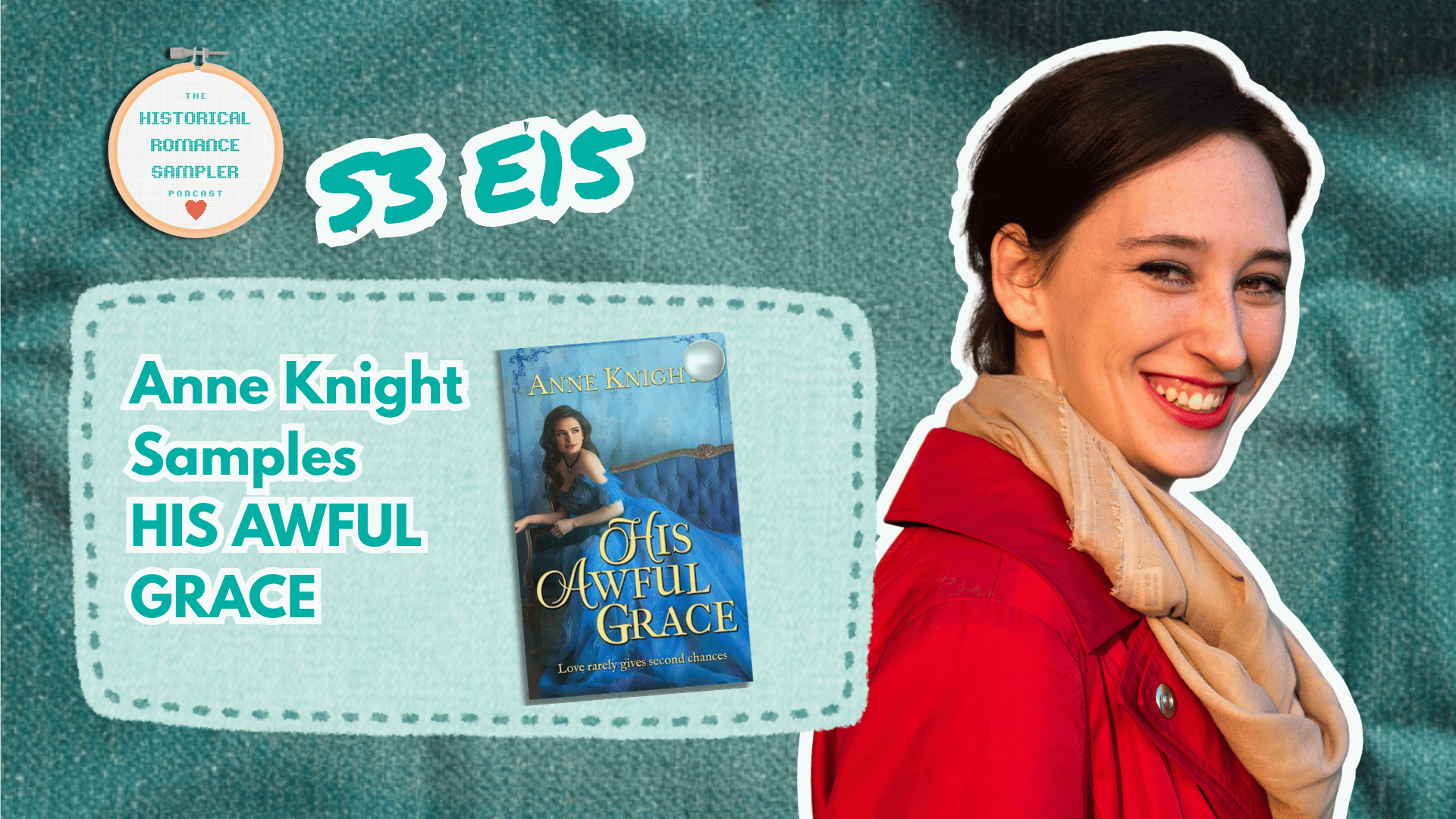
Anne Knight Samples His Awful Grace
Katherine Grant: Welcome back to the Historical Romance Sampler, where every week you get to meet a new historical romance author. I'm your host, Katherine Grant, and today I am very excited to be joined by returning guest, Anne Knight.
Anne Knight: Hi, thank you for having me.
Katherine Grant: I'm so excited to have you. We first met you as a podcast on season two, episode 36, when you came on to talk to us about book bans and censorship, and why it matters to romance readers.
And listeners, if you haven't caught that episode yet, definitely put it in your queue because it's important to know about this. But I'm very excited that Anne is returning to talk about fun historical romance this time. We're just gonna enjoy the genre today. So to introduce Anne, Anne has been writing stories since she was three years old.
Before she could read or write, she followed her parents and babysitter around begging them to dictate her words. Eventually, she learned the alphabet and began writing herself. She sneaked her first romance novel when she was 13, but did not become an avid reader or writer of the genre until after college.
Today, Anne reads and writes romance with immersive historical detail, cinnamon roll heroes, and trailblazing heroines. She lives in Arkansas with her real-life swoony hero, four children, and two cats. Anne, thank you so much for coming on.
Anne Knight: Thank you for having me. I'm really happy to be here.
Katherine Grant: I'm so excited.
You are reading from your latest release. Do you want to tell us about it?
Anne Knight: Yes. So this is His Awful Grace. It is actually my debut novel. I've released several novellas over the past year or two, but this is the first full-length novel. So His Awful Grace is kind of like, a Victorian romance, like Call the Midwife, if you're familiar with the BBC show.
So, it's a second chance romance about a heir to a barony and his estranged wife. They've been estranged for eight years. All of a sudden, he suddenly needs to produce an heir to for the barony, and so he shows back up and has to convince his wife to let him back in so that they can at least have a baby, and he realizes that she is entirely different than what he remembers.
And he doesn't even know her anymore, and she is in the eight years since he's seen her, she has researched medical issues, and she's providing medical care to pregnant women and infants in the London slums. And so it's a brand-new kind of cutting edge look at what we now know as neonatology.
And she is considered one of the first experts in Great Britain.
Katherine Grant: Mm.
Anne Knight: So, so this scene is a couple of chapters in that I'm about to read, and it's after they've met again, and she's still very angry at him, and he is still very confused over who she is but also very interested in finding out.
For the next week, Mark kept busy. He still didn't know how to both avoid causing Ellen more pain and do his duty to his family. Maybe she'll be excited about the possibility of more children. He ran the razor over his stubble one morning. I've changed, grown deeper and better over the years.
Why should I be surprised that she had too? Perhaps I could build a life that shall make her happy. He snorted, recognizing that for the fantasy it was. "Don't get distracted, old boy," he muttered to his reflection in the mirror. "Domestic bliss is not on the agenda. But I owe the estate an heir. She married into the family.
She knows she owes it too, as my wife. Keep it at that, and you won't be disappointed." Dryden, his valet, looked up from his tasks in the closet. "Do you need assistance, sir?" Mark eyed himself in the mirror, wiping a spot of cream by his nose with a warm, wet rag. "I have it. I shaved myself for eight years on a moving ship while sharing my quarters with other men.
I can handle this now." As he scraped the razor across his second cheek, Mark thought about everything he had to do. Over the past week, he'd aired out the house, hired a cook, chambermaid, and footman. The elderly caretakers, who'd lived in the home while he served in the Navy and Ellen lived with her family, had resumed their former posts of butler and housekeeper.
He had filled the study to brim with his books already, and organizing them and purchasing enough bookshelves for them was his special project. His father, the previous Lord Cotslow, had purchased this townhouse as a wedding present. It wasn't a mansion like Glenville House, merely fifteen rooms and an attic for the servants.
A far cry from the dreams he'd had eight years ago of a life split between being an Oxford don and a man of prestige and status in society, maybe even founding a royal classical association like those chaps in the Astronomical Society. He couldn't make up his mind which he'd wanted more at the time, which is perhaps why joining the Navy hadn't been such a hard decision.
Once, he thought he needed his wife's dowry of fifteen hundred pounds a year to supplement his own allowance for any of a semblance of a good life. But now, he wanted peace and quiet. Navy life had shown him how little he needed for a decent life, but also how much he valued a little space and silence to call his own.
As if to punctuate his thoughts, a door slammed below. Voices rumbled in the small foyer. Mark sighed as he turned the razor to get a particularly tricky corner near his ear. Probably Luke or maybe one of the twins visiting London for the weekend. A woman's voice rose above the hubbub, urgent and clear.
So not Luke or John. Luke preferred the company of men, particularly his valet, and John so far didn't seem to prefer the company of anyone. "I am the mistress of this household, and I can go into any room I choose." The woman stormed down the hallway. Dryden sighed heavily, as if already exhausted by the ordeal, and stepped out of the closet to the door.
"Wait." Mark set his razor down on his vanity table. The door burst open, and Ellen stood as glorious and furious as ever. "Excuse me, the master is not fit to be seen. He's in a state of undress." Dryden stretched out his hands, ready to fend her off. He approached cautiously, attempting to block the sight of Mark, clad only in trousers and socks, from her line of vision.
Mark, startled speechless by surprise and her fury, watched. She was beautiful again, her hair hanging over her shoulder in a loose braid. Two of her jacket's buttons mismatched, as though she'd left her home in a hurry. She was angry. She was alluring. Since when do I find angry women attractive?
"I am his wife."
Ellen drew herself up to her full height, which was merely average, and glared at Dryden. "I can see him in any state of undress I choose." Mark grinned. He slung the wet cloth in his hands over his bare shoulder and faced her. "To what do I owe the honor of this visit?" Ellen peered over Dryden and looked him up and down.
Her face turned cherry red, but she stole a second glance at his bare chest before glaring at Dryden. "This is a private matter." Dryden looked over his shoulder at Mark, who nodded. The manservant grunted, then strode around Ellen and out the door. In the hall, the chambermaid, footman, and elderly butler stood gawking.
Mark walked past Ellen, who flushed an even brighter red, and shut the door firmly. "Now." He turned to survey his wife, unable to stop himself from admiring her figure. Ellen, in his bedroom, where he performed his morning ablution, felt very intimate, and it had been so long since he'd had a woman in his arms.
Ellen raised her chin. She did that when she was nervous, he remembered. "I have come to see about moving back in with you." Mark crossed his arms, noticing how she refused to look at his muscles and bare skin. "Why?"
"Can you please put a shirt on?" Ellen muttered, glancing away. Mark laughed and walked past her, back to the vanity and mirror.
"Not until all the shaving cream is gone from my face." He picked up his razor, wet it in the basin of warm water, and set to finishing his right cheek. He looked at her through the mirror. "Why?" he repeated.
Ellen pinked again and looked at her feet. Mark tried not to grin, but it was still nearly a whole minute before he could put the blade to his cheek without fear of drawing blood.
Don't get your hopes up. Once he began, Ellen finally broke the silence. "My parents are attempting to restrict my freedoms. I dislike it, and I want to move here."
"I'm going to need more details than that." Mark flicked his gaze in the mirror to meet her eyes. Interesting. She's looking at me when she thinks I won't notice.
Smug male pride bloomed in his chest. Ellen groaned. "If I give you the details, will you say yes?"
Mark did what anyone would do in a situation where a beautiful woman demanded his help. He told her he had two conditions.
"What are they?" Ellen asked suspiciously.
"Just tell me the story."
"Is that one of your conditions?"
"No." Mark swiped a long stroke of cream away and flicked it in the foamy water. "Talk."
Katherine Grant: So tantalizing. Oh, my goodness. Who doesn't love a good shirtless scene? Well, I've got lots of questions for you, but first we're gonna take a quick break for our sponsors.
This episode is brought to you by The Kissing Ball by G.L. Robinson. This collection of five charming Regency romance short stories will warm your heart at Christmas and all year round. In The Fiancée Who Wasn't, a young woman arrives on the doorstep just days before Christmas claiming to be the fiancée of the son of the house.
The only problem? He has absolutely no idea who she is. In The Widow's Neighbor, a widow discovers that fresh starts come in the most unusual packages when an eccentric new neighbor turns up on her doorstep looking for help. In The Alchemy of Love, a sharp-witted young woman expects a simple business transaction when selling her father's chemistry lab, but she gets more than she bargained for with the handsome young gentleman who buys it.
In A Dog and a Dimple, the fashionable Sir Robert steps far outside his comfort zone to escort a governess and her young charge to London, and an unexpected stray dog and a captivating dimple threaten to change his bachelor future forever. In More Than a Pretty Face, a wallflower learns that true attraction runs far deeper And that beauty isn't everything when it comes to matching hearts. Read The Kissing Ball now on Amazon.
Katherine Grant: I am back with Anne Knight, who just read a sample of His Awful Grace. Now, this is a second chance romance, and that came through in this scene where Mark is reflecting on why he joined the Navy, what he wanted to be back then. He's also thinking a little bit about his future self, although we don't get too much of that in this scene.
And then obviously there's his current self that's shirtless, shaving, and confronted by his angry but alluring wife. I think the scene did so much to illustrate that particular aspect of second chance romance. So my first question for you is what do you love about the second chance romance, and what did you love about exploring it in this novel particularly?
Anne Knight: Second chance, I think I really love the idea of people trying again and getting it right the next time, you know? And I also love seeing the way a relationship grows over time. So whether a second chance or just your more traditional marriage in trouble you get to see what life is like after they've already committed to each other in some way.
And so, you know, we all love the happily ever after. That's why we come to romance and love it so much. But seeing that the path to happily ever after sometimes extends beyond the wedding day or beyond the honeymoon and what life looks like years after a couple's committed to one another is really fascinating to me.
And I think it's something historical romance is really good at really setting that scene where it creates that almost forced proximity just by, like, society's standards and expectations.
Katherine Grant: Yeah, it can be very delicious.
So you mentioned in the setup that Ellen is, you know, an expert in this neonatal care that's being developed at the time.
Can you tell us about how you researched that and what your approach was to portraying healthcare on the page when we know Victorian healthcare isn't quite up to our standards?
Anne Knight: Yeah. Yeah. So this, in some ways, this book was really personal for me which I talk about in my author's note. First of all, for anyone that is interested in reading it, I do wanna be upfront in that there are a lot of content warnings in this because we're dealing with maternal mortality rates in the slums of Victorian London and premature birth and all that our ancestors had to deal with.
But I kinda came up with this idea... back in 2019, I had twins early, 'cause that's how twins work usually. And so as I was rocking them in the NICU, they were there for a month, and I was like, "What, what would this have been like 50 years ago?"
Would I be sitting here holding my babies right now and, you know, 100 years ago, 150 years ago? And so that... What, what did our great-great-great-grandmothers experience, and how did they live through some pretty traumatic, you know, stories? And how did they make the world a better place and still hold on to hope through all of that?
So, so that was kind of my first thought. And it was just really fascinating to look into, okay, well, how did we take care of premature infants? Not really, right? Like, England didn't really try to save premature infants until they had their maternal mortality kind of, like, trending downward at least.
But there was a lot of fascinating things happening in the 1880s in France and eventually in America as well where they were able to create incubators, which I talk about in the story as like, they were like, "Oh, what if we kept babies in, like, an enclosed, warm, safe space?" And shocker, their, their survival rate goes up.
And so I read a lot of online resources and found a lot of things, like, on JSTOR, and unfortunately I don't speak or read French, so I'm sure there's tons of resources out there from, like, the very first neonatologist that I was not able to read. But seeing how it slowly trickled over into England and America was really fascinating.
So that and then, you know, if you read any, like, Lisa Kleypas or Meredith Duran or Elizabeth Hoyt, you know, you're gonna get a pretty, unflinching look at what, you know, the rookeries and the slums of London looked like. And so that was a really great starting point to then, like, go further in research of what things looked like for women and children during that time period.
Katherine Grant: Yeah, that's really interesting, and I feel like that's a moment where you know you're actually called to be a historical fiction writer, when you're, you know, living your life in the contemporary day, and your escape mechanism is to be like, "What would this have been like 150 years ago?"
Anne Knight: Yes. Yes.
Katherine Grant: So speaking of unflinching how do you think about writing Victorian romances that do present this unflinching look and yet are romances, which is a very optimistic genre?
Anne Knight: Yeah. To be honest, I'm still kind of figuring it out. I would say this book really straddles the line between historical fiction and historical romance.
You know, most historical romance will be, like, 70% romance, 30% history, or maybe, like, 60/40. This is, like, pretty 50/50. And so, it's gonna appeal to different people. It has a very specific audience, I feel like. Like, if you love Call the Midwife, you'll probably like this book.
Katherine Grant: When you say it's kind of 50/50, do you mean that it has the romance beats that we're expecting- Yes ... but it also kind of luxuriates maybe or spends a lot of time on non-romance beats that are depicting the historical world?
Anne Knight: Yes. Yes. Thank you. Yes, that's a good way to put it.
So there is a lot of the book takes place not necessarily at Mark and Ellen's townhouse, but at this... we would call it today, like, a clinic, like, a charity clinic. Then it's called a dispensary which is, you know, where a, a lady doctor and a nurse and Ellen volunteer their time to provide medical care to the people in the rookeries because they either wouldn't be accepted at some of the, the greater charity hospitals or there just, there weren't enough resources and their doors and beds would've been full anyway.
So, the setting tends to be, like, not your typical historical romance setting. Like there aren't any balls in this. I love balls. I love reading about them and everything, but this book just didn't wasn't the place for them. And then, you know, there is a subplot about the ethics of donations and what it means to donate used goods and how to, like, preserve dignity across everyone throughout these transactions.
One of Mark's greatest passions is Latin and ancient Greek, and translating that. And there's a whole, like, massive class divide between that, you know? Like only the rich can understand classics or only the educated, and, you know, the masses couldn't possibly. And yet, and yet at that time, there were street plays of, like, the Odyssey and the Iliad where, like, Homer would be a street sweeper.
You know, Ajax would be a butcher. And so there's a lot of, like, class interplay that I think historical romance does really well, and I was able to just take, like, a little bit further when I leaned into the historical fiction aspect of the book.
Katherine Grant: Yeah. That's really interesting. Now, you kind of mentioned it, you've published several novellas leading up to publishing a novel. So how does it feel to write a novella versus a novel?
Anne Knight: They're, they're, they're pretty different. I did write this in... The very first rough draft of His Awful Grace was during NaNoWriMo in 2022, I believe, and I banged out 72,000 words in 12 days.
Katherine Grant: Oh my gosh.
Anne Knight: Yeah.
Katherine Grant: Just, just for people who don't know, NaNoWriMo was a yearly, you take the month of November to write 50,000 words. That was the challenge, and you get celebrated if you succeed. Yeah. And you just lapped everybody.
Anne Knight: Well, that was the one time. I don't think it'll ever happen again.
But I think, so much of this book meant so much to me that it just kind of poured out. The historical fiction, the romance, the care of infants, the the women who experience stillbirth the grief the delayed grief of Mark as he's trying to catch up to everything that his wife has experienced.
It was just sitting on my heart, I suppose. Mm-hmm ... and it needed to come out, so it did in 12 days. And I was exhausted. And then of course I took some time to, you know, revise it and everything. The novellas came later. And that was a really good, like, skill-building experience of, how can I tell a story in basically a third of the word count?
And so, yeah, they're, they're pretty different, and I feel like it made me a better writer. Focusing on novellas for about a year or two made me a better plotter and a better editor and learning about what truly matters, you know, and what can be cut away for word count. And like, how do I get to the heart of who a character is in a much shorter amount of time?
Katherine Grant: Yeah. I too feel that writing novellas is really a skill-building opportunity.
I had written several novels. I had written some short stories and novellas, romance short stories and novellas. And I didn't feel like I understood them. And then I, I really wanted to commit to writing novellas, and so I kind of approached it by reading what other people did and what did I really like about it.
And then I started to really write these novellas. And I, I play with form, I play with timing. I, I play with a lot of things in my novellas. But I do feel like it has... It's kind of like sharpening a knife. It, it just makes me feel like when I return to a novel, that I am fresher and have kind of a different set of eyes for plotting and crafting and all that.
Anne Knight: Mm-hmm. Yes, it makes you very frugal with words, and, and you learn how to do a lot with a little.
Katherine Grant: Yes. So I guess now is a good time to transition, to transition to Katherine's quick questions.
Katherine Grant: All right. If you had to use one of these words to describe your writing sensibilities, would you describe yourself as a realist, a comedian, or a fantasist?
Anne Knight: Mm, I've gotta say a realist. I admire the comedians. I wish I was funny. I am not funny. I wish I was. And the fantasist is fantastic, too. Like, they have, they provide a lot of hope. But I tend to, like, lean toward realism, I think, in my writing.
Katherine Grant: Yeah. It's just so interesting to try to capture reality.
Anne Knight: Mm-hmm.
Katherine Grant: If you had to choose, would you add more real history or more romance scenes to a story?
Anne Knight: See, that's so hard. See, I think in my rough drafting, I tend to lean too heavily into the history. One of my best friends in real life read a horror novel that my agent was gonna put on submission.
And she said, "I love all the historical detail, but it might come at the expense of the vibe." And that sums up a lot of my early drafts.
Katherine Grant: Okay, if you were forced to do a genre-blend story, what crossover genre would you choose?
Anne Knight: Hmm. I love genre blends so much. Historical fantasy is probably my absolute favorite like of anything.
My favorite, one of my very favorite authors ever is Juliet Marillier. She does, like, historical fantasy, usually with, like, a romance subplot. Yeah, they're just, they're just everything. They're, like, magic and the history and the myth and the, like, the old ways and the... Yeah, they're just so good, and sometimes there's fairy tales retellings in them, and yeah.
I recommend Juliet Marillier to everybody. So yes, love historical fantasy and of course with romance in it. And then I've also found I really love like, Gothic and horror with strong doses of romance in them.
Katherine Grant: All right. And finally, what does escapism mean to you?
Anne Knight: Hmm. I think to me escapism is, in books, is a chance for us, for our minds to get away from, like, the crushing, unrelenting, you know, reality and all the troubles therein. That it's, it's a short break to let our minds rest and subconsciously process whatever we're going through.
Yet giving us a chance to enjoy ourselves and have a bit of hope that it won't always feel like this. The best escapist books, I think, are the ones that allow your mind to creatively solve what's going on while you are being given distraction or joy or hope to keep you pushing through in the long haul. So, like, I love fairy tales, and I was, like, raised on C.S. Lewis. Like, Chronicles of Narnia is, like, the first thing I remember my parents reading to me.
And so I also love George MacDonald, G.K. Chesterton, all of that. And G.K. Chesterton has this quote about, like, "Fairy tales do not tell children that dragons exist. Children already know that dragons exist. Fairy tales tell children that dragons can be killed."
Katherine Grant: Mm.
Anne Knight: And I always felt like that was very meaningful in that there's escapism and yet there's also, like, a building of resilience and hope even within that escapism, and that, I think, can be very powerful.
Katherine Grant: Absolutely. I love that framing.
Anne Knight: Wow.
Katherine Grant: Well, Anne, thank you so much for coming on the podcast again and sharing your writing with us. Thank you. Where can listeners find His Awful Grace and you on the Internet?
Anne Knight: Yes. They can find me on Instagram. I also have a website, which is just anneknightbooks.com. I have a newsletter where you can get a free novella as well, that is not about medical or Victorian slums but still is has a lot of historical detail, if that is something that interests readers.
So sign up for my newsletter. You can get that free. Anneknightbooks is my handle everywhere. His Awful Grace you can find on NKU, or you can request your libraries purchase it as well.
Katherine Grant: Awesome. Thank you so much. This has been really great. Listeners, I'm putting those links in the show notes so you can find Anne's website very easily.
And if you're on Instagram right now watching this, you know, we'll tag each other.
Anne Knight: Thank you.
Katherine Grant: Yeah. Thank you so much for coming on.
Anne Knight: Yeah. I really appreciate it. Thank you for making space for me.
Katherine Grant: Absolutely.
That's it for this week! Don't forget to subscribe to the Historical Romance Sampler wherever you listen, and follow us on Instagram and YouTube. Until next week, happy reading!