

This podcast is a proud affiliate of Libro.fm. By clicking on this banner, we may earn a proceed of any purchases you make, in which case, we thank you very much!
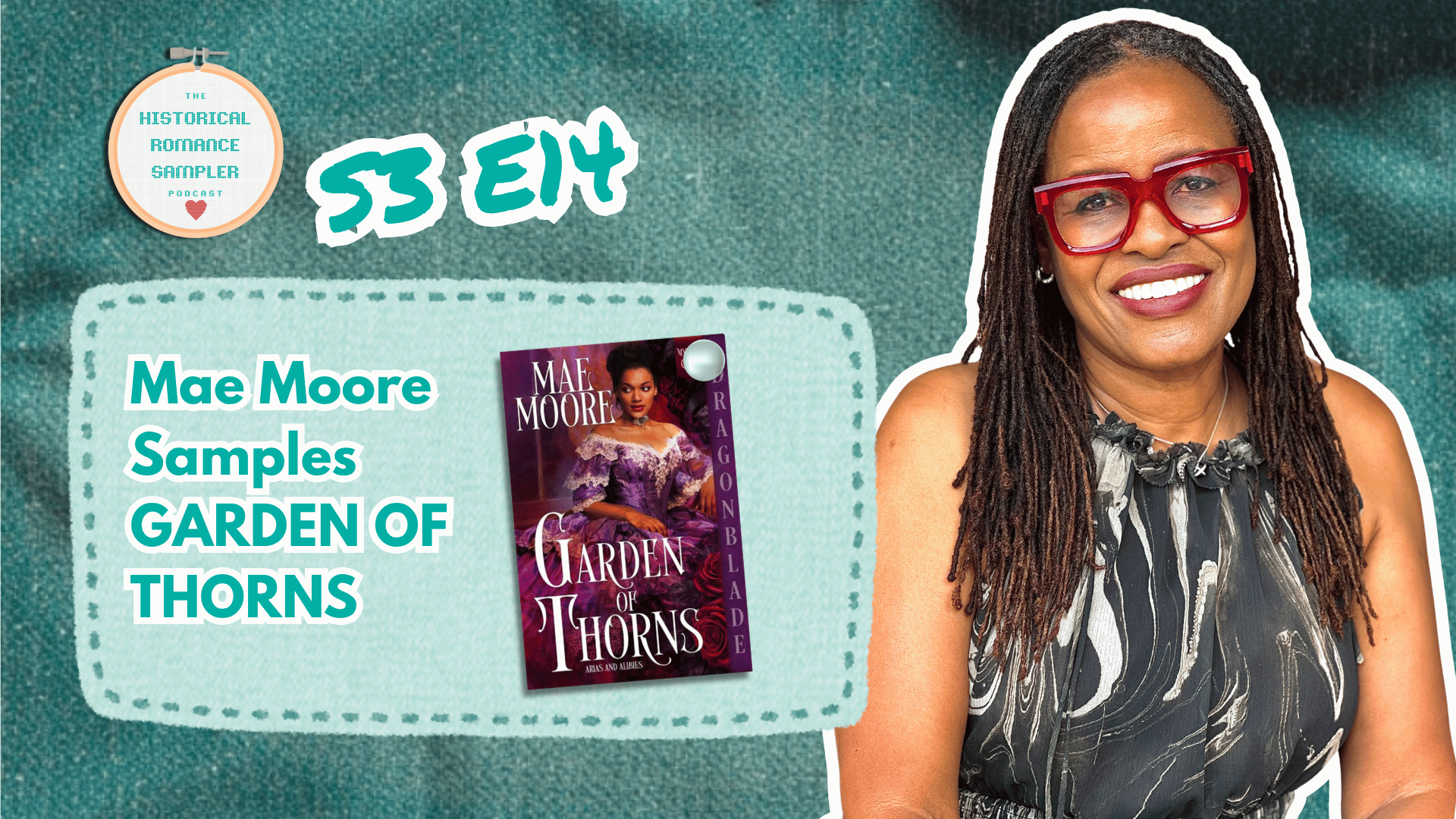
Mae Moore Samples Garden of Thorns
Katherine Grant: Welcome back to the Historical Romance Sampler, where every week you get to meet a new historical romance author and hear a little bit of their work. Today, I'm very excited to be joined by Mae Moore. Mae is a historical romance author residing in the Midwestern United States, and is the author of two books: Garden of Thorns, a Victorian historical mystery, and Fields of Briar, both in the same series.
Fields of Briar is coming out October 2026. In addition to writing, Mae loves golfing, baking, and spending time with her family, which includes two lovely grandchildren and a menagerie of grand pets. Mae, thank you so much for coming on the podcast.
Mae Moore: Oh, my goodness. Thank you for having me, Katherine. I was, I've been looking forward to this.
Katherine Grant: And I'm looking forward to hearing from your Victorian historical mystery series. Listeners of the podcast know that I'm a huge fan of mysteries- Thank you ... and I always wanna find out how you like writing mystery, how you like writing romance, and putting the two together. Mm-hmm. But first, what are we gonna hear from you today?
Mae Moore: Well, today you're gonna hear from Garden of Thorns, and it is chapter four. It is where our fish out of water debutante is being debuted in society. So I personally loved writing this, this scene, and I thought everyone would love hearing it too. It is from the perspective of the heroine Myrtle Gray, and I hope it's exciting for you all.
Katherine Grant: Awesome. Well, take it away whenever you're ready.
Mae Moore: Chapter four. From the ornate feather atop their heads to the requirements on the length of the train on their gowns, Myrtle felt even more like a wedding cake.
To make matters worse, she had not been able to ward off the warning she had received the night of the ball from her mind. While her name had not been written on the message, something in the pit of her stomach told her she was the intended audience. On the heels of such a monumental return to society, Myrtle had not shared with her mother or her sisters.
They would have been terribly distressed. So many questions plagued her, yet no answers came forth. How would someone have gotten into her bedroom? Who even knew her to send such a menacing letter? She had decided she would tell her mother and her sisters eventually.
She was simply waiting for the best time. After the debut, she decided. Myrtle's nerves were as pinched as her bosom in the flowing white fabric. The earl's sister, the Lady Everly Francis, had been gracious enough to be their sponsor for the season. She was plump and overly adorned with jewels and rouge, a stark contrast to most of the ladies she'd encountered.
Mrs. Bollinger had remarked that the similarities between Lady Everly and the Earl of Berkshire were uncanny. Whether she meant in audaciousness or appearance had never been clarified. Nonetheless, Mama was grateful for the sponsorship. Myrtle took a deep breath before stepping from the conveyance, the second in their little caravan.
With a party of their size, they had required three. Even as Myrtle and Auris stated they could ride up front, though Mama thought it, that a terrible idea. Auris was the most disappointed, as she would love nothing more than the company of horses was leading them toward their destination rather than their potential doom.
Their actual journey was no small feat either, with Violetta demanding all the attention. She insisted on being perfect, as if perfection were even possible. Everything from her hair to her dress, to her choice of Mama's fragrances. Even Seraphine was put off, based on her pursed lips and shaking hands.
After all, Seraphine had never been presented to society. In a host of ways, it was her coming out as well. From her origins as a servant girl to an opera singer, she had graced the stages of London, yet never been invited to sit amongst the aristocracy as a member and equal. It would've been unheard of in prior years for her daughters, regardless of wealth, to wed a member of society.
She thought their destiny was Newport, where wealthy and elite Black families found their matches. Mama had said returning home was her dream, and it was being realized. Standing before Kensington Palace, she wondered what the day would hold. She had heard Queen Victoria was fair, had forged new traditions such as visiting parts of the Commonwealth previously ignored, and delighted in her visits to India.
Of course, there had been whispers of her treatment of her own mama. That was where Myrtle found reservations. She wondered what it must be to quarrel with the one person who should understand more than any other. "This is enormous," Auris whispered once out of her carriage. Myrtle glanced over at her.
The tip of her feather brushed against the footman. She held her head back so far. "Auris, come along. I'm not extremely familiar with presentations to the queen, but I am sure it does not involve impersonating an ostrich." As Myrtle turned to meet Mama, the Widow Bolinger and Violetta, along with Earl Berkshire and Lady Francis, could hear Auris stifle her chortle.
"You haven't even seen an ostrich before," she muttered, then fell in line. Nerves must have gotten the better of everyone. Save Auris' occasional gasp, there was silence as they were led past a series of drawing rooms. Entering the last door, they stepped inside a large room with sumptuous decor.
Cream and gold colored walls were the, with the softest pink adornments filled the spaces between elaborate sconces. There were bursts of floral arrangements overflowing with blooms on wood and marble tables strewn throughout. Fainting couches and chairs lined the walls. There must have been 20 floating feathers in the air and not a single girl seated, nor their companions, maids, governances, and mamas.
The same as the Grays. The difference primarily being not a single one of them were children of aristocrats. Their father had previously been enslaved, and once freed, he'd saved himself through sheer will. Asa Gray had built his empire one hulking steer at a time. He would not have liked them seeking out husbands in foreign lands.
Until his demise, Myrtle was sure they would never set foot in London, England, for that matter. Somehow, that was exactly where they'd found themselves. Myrtle did not fully understand why another rancher or professor from one of the Black universities would not have been good enough. What she did know was her uncle was heavily involved and would likely gain connections in Chicago as a result of their presumed nuptials.
As the beneficiary of Papa's estate, the wealth coupled with the luxury of the English titles was alluring to Uncle. If the scheme worked, in that way, their futures were not based on their own best interest. Instead, the best would go to someone else. Perhaps it was fine for Violetta and Auris. They were younger.
Violetta was stunning. Auris, strong-willed and vibrant. Myrtle was by far the least beautiful. It was the reason she had been unwed for so long. Undoubtedly, they would be the first to marry off, viewed as more desirable in their ability to create more heirs. Pliable, in that they held no bitter- bitterness for having been alone for so long, or so it was said of spinsters.
Myrtle had been on the marriage mart for some time. To be reintroduced was embarrassing. Her cheeks grew warm at the thought Yet it was the only way forward to be approved to marry the penniless dukes, earls, viscounts. With that knowledge, would Myrtle even find a suitor in the three years they'd been afforded to do so?
Without warning, a wave of nausea overcame her. Myrtle felt altogether clammy and uncomfortable, her chest seemingly more constricted by the moment, but that was the heat. She was so warm she could barely contain herself. She opened the fan attached to her wrist and feverishly waved it, hoping to generate at least a modicum of cool air.
Alas, there was no relief to be had. Glancing around the room, Myrtle found the other young women were all smiles and nerves. No one else around them seemed to be affected so. When they returned her attention to her own party, she found Mama fussing with Mrs. Bollinger over a snag in Violetta's gown.
Were they not even the slightest bit flustered? She couldn't be the only one out of sorts. Perhaps a cool drink would help. Searching the room, she spotted one of the tables in the corner with glasses of lemonade and other beverages. Cutting through the crush of bodies, Myrtle was sweating even more profusely.
Without thinking, she picked up the glass and drank heartily. The tangy, delicious drink offering a modicum of relief. Not enough to put Myrtle right again, though. Never in her life had she fainted, but she'd seen her aunt succumb to exhaustion just before she'd gone into labor. Lord, how she prayed to retain consciousness.
How embarrassing to be presented to the queen flat on her back. Holding onto the wall, she made her way to the exit, A veil of darkness encroaching her, upon her vision. Desperately trying to avoid scrutiny from the mob of ladies in the drawing room, she slipped through the barely open crack she'd made for herself.
Outside, she leaned against the wall in the empty hallway, practically panting in an effort to catch her breath. She couldn't get ill. It would become yet another damning thing to be held against her and her sisters. The corset was not allowing her to get enough air. If only she could have ripped the thing off.
The dress offered not an inch of give, cut too tight. The gowns she preferred, American gowns, did not have near the amount of voluminous fabric. The French designs the modiste bragged about might have been upright coffins, she thought. Myrtle knew she wasn't dying, however, heat exhaustion was not out of the question.
Frantically searching from right to left, there were no chairs or davenports near her. With one last desperate gasp for air, she found herself sliding down the wall, her consciousness fading. Mortifying was the only word she could manage to think in her muddled brain. "My word." The voice was probably much louder than it sounded, Myrtle knew.
Everything around her was losing its sharpness and wrapped in dull parchment of her senses. She wanted to stand up and straighten herself before whomever had called out to her. "I, I need air," she gasped. "Here, hold on to me," the male voice said. And while she wasn't able to fully understand who was pulling her from her slumped position, she recognized his scent.
With her head lolling a bit, not that she could help it, she caught a glimpse of the viscount, every bit the handsome devil he'd been at their last encounter. In another moment, everything was blurred and muddled. "Where, where are you?" Myrtle wanted so badly to ask him a coherent question. "I'm here, just here," he said.
A warm hand clasped her own. "Are you unwell?" he asked, his voice sounding so very far away. "Yes," she thought she said. There was no way to tell whether she had spoken the words aloud or mentally, whether she was still inside her body. Before she could place him, she felt the last vestiges of reality slip through her limp fingers.
Katherine Grant: Woo. What an introduction.
Mae Moore: Oh, thank you. I really love those two. They kinda, they make my day. I, I- Yeah ... really enjoy writing them.
Katherine Grant: Well, I look forward to talking more about Myrtle and Samuel and this fantastic series you've created, but first we're gonna take a quick break for sponsors.
This episode of the Historical Romance Sampler is brought to you by Snowfall and the Duke by Meara Platt. Can 10 kisses heal a wounded heart? Jonas Langford, Duke of Ramsdale, knows he is a beast and no one can possibly love him. He was the ton's most eligible and desired bachelor before the Napoleonic War left him horribly scarred.
That is, until one Miss Ailis Temple tumbles off her horse in front of his home and dislocates her shoulder. What else is a duke to do with a snowstorm approaching, but take her in and tend to her wounds? When he discovers Ailis has come to solicit donations for the local vicarage, Jonas strikes a bargain with her.
If she gives him 10 kisses, he will give her 100 pounds a kiss. Will their 10 kisses lead to her ruin, or heal Jonas' injured heart?
Says one Goodreads reviewer, "This book and series is a keeper." Read Snowfall and the Duke on Amazon now
I am back with Mae Moore, who just read a sample from Garden of Thorns, where we meet Myrtle and Samuel. And I'd like to start, 'cause one of the things we hear in this sample is little bits of the world-building.
We are about to meet Queen Victoria herself.
Mae Moore: Mm-hmm.
Katherine Grant: There's mention of Myrtle's father, who built himself a career with steers in Texas. Mm-hmm. And there's an uncle in Chicago, so there's, like, this sense that there's a very real world that we're plugged into.
Mae Moore: Yes.
Katherine Grant: So I'd love to find out what drew you to the Victorian period, and how did you go about building the world for your story?
Mae Moore: The answer is in a lot of research. First, I was drawn to Reconstruction period, the Gilded Age, and the Victorian era. So, there is overlap between the Gilded Age and the Victorian era, of course. But what really drew me in was the idea of dollar princesses. And a dollar princess is rich heiresses, most famously I believe it was the Vanderbilt daughter that went over and married herself a duke.
And it was essentially like dukes for hire which sounds awful. But with the economic changes of the day there were- a lot of rich heiresses from the Gilded Age who were, you know, looking for husbands and You know, as the story goes when you have a deficit in your coffers and a pretty young lady, why not go get her from I do think we Victorian era writers take some liberties because I think there are, like, two or three dukes remaining at the time.
But it is a fascinating time because when you're from wealth and your entire economic structure has kind of crumbled, what do you do? So, it was, it was a great time to kind of delve into what that meant for romance and matches and possibilities. So that is what drew me to it. I do love, like, all of the current content that is being made around the era.
I think we have Gilded Age, we have harlots, you know, and, and all of those stories that kind of come from there, and it is just a remarkable time to usher us away from so much Regency into the Victorian era.
Katherine Grant: Yeah. And on the American side of it, what drew you to kind of, pinpoint them in Texas and have that be their backstory?
Mae Moore: So I am a big old fan of Beverly Jenkins and she writes Western historical romances. A lot of her stories take place in the West. I was particularly interested in Texas because that is where the first Black millionaire rancher existed during the reconstructed era- Reconstruction Era.
And I'm- I wonder, like, what do you do with your daughters? Where do you marry them off? They are not exactly the types that would, you know, kind of go back to Newport with you know, the wealthy b- Black families there, the Black 400. But, you know, you pair that with one of many BIPOC individuals from London and what happens then if they were to go back home to their mother's home and, you know, try to enter the marriage market?
And I think it was, like, kind of fantastical to do that. You know, but we do know that you know, there were a lot of minorities, specifically Black folks, in London at the time, and I thought it would be great to kind of pair that with the wilds of Texas. So we start in London, but who knows, maybe we'll revisit Texas or Chicago where Uncle Tolliver lives, so it's been a good time.
Katherine Grant: Yeah, that's exciting.
Mae Moore: Yeah.
Katherine Grant: And when you mention research, what kind of research do you, did you find yourself doing for this story? Is it mostly- books? Are you looking at primary sources? Are you watching documentaries? All of the above?
Mae Moore: All of the above. You know, c- because it was hard to... It was definitely difficult to find Black individuals in London bec- primarily because they were not called Black people.
They, We did find a lot of them through pensions. So, you know, and that is you know, from careers in the military we found records of their existence and, and having, you know, fulfilling, wonderful lives. There was also seafarers and lots of individuals that shaped up Black society.
So I did do a lot of r- diving through records with the help of, of folks that had already done that type of research. Additionally we're finding things every day to, you know, kind of see the existence and how those lives were lived. So I do a lot of reading. I wish there was more, like, video content to support it.
I prefer to use content that is or research that is verified. So I spend a lot of time in libraries. I do read a lot of historical romance, and I know that historical romance authors, I feel like we're the best historians and archivists even because there's just a wealth of information there.
In all that research, we wanna, don't wanna bore our readers to death, like, you know, but it is important to know so that you can create these worlds of ours, so.
Katherine Grant: Yeah. Mm-hmm. I think it is so important to when you're doing the research, to discover/remember that maybe you're not finding something because they weren't describing it the way that we describe it today, or they weren't keeping- Mm
track of it.
Mae Moore: Mm-hmm.
Katherine Grant: Did you find that- You know, your Myrtle is American, and so as Americans we have an idea of what racial understanding was in the 19th century. And then for the British characters, did you find that there was a different understanding of race in Britain in the 19th century?
Mae Moore: I feel like a lot of the architecture of race was based on where you were, right?
So in Britain they of course abolished slavery a little before us a lot of those individuals were responsible for slavery, right? So I think they viewed it the same, I think. But what was considered you know, kind of, appropriate was different. And I think, you know, there's a polite w- way to talk about it in Britain where they didn't, you know, at least publish some of the things that they were saying.
But racism did exist, you know, on both sides of the pond. I think it was d- a different, a definite difference in the way that they were talking about it. And the length of time that slavery went on and then ultimately the Civil War that made a, a big difference in the landscape for each country. So I think the Brits kind of considered themselves like, "Oh, we're not super racist as our-
as our folks over in America." And I think that still exists a little bit. But then we see it, right? It shows up. Like we can see the difference in treatment of princes and you know, Harry and William right now. And then we see, you know, obvious issues with diversity and inclusion here in America.
So is it, is it different? Not really. But in the way that it's spoken about, probably. And I think, you know, they're like, "Well, I'm, we're civilized and you're not." But is it civility at all?
Katherine Grant: Right.
Mae Moore: So yeah.
Katherine Grant: Yeah. Thank you for teasing that out.
Mae Moore: Yeah, no problem.
Katherine Grant: Okay, so you mentioned- The iconic Beverly Jenkins.
Oh, yes. Are there any other authors that you would say are big influences on your writing?
Mae Moore: Oh my goodness. So I, I am a woman of a certain age, and I was stealing my mother's, stealing my mother's Harlequin romances. So and at the time she was really into historical romance, and I was probably like 13, so I was reading a lot of stuff.
I was reading Kathleen Woodiwiss. I was reading everything. So any, any author that published Har- in Harlequin in the 1980s, I've read that author. But more recently, I am enjoying, like, a great... The, the diversity and all of the different stories that are coming out. So right now I am still being influenced, 'cause we never stop learning.
I love Amalie Howard. I love the way that she incorporates, like, real-world challenges into you know, her heroines and giving them agency when, you know, agency was scarce. You know, so she is one of my favorites. I absolute- and now I'm blanking on everybody. I love is it Adriana Herrera with the- Mm-hmm.
Yes. The
Katherine Grant: Caribbean Heiress in Paris.
Mae Moore: Yes. Very good work there. So I am just having a really good time you know, reading. Erica Ridley is fabulous. You know, so I think the new... I don't wanna call them new, because I don't wanna imply that the old historical or the legendary historical romance authors were doing anything wrong, you know?
They, it's just a different day, right? But I do love a mix of both of them, and those are some of my favorites.
Katherine Grant: Lovely.
Mae Moore: Mm-hmm.
Katherine Grant: All right. Well, it's time for Katherine's Quick Questions.
Katherine Grant: If you had to use one of these words to describe your writing sensibilities, would you describe yourself as a realist, a comedian, or a fantasist?
Mae Moore: Oh my goodness. Katherine, I think I have to say fantasist because I do like reimagining things. I do give my heroines a little bit more leeway than they probably would've actually had. So I think I'm a fantasist. But I'd like to call myself a comedian, even though I don't know if I'm that funny, so that's why I landed on fantasist.
Katherine Grant: We'd all love to be funny, right?
Mae Moore: Oh my goodness, wouldn't we, though?
Katherine Grant: All right. If you had to choose, would you add more real history or more romance scenes to a story?
Mae Moore: I think I need more romance. I, I adore the yummy tension of the day. And you know, I could just, you know, I could read that on and on forever.
So I think romance is always gonna be my thing. Even though I love history I think romance needs to be present, so.
Katherine Grant: All right.
Mae Moore: Mm-hmm.
Katherine Grant: If you were forced to do a genre blend story, what crossover genre would you choose? For example, I have here mystery, and I'm realizing I forgot to even ask you about mystery.
So anyway- Yeah. Is there a secondary crossover genre you would add?
Mae Moore: Probably paranormal.
Katherine Grant: Mm.
Mae Moore: I love paranormal. I love you know, vampires are my f- absolute favorite. And then I love werewolves. I love the whole, like, you know, ghosts and all of the things. So I would say it would be paranormal, even though that's kinda like a blend of fan- fantasy, but paranormal specifically.
Katherine Grant: I love it. Okay, and let me ask you.
Mae Moore: Yes.
Katherine Grant: How is it writing mystery? How do you balance mystery and romance in one story?
Mae Moore: So I l- I write cozy mystery, so it's very, Like, yes, someone died, but it is, it is, it is the secondary plot for sure.
And I do balance it in by, you know, forcing my characters to kinda solve the problem. There are still challenges with you know, the police in their day. So, you know, I like to, like, thrust them together by, like, trying to figure out or solve this murder or solve this crime. So that is how I kinda blend it.
So I do have mystery, a bit of the mystery later in the book, whereas, you know, usually mystery, page one, the dead body drops. But, but that's kinda how I do it is with a light hand. And there will be someone dying, for sure. So it's, it's not as forward as you know, most mysteries, but yeah.
Katherine Grant: The romance is more important. It is. Which is all we care about, so. It is.
Mae Moore: It is. Even when somebody dies, so yeah.
Katherine Grant: Okay. And the final question of Katherine's Quick Questions, what does escapism mean to you?
Mae Moore: Oh my goodness, back in the day I would've told you reading a good book, drinking a cup of tea, that's my definition of escapism, falling into the world.
But now content is all around us. And I think, you know, with the problems of the day and the things that we deal with it- I love just cutting off the world through social media and other things and, you know, enjoying whatever fuels my well. And sometimes that's Heated Rivalry, and sometimes that's The Vampire Lestat, and sometimes it's, you know, watching Bridgerton.
But Katherine, I think it will be defined by whatever makes you feel good. And we need so much of that. So shut the world off and fall into whatever your preferred content is. I think it's- I
Katherine Grant: love that. Good. Thank you.
Mae Moore: You're welcome.
Katherine Grant: Well, Mae, I have really enjoyed talking to you. Where can readers and listeners find your books?
Mae Moore: You can find my books online. They are available on Amazon for KU readers as well as Kindle and print versions as well. There are some independent booksellers that may carry my books, and hopefully libraries will have access to them as well, so,
Katherine Grant: Awesome ...
Mae Moore: yeah. And you can follow me on
Katherine Grant: social media.
And do you have a newsletter or social media?
Mae Moore: I do. I am often on Threads probably too much because I'm a pantser and procrastinator, so I get in trouble. But I am Mae Moore on Threads and also on Instagram. I also have a newsletter and a website. So you can find me by searching the name Mae Moore Historical Romance Author.
Katherine Grant: Awesome, and I'll put your links in the show notes.
Mae Moore: Fantastic.
Katherine Grant: Thank you so much for coming on. This has been awesome.
Mae Moore: It has been awes- awesome. Thank you for inviting me, Katherine.
That's it for this week! Don't forget to subscribe to the Historical Romance Sampler wherever you listen, and follow us on Instagram and YouTube. Until next week, happy reading!