

This podcast is a proud affiliate of Libro.fm. By clicking on this banner, we may earn a proceed of any purchases you make, in which case, we thank you very much!
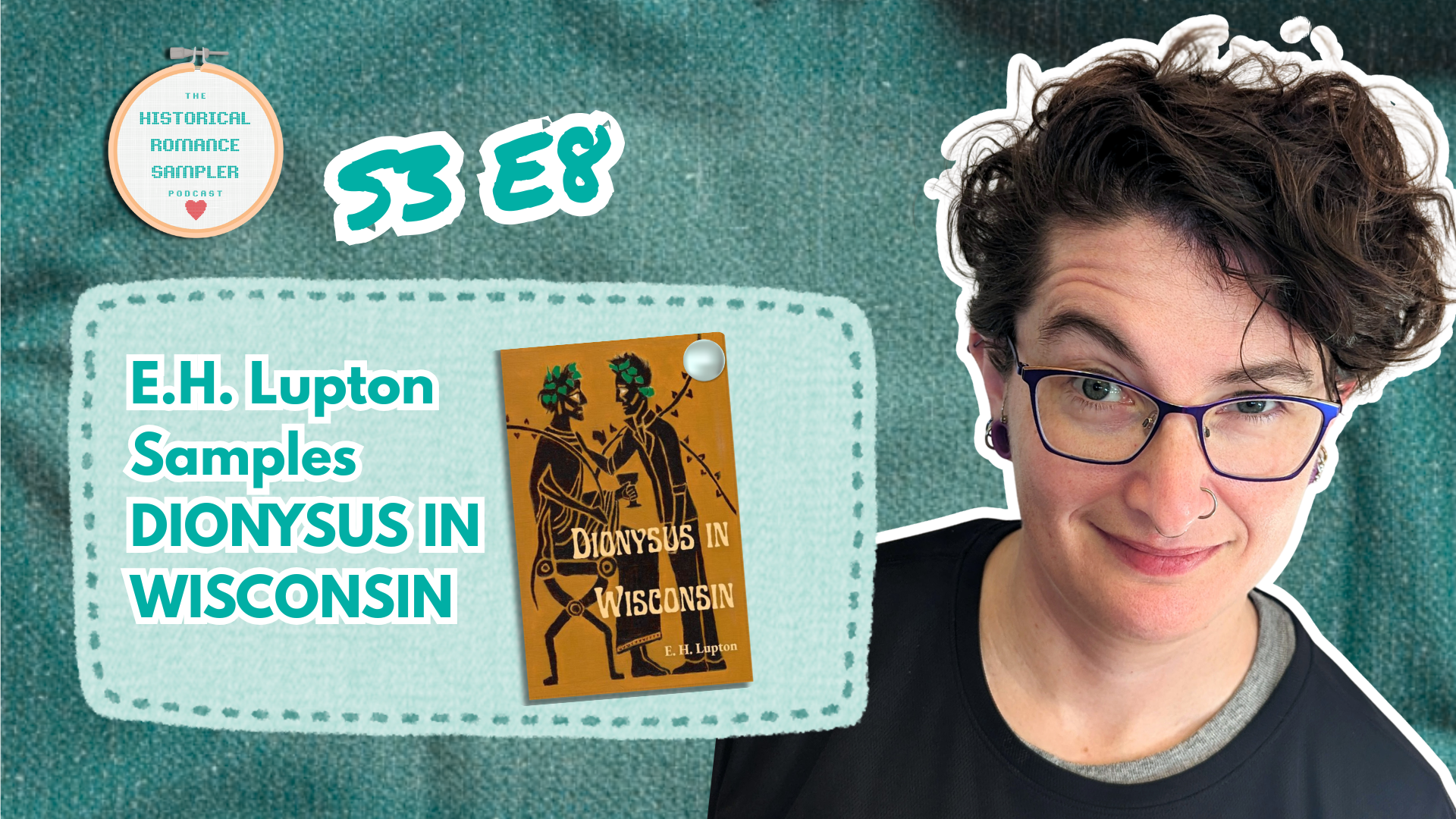
EH Lupton Samples Dionysus in Wisconsin
Katherine Grant: Welcome back to the Historical Romance Sampler, where every week you get to hear a different book from a different historical romance author. This week, I am very excited to be joined by E.H. Lupton. E.H., or M, lives in Madison, Wisconsin with her family. When not writing, she entertains herself by running, quilting, painting, and doing martial arts.
Her debut novel, dionysus in Wisconsin was shortlisted for the Lambda Literary Award. Lazarus: Home from the War, the fourth book in the Wisconsin Gothic Series, was shortlisted for the Edna Ferber Book Award, and was one of the Fated Mates podcast's best romance novels of 2025.
Her poetry has been published in a number of literary journals, including Asimov's Science Fiction. And M is also half of the hit podcasting duo behind Ask a Medievalist. So I'm so excited to have a chance to sit down and ask you at least 20% of the questions that I have for you.
EH Lupton: All right.
Katherine Grant: Thank you so much for coming on the Historical Romance Sampler.
EH Lupton: I'm so excited to be here.
Katherine Grant: Yeah. So as you know, the first half of the show is you reading a sample of your work for us. So what should we know about Dionysus in Wisconsin and the scene that you're gonna read?
EH Lupton: Okay. So this is a scene from chapter two. I've been doing the audiobook, and so I thought we would go back to Dionysus in Wisconsin, even though there's a couple books in the series out, because, it's really fun and it's where we get to meet the characters.
In this particular scene, I think the only thing that you really have to know to set it up is that we have our, our main characters are Sam and Ulysses, and Ulysses has been investigating Sam, because of weird, magical goings-on. And I... And Sam doesn't know it yet.
Katherine Grant: Mm.
EH Lupton: Basically.
Katherine Grant: Okay. Awesome.
EH Lupton: The hall was growing dim as the sun began to creep toward the horizon, and the elevator took an interminable time to come when Ulysses called it. The long hallway, all linoleum and flickering fluorescent lights, felt suddenly cold. He frowned. The elevator slid open, and he stepped in.
In general, ghosts did not wander campus buildings. There was no specific reason for this other than that students tended to be young and fairly healthy, so there weren't a lot of deaths. But sometimes buildings could develop a kind of rudimentary self-possession. Ulysses didn't know if that was indeed what was happening, but it felt like something was trying to get through to him.
There was a sense of tension in the atmosphere, like the breeze before a thunderstorm. The elevator crawled downward slowly, creaking as it went. On the fourth floor, the door opened, and Sam was standing there. Ulysses jumped before he realized that Sam was corporeal. "Sorry, Lenkov," Sam said, rubbing the back of his neck.
"I didn't mean to... I'll get the next one."
"No." Ulysses reached out and held the door. "You just startled me. It's fine."
Sam looked cautious but stepped into the elevator.
"Also, call me Ulysses."
"Really?" Sam pressed the button for the ground floor automatically, even though Ulysses had already pressed it. "Call me Sam."
The elevator doors creaked and shuffled closed, giving the sense that they really didn't want to, and the elevator took off again "What brings you to this part of campus?" Ulysses asked. The elevator was getting noticeably cold now, and a very slow breeze stirred Sam's hair. "Research?" He glanced at Ulysses.
"What about you?"
"Business." He smiled politely. The sense of tension was getting stronger, and something definitely smelled odd, pungent like myrrh rather than old paper. Frost started to form on the inside of the elevator doors. "Did you, uh, um, get a n-new cologne or something?" His heart beat faster, adrenaline hitting his bloodstream as he re- as his body realized something was happening and objected.
"No," Sam said, "that's not... I don't really like scented..." Every hair stood up on Ulysses' arm. The elevator jolted to a stop. Sam looked around, clutching his briefcase. "This is..." The lights went out, and he made an involuntary little squeak. Ulysses' eyes went wide. This guy, who was apparently an incredibly powerful magician, was afraid of the dark?
He reached into his pocket and fished out a Zippo. "Hey," he said, "it's gonna be all right." He flipped the wheel. As the light flared, they saw words scraped into the frost on the inside of the elevator doors. "Dionysus is mine." Sam actually shouted then. He stumbled backward into Ulysses, knocking them both against the wall of the elevator.
The Zippo dropped to the floor and went out. For a moment, Ulysses was pressed against the wall by Sam's rangy form. Lacking a better idea, he put his hands on the man, one on his upper arm, the other grazing his side and hip. "Hey," he murmured quietly, "it's okay."
The lights came back on as abruptly as they'd gone off.
There was no frost, no message. Sam looked up at the ceiling, then back at Ulysses wide-eyed. "You saw that, right?"
"Yeah, I saw it." The elevator ground back into life, and Ulysses carefully steered Sam forward a few steps so he could bend over and pick up his lighter. He returned it to his pocket and found there a small bag of lemon drops.
"Here," he said, offering one to Sam. "It'll help with the shock."
"Shock?" Sam took the candy and stared at it. Ulysses nodded, popping his own piece of candy into his mouth. "Helps the nervous system get itself back in order."
"Sure." The other man finally ate his candy. The elevator stopped again, and the doors opened.
Sam grabbed his briefcase and all but leaped out, Ulysses following at a more sedate pace. Outside, Sam leaned against the building's pale sandstone facade. "So you've done this before?" he asked Ulysses. "You know about this kind of thing." That phrase covered a lot of ground.
"I know about a lot of things," Ulysses said.
He stuck his hands in his pockets. "Look, um, I'm sorry about that. Come to dinner with me. I'll explain."
Sam blushed. Then he looked down at his watch.
"I, I can't. I have to get back to my apartment and change for the play tonight."
"You're in a play?"
Sam gave a delightful little half-smile. "I'm the stage manager. My friends wrote the show. I'm just helping out." He looked away. "You could come if you wanted. It's at James Madison Park.
There's a suggested donation, but you don't have to."
Ulysses raised an eyebrow. "What's it called?"
The other man hesitated. "It's called My Kingdom for a Horse. It's all of Shakespeare's War of the Roses plays done back to back as a musical comedy, meaning Richard II, Henry IV parts one and two, Henry V, all three parts of Henry VI, and Richard III.
They left out King John and Henry VIII for obvious reasons, but a few people have complained."
"Really?"
"Yeah." Sam made an uncertain face. "It's short."
"It doesn't sound short, but all right." Ulysses gestured to his motorcycle, which he had left parked inconsiderately next to a bike rack. "Can I give you a lift?"
Sam looked wide-eyed at the motorcycle for a long moment, then back at Ulysses. "Of course that's yours," he muttered.
"Is that a yes?" Ulysses asked, starting to laugh.
"I bike to campus. I'd have to get the bus tomorrow or walk." Sam looked genuinely torn, which made Ulysses laugh harder.
Ulysses finally took a deep breath and added, "I promise not to go too fast."
"Oh, go to hell," Sam said. "All right, fine."
Ulysses found that he was enjoying the show even though he had totally lost track of the plot around the time they'd progressed into Henry IV Part Two.
It was a beautiful night, cool and clear, with the sun boiling away in a spectacular sunset over the lake as the evening wore on, and the slow emergence of thousands of stars and a nearly full moon. The performance used a large concrete patio in front of a park building that doubled as a boat rental spot during the day, so the audience was arranged along the edge of the lake and out onto the piers.
They'd put up a handful of lights and a screen on either side, and the actors scrambled in and out of the boathouse in lieu of a real stage with wings. When the lights came up, Ulysses sat for a while on the long grass, listening to the distant song of night insects and the lapping water. He found Sam around the corner, assisting someone who might also have played Richard III with the lighting board.
He stood in the shadow of the building for a moment, watching them. Sam's face was unguarded as he joked with his friend, and he looked kind, Ulysses supposed. Happy. Not at all like the center of a very unpleasant little mystery. "Oh, there you are," Sam said, looking up and smiling at him. "Are you ready to go?"
"No rush." He watched as Sam pulled on a suit coat over his stage blacks. Sam lived, somewhat to Ulysses' surprise, on Bassett Street, where the population was primarily hippies, on the top floor of an old house that had been converted into apartments. He brought the bike to a halt at the curb and felt it rock slightly as the other man slid off.
Sam didn't run for the door the instant he touched the ground, which was nice. Instead, he licked his lips nervously, shifting his weight slightly from foot to foot. "It's not much, but if you want to come up..."
"Oh. Oh. Some other time?" Ulysses asked. "I've got a case to take care of tonight."
Sam raised an eyebrow.
"A case?"
"I'm a very specific sort of private investigator."
Sam sighed. "Of course you are." He started to turn away.
Ulysses slid off the bike and caught his sleeve. "Hey."
Sam turned around. "What?"
Ulysses leaned in and kissed him very gently on the cheek. "Thanks. I had a good time."
"I, uh..." Sam's brain appeared to shut down for a moment, and he closed his eyes.
"Thank you. I mean, you're welcome? I mean, I'm glad."
Ulysses grinned. "See you around."
Memorial Library was still open when he arrived, and Joanna was behind the desk. "Ulysses," she crowed as he came in, " I didn't expect to see you back so soon."
"I got a hot tip, Jo." He leaned on the desk. "You hear about anything weird happening lately?"
Jo started to shake her head, but then stopped. "Actually, I heard from one of the guys who shelves books that something weird is happening on four. Cold spots, rustling." She shrugged. "I was going to ask you about it when I saw you next."
"Lucky for you, here I am." He looked around conspiratorially. "Can I go up now?"
"Be my guest," she winked. "Just try to keep the chanting quiet. If you scare the grad students, I'll never hear the end of it." Ulysses took the elevator up and then wandered into the stacks. Along the edges of the room were study cages, tiny rooms big enough for a chair and a desk with a shelf above for books.
The far wall was made of concrete blocks painted olive green. No one was around, and the lights were all off. He closed his eyes for a moment and stretched out his senses until the lock on one of the cages started to call to him, a wordless yearning. He went over and peered in, then pulled Sam's keys from his pocket and opened the padlock.
Katherine Grant: Ooh, mysterious. All right. Well, I have 101 questions for you. Okay. But first we're gonna take a quick break for our sponsors.
This episode of the Historical Romance Sampler is sponsored by the Society of Smut and Scandal. Nine forbidden beginnings. One irresistible romance series.
In book four, Secrets for a Seductress by Laura Linn, a Bow Street runner and the madame of London's most infamous brothel team up to solve a murder, discovering that the truth is rarely simple, and love may be the greatest risk of all.
In book five, A Divorcee and Her Captain by Steffie Smith, a ship captain tries to deny his love for a married countess, but when she stows away, they have no choice but to face the scandal And in book six, Scandal with a Viscount by Christina Diane, one reckless wager at a house party leads to a secret, no-strings arrangement between a viscount and his best friend's sister.
When they don't want the affair to end, scandal looms. These books and more from the Society of Smut and Scandal are now available to read on Amazon and KU.
Katherine Grant: This episode of the Historical Romance Sampler is brought to you by the historical romance Otters and Obstacles by Alexa Santi. Goodreads reviewers call this a "charming, lighthearted read" that delivers the "nervous system reset" you need, perfect for fans of Tessa Dare and Julie Anne Long.
A sleepy Yorkshire village, three mischievous otters, and a lady in disguise. What could go wrong? When Georgiana Morland's cruel cousin sends her beloved pet otters away to what seems certain death, she has no choice but to pursue them, even if that means disguising herself as a young man for the journey.
In the charming village of Kilbythorpe, the Reverend Lord Peter Avondale knows he only has one chance to salvage his damaged ecclesiastical career. But the arrival of three exotic otters, followed by a mysterious young man who claims to be their keeper, upends Peter's resolve. The revelation that the young man Peter invited to stay with him is a respectable young woman
leaves them with only one option, marriage. Read Otters and Obstacles on Amazon now.
I'm back with E.H. Lupton, who just read from Dionysus in Wisconsin. Now, one of the things that really struck me about this chapter two is, as often happens in early chapters, there's a lot of world-building, but you're doing world- world-building on two different levels.
First, there's all this magic stuff, and there's clearly rules that Ulysses understands, but we the audience don't understand. Sam has no idea yet. Mm-hmm. And then there's the world-building of Wisconsin. Is this at the University of Madison?
EH Lupton: Yeah, UW Madison.
Katherine Grant: Okay. So, like, the lake, the, what the library looks like, plus this is historical, so there's, like, the historical details.
So I guess my question is, when you're thinking about world-building- How do you think about it, and is it different when you're approaching the mythology versus the, historical aspects, or is it kind of the same approach for both?
EH Lupton: That's a really good question. So the funny part is that the Madison stuff, the history, the physical environment, even to a large extent the people are very true to, like, Madison.
I've had friends who live here text me and say, "I swear I just saw, like, an extra from one of your books walking down the street." But I do try really hard to figure out, like, to reconstruct what Madison was like in the late '60s, which physically is quite different from the university at the time that I was a student there.
I started fall of 2001. So a- and it's not just a question of, new buildings, although there are. Like, there are buildings that I did, like, my entire master's program in later on that were not there at the time that I'm writing about, which is kind of baffling to me somehow still. But also the, there's roads that were open to traffic at the time that are now, like, a pedestrian mall.
Mm-hmm. Um, there's major events in the city that hadn't really started yet, like, um, the Dane County Farmers Market. If you come, if you're gonna come visit Madison, people will be like, "You gotta go to the farmers market." That didn't start until, like, '73 or so.
Katherine Grant: Mm.
EH Lupton: So, um, I spend a lot of time looking at that.
And then with the magic-
A lot of magic stuff can be like, We set up some rules, and they do talk about later on, they talk about some of the rules. I think the essential, like, bottom line is that if you want to do something using magic, you have to have a sacrifice, right? Like, that was sort of my beginning thought is, like, you can't have something for nothing.
And if the sacrifice has to be commensurate with the thing that you're getting, that means that magic is often not very useful, which is kind of why it becomes more of an academic discipline, I think, than, um, something that we see a ton of people, like, using on the street. But once you've set up those rules, you, you basically start to write, like, how
This is a thing that breaks the rules that's going on, right? And, like, how does it, how does it do that? W- how can we push the boundaries? How can we change the understanding of the constraints that we've laid down, while still, in some sense, preventing our characters from becoming all- all-powerful?
Katherine Grant: So conceiving this story, there's the supernatural element with Dionysus- Mm-hmm ... possessing Sam. The historical element, I'm curious, it's set in 1969, which I think is a pretty significant year. What drew you to 1969?
EH Lupton: Well, basically there was so much history happening that year. Like, this is crazy. The moon landing and Stonewall happened in the same summer. How did anybody... And Woodstock poorly planned on the part of, like, history, I guess.
Okay, so this started out as, like, "Okay, I wanna write about something happening in the 20th century," 'cause I thought about Wisconsin in, like, the 1880s, and there were horses. And that- ... horses become a character in the story. It's like horses are a lot of work. So I was like, "Okay, 20th century. Um, maybe... " And I started with this idea maybe that there was some sort of Nazi experiment.
And then if Sam was turning 25, which is, like, a big event at the end of the book, that could be, you know, 25 years after the end of the war. But then I sort of dropped... I dropped the Nazis because I was like, "Nah, no. Not doing that. Indiana Jones took care of it. I don't wanna touch that." Yeah. Um, but I did think, oh, 1969 in Madison was a very exciting time.
Um, like the, the late '60s and the early '70s, Madison was a big epicenter for anti-Vietnam protests.
Katherine Grant: Mm.
EH Lupton: In fact, we had a mayor for quite a while who had famously been beaten at, I believe, an anti-Dow Chemical protest that happened. In the 1970s, there was a firebombing, um, at the, at the Red Gym. There was a grocery store that got burned down as a response to Kent State.
So that was, like, May 5th or so. ... And then in August, they blew up the physics building. They. Wow. Like, four guys blew up the physics building. Um, so it was, like, a lot of stuff going on. And- Yeah ... that becomes a really rich place when you take a God, who's, like, kind of thematically related to underdogs.
Um, one of the reasons that the king in, in the play, the Bacchae, doesn't want Dionysus to be worshiped is that he appeals to women and slaves, and the king is like, "I don't want those people to have political power." Hmm. Um, and you're coming into a time when there was, like, walkouts for Vietnam, walkouts because of the, the Black student movement.
You have, like, women's rights sort of coming up. There's a lot going on, and, uh- Yeah ... yeah.
Katherine Grant: Yeah, it's very interesting. I didn't know that Dionysus is that kind of, like, avatar for, um, essentially the working class, so...
EH Lupton: Yeah. A lot of people think of him as just drunkenness, possibly because of his association with Bacchus, um, which is kind of too bad.
Wisconsin, obviously we drink a lot. But also Dionysus is not just Bacchus, but he's associated with a, um, Roman deity called Liber Pater, and I found out that one of the things that happened during his festival was that people would have free speech.
So he- Wow ... like, carried this a little bit.
Katherine Grant: That's really interesting. Well, it's time for Katherine's Quick Questions.
Katherine Grant: Okay. If you had to use one of these words to describe your writing sensibilities, would you describe yourself as a realist, a comedian, or a fantasist?
EH Lupton: Oh, my God. Well, so I feel like I should say fantasist because a lot of my writing does involve magic, but in truth, whatever I'm writing, I find myself... So, like, when you come to a choice in your writing and you're like, "We could do this or we could do that," and I always go with whatever I think the funnier option is.
Katherine Grant: Hmm.
EH Lupton: So, like, I've, I've sort of facetiously described my work as rom-com, but the com stands for communism. But also, the com is, like, comedy. Like, the, they're, the books have serious themes about things like love and family and, like, dealing with the past and whatever, but also they're funny.
Katherine Grant: Yeah. Okay. A comedian.
If you had to choose, would you add more real history or more romance scenes to a story?
EH Lupton: I mean, like the ideal is a romance scene where people are also talking about like history, right? Um, which I have... I don't know that I've actually managed that.
I've done people talking about like epistemology during sex, which is kind of close. Um-
Katherine Grant: Talk nerdy to me, baby.
EH Lupton: Yeah. My, my own philosophical problems, I guess. Um,
I always really, really want things to be grounded in the history of the time. So I think I'm gonna go with history, and then we'll see what else we can squeeze in from the edges.
Katherine Grant: Yeah. Okay. If you were forced, forced to do a genre blend story, what crossover genre would you choose? For example, romance plus mystery, romance plus fantasy, romance plus horror.
EH Lupton: Mm-hmm.
Katherine Grant: You're a little bit already crossing over.
EH Lupton: Yeah.
Katherine Grant: You can add a third.
EH Lupton: Yeah, I'm already very fantasy, um, urban fantasy heavy, I guess.
Um- Oh gosh. I, okay, I, I have always kind of wanted to write a sci-fi thing. I used to write a lot of prose poems about robots and stuff like that. Like, I was, as I said... as you said in the introduction, I had a poem in Asimov's Science Fiction, so it's not totally out of left field. But, um, I... for, for a while I've found the idea of, like, anything futuristic very difficult to think about.
So, um- Mm-hmm ... that might be fun. Yes. I think I'm already sort of, like, nibbling around the edges of mystery and horror a little bit too much to be like that. Like, that's e- that's too easy, but, um-
Katherine Grant: So the answer is all of the above.
I love it. All right, and finally, what does escapism mean to you?
EH Lupton: Oh my gosh So, so this is interesting because as I said, hard to think about the future, right? When I started writing historical fiction, in about 2022, it was because of very stressful things that were going on in my day-to-day life. And I did not want to live in the 2022 anymore.
Like, if I could spend part of my day in whatever, whatever I was writing. I did write a novel set in the 1880s and then I wrote Dionysus and that's in 1969 and I was like, very good. Not, not dealing with the... And, and I think that's kind of the good part about escapism is that it, it can provide a respite from things that are going on that really You, you know, like there's things sometimes when people are like, "I need to get away from this," and it's like...
I mean, I do this too. "I need to go do something that isn't this." And the this is like the laundry or whatever, right? Mm-hmm. Like, I get, I get stressed out by silly things sometimes, and it's, and it's like you do not get to use escapism to get out of doing the laundry. But sometimes there's things in your life where you're like, "This is a thing that I just have to go through," and like there's not a way to avoid it.
Like, there's not a choice I can make that will take me away from it. So it, it can give you like a time away from the, the constant like stress and recycling all these things in your head, and like rumination, and like, you know, whatever. Um, so that- So it- ... I think that's what escapism is. It's like, like a room you can go into and you can be like, "I can breathe."
And then like that- Yeah ... can help you when you go back to your, you go back to your real life, right? Like, I was going through these, these things related to kid health, so like I could go into my little room, and then I could come back, and I could be like Better potentially at parenting and, like, being with my kids and not being, like, the anxious, terrible wreck that I really was inside, right?
Like, that isn't- Yeah ... you, you have your feelings, but that isn't gonna make your kid feel better, right? So you gotta put everything away.
Katherine Grant: Yeah. A little oasis for your nervous system.
EH Lupton: Mm-hmm.
Katherine Grant: Yeah. So you can breathe. Well, that is beautiful and raw, and thank you for sharing that. Em, I have loved talking to you.
I feel like, I could keep talking to you. Also, like, learn all the Greek mythology from you. Oh, yeah. Uh, so, um, unfortunately we have to wrap up, so I'd like to ask where can our listeners find you and your books and your podcast?
EH Lupton: Yes. Um, all of my stuff is at ehlupton.com and o- you can find listings for all the books through that.
Um, or, uh, winnowingfanpress.com has, like, all the books listed. You should check the audiobook of Dionysus is gonna be out at the end of the summer, and- Awesome ... it will be read by someone a lot more profession- proficient than I am at doing all the voices. And then the podcast is Ask a Medievalist, and that's also the website, and if you search in your podcast app of choice, you should be able to find all of our episodes.
Katherine Grant: Awesome. And I will put links in the show notes so listeners, you can go find these things. Should be easy for you to find another podcast since you're already listening to a podcast. Yes. So thank you again, Em. I really... It's been a fantastic conversation.
EH Lupton: Thank you. This has been great.
That's it for this week! Don't forget to subscribe to the Historical Romance Sampler wherever you listen, and follow us on Instagram and YouTube. Until next week, happy reading!