

This podcast is a proud affiliate of Libro.fm. By clicking on this banner, we may earn a proceed of any purchases you make, in which case, we thank you very much!
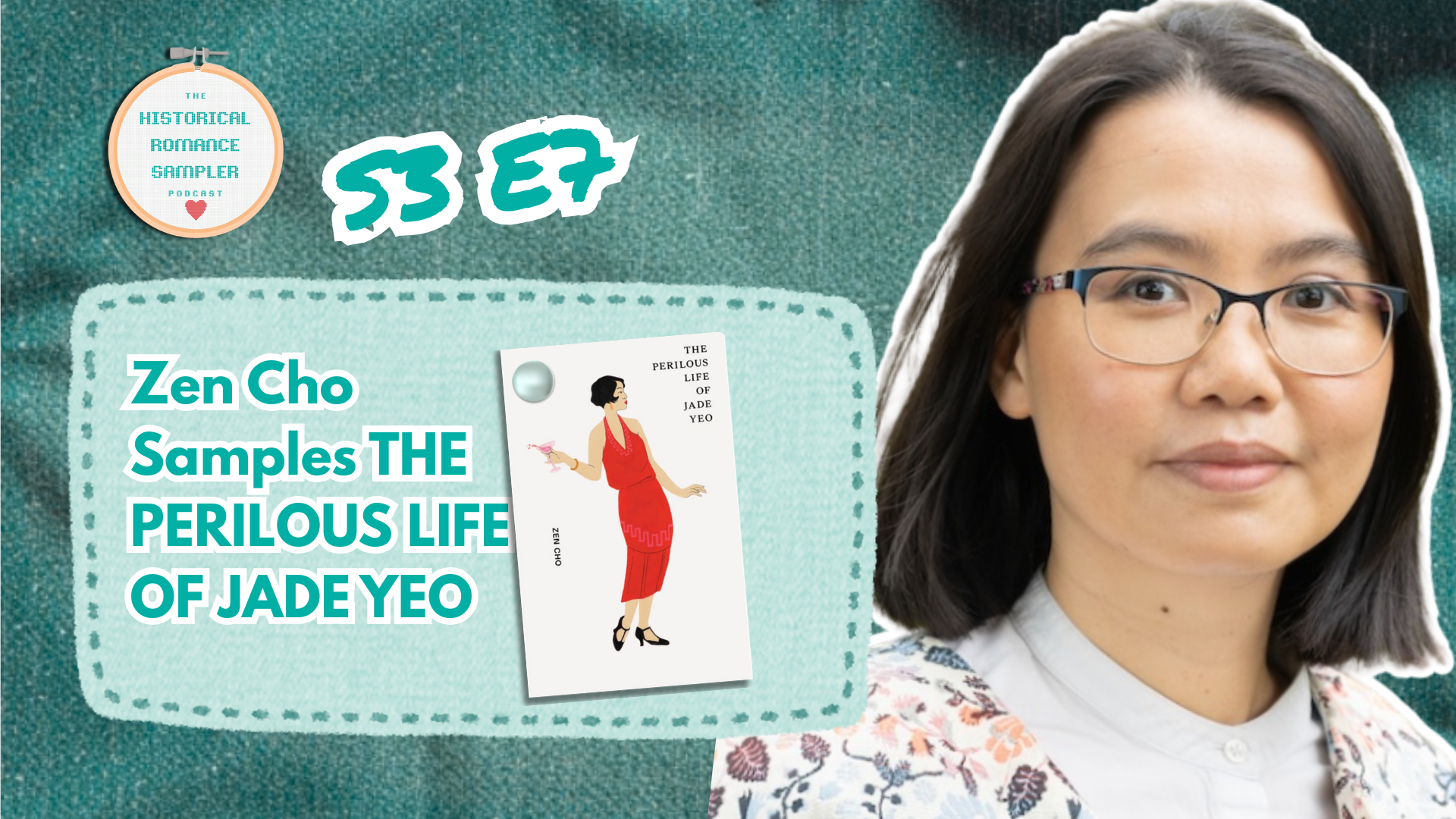
Zen Cho Samples The Perilous Life of Jade Yeo
Katherine Grant: [00:00:00] Welcome back to the Historical Romance Sampler, where every week you get to meet a new book and a new author you're gonna love. This week, I'm very excited, we're joined by Zen Cho. Zen writes fantasy and romance, and has won the Hugo, Crawford, and British Fantasy Awards, and the LA Times Ray Bradbury Prize.
Born and raised in Malaysia, Zen now lives in the UK and writes a really interesting array of different types of romance books. So Zen, I'm so excited to have you here today. Thank you for joining.
Zen Cho: Thanks for having me. Yeah. So you're gonna read from one of your historical romances, The Perilous Life of Jade Yeo.
Katherine Grant: Can you tell us what we should expect from the book and the scene that you're gonna read?
Zen Cho: Yeah. Absolutely. So, The Perilous Life of Jade Yeo is a novella, so it's historical. I guess I, I call it romance, but I think it's more about the journey of the main female [00:01:00] character Jade. So I guess nowadays one would call it women's fiction potentially, or historical fiction.
It's set in the n- 1920s in London, and it's about a young Malayan Chinese woman who is working as a writer, as a reviewer, and she writes a scathing review of a very established British author's novel, and he, w- which intrigues him enough that he asks to meet her, and they, they start a romance. But it's, it's, I suppose, not...
It's not maybe what you might think it is based on that premise. And and she has a kind of adventure, let's put it that way- ... with Sebastian, but also not, you know, with herself, I suppose. It's really more about her journey, I think. Awesome. And what are you gonna read for us today? So I'm just gonna read from the opening.
It is an it is an epistolary novel, so it's told in diary entries. And it was... I mean, this sounds very hoity-toity, but basically I wrote it after spending ti- some time reading all of [00:02:00] Virginia Woolf's letters and diaries. So I was very much in that kind of Bloomsbury group, like, mindset. Like, Virginia Woolf obviously wonderful writer but also really catty
and very gossipy in her diary her diaries and her letters. And I, I kind of took a bit of the tone from that, and that's kind of what I wanted to, to kind of have fun with myself. So I'm gonna read from the opening. It's her very first diary entry.
Saturday, 7th August, 1920. I had tea with the intolerable aunt today. Aunt Iris, the one who's so rich she has a new fur every year, and so mean she has installed a tip box by the door, by the door of every WC in her house, so you have to pay a charge every time you need to go. And so sinfully vainglorious.
I remember she came to visit us at home once and wore a wonderful, glossy, black mink fur. She sat on the sofa with a fixed grin on her face, sweating gallons in the heat. Ma had to send [00:03:00] Koko out to get the doctor. It was just before New Year, and Ma was terrified Aunt Iris would go into an apoplexy in our drawing room, which would have been such bad luck.
I had my angle of attack all planned out today, though. On Wednesday, I'd find out, I found out how much a piece of chocolate cake cost at the restaurant, and I went in with the exact change in my purse. When the waiter asked me what I wanted, I said, "Chocolate cake, please." And I counted out my co- coins and paid him right then and there.
"I haven't got any more money than that," I explained. Aunt Iris was furious. She looked like an aunt, and she was wearing her furs, of course. Even the English must have thought it peculiar. But even so, she didn't offer to pay. She ordered two different kinds of cake and a pot of their most expensive tea just to show me.
But I profited in the end because she couldn't finish even half of one of her slices of cake. I whipped out my notebook and tore a page and wrapped the other slice in that. "I'll save you the hassle of eating it, Auntie," I said. "You must be so full now. I don't know how you stay [00:04:00] so slim at your age." I hadn't meant the reference to her age as a jibe.
My mother is a very modern woman in most ways, but she would still be offended to be accounted any younger than she is. Her opinion is that she did not struggle her way to the august age of 43 only to have the dignity accorded to her years snatched away from her But Aunt Iris has become quite Western from living here so long.
She has a passionate hunger for youth. It is especially hard on her to be thwarted in it because the British can never tell an Oriental's age, so she's been accustomed to being told she's 10- she looks 10 years younger than she is. "My dear Jade," she said in her plushest voice. Her voice gets the more velvety, the crosser she is.
"I know you don't mean to be impolite. Not that I'm saying anything against your dear mother at all. Your grandmother wouldn't have known to teach her these things, of course, considering her circumstances. But as an aunt, I do feel I have the right to give you, oh, not a scolding, [00:05:00] dearest, but advice meant in the most affectionate way, you know, given for your sake."
The swipe at my grandmother's circumstances made me unwise. Aunt Iris is not really an aunt, but a cousin of Ma's. Her mother was rich, and Ma's mother was poor. But my grandmother was as sharp as a tack, even if she couldn't read, and Aunt Iris's mother never had two thoughts to rub together, even though she had three servants just to look after her house.
"You should call me Geok Hui, Auntie, please," I said. "With family, there's no need for all this Jade." I spoke in an especially Chinese accent just to annoy her. Aunt Iris's face went prune-like. "Oh, but Jade is such a pretty name," she said, "and Geok Hui, you know." She looked as if my name were a toad that had dropped in her, into her cup of tea.
"Geok Hui in the most glamorous city in the world in the 20th century, it has rather an absurd sound to it, doesn't it?" "No more absurd than Bee Hoon," I said. "I've always wished I could name a daughter of mine Bee Hoon." A vein in Aunt [00:06:00] Iris's temple twitched. "It means beautiful cloud," I said dreamily. "Why doesn't Uncle Gerald ever call you Bee Hoon, Auntie?"
Aunt Iris said hastily, "Well, never mind. You'd best take the cake, my dear. Are you sure you don't want sandwiches as well?" I was not at all sure I did not want sandwiches. I said I'd order some just in case, and ordered a whole stack of them. Ham and salmon and cheese and cucumber. Aunt Iris watched me deplete the stack in smiling discontent.
"Greedy little creature," she tittered. "I would rap your knuckles for stuffing yourself, but you rather need feeding. You are a starveling little slip of a thing, aren't you? Rose and Clarissa, now, have lovely figures. They're just what real women should look like, don't you think?" "You mean they have bosoms and I don't," I thought, but did not say.
It didn't seem worth trying to enunciate through my mouth full of sandwich. She had lots more little compliments like that. "You would be so pretty if not for your eyes, dear," and, "It's such a pity you've inherited your mother's nose. Don't take this the wrong way, dear, but your mother's face [00:07:00] has always had such a squashed look.
A good nose does so much for a woman's profile, doesn't it? Rose has an exquisite profile. I think she is prettier from the side than from the front. That's from Gerald. His mother was known for having a beautiful nose." "What a strange country this is," I said, "where a woman can have a famous nose. Did they write about it in the newspaper?"
Well, I didn't say that last sentence. The first were quite enough. I am sufficiently Confucian not to want to alienate even the intolerable aunt. After all, she's the only aunt I have here. It did sting though. I know, at least my mind knows, that she thinks Rose and Clarissa are beautiful because they look English, and anything that is English is good to Aunt Iris.
My heart is rather less sensible and vulnerable to jabs about eyes. When I got home, I crept down to the landlady's drawing room and stared at myself in her full-length mirror to remind myself of how pretty I am. You can't ever tell people that you think you are pretty. Even if you are pretty, you have to flutter and be modest.
Fortunately, here [00:08:00] nobody thinks I'm pretty, so my thinking I'm pretty is almost an act of defiance. It makes me feel quite noble. I have that slim, bending, willowy figure that looks so good in a robe, and smooth, shining black hair like a lacquered helmet, and a narrow face with a pointy chin and black slashes of eyebrows.
It took me a long time to realize I was pretty because Ma and Pa never thought so. Even the fair skin they don't like. I'm not the right kind of fair. The Shanghainese girls on cigarette cards are like downy white peaches. I am like a dead person. This was disturbing on a child. Now I'm an adult, I'm like an interesting modern painting, but my parents are keen on moon faces and Marcel waves.
They are the nicest parents though. They always told me I was clever. But the eyes are small. There's no getting away from that. Poor phoenix eyes. Here you might as well be sparrows. What a disgusting entry. I must improve my character. The reason why I started this diary was to become a better writer, to develop a pure voice, and to practice cursive [00:09:00] handwriting.
And here I am raving about looking like a willow when I don't in the least not being anywhere near as leafy, and all in handwriting that would be enough to make the sisters at my old school cry, or more likely, move those tough old biddies to make me cry. Enough. I must work on my review. I'm reading a terrible sententious book called The Wedding of Herbert Mignon.
Firstly, what sort of a name is Herbert, and why would a p- parent with any trace of natural affection wish to afflict their child with such a name? Herbert's parents do not feature prominently in the book when this choice alone makes it obvious that they are the most interesting people in it. Secondly, et cetera, it is awful, hollow, intellectual grandstanding that always stays five steps away from any true feeling even while it professes to plumb the depths of human experience.
And no sense of humor. I cannot forgive a book that has no sense of humor. I shall write a review tearing it apart and ask Ravi to look at it. He might give me enough for it that I could buy myself a new [00:10:00] dress. So that's the end of that entry.
Katherine Grant: Fantastic. Oh my gosh, what a sense of voice. What a strong character coming through in just that little diary entry.
Thank you so much for reading. We're gonna take a quick break for our sponsors, and then I'll be back with questions. This episode of the Historical Romance Sampler is brought to you by the Society of Smut and Scandal. Nine forbidden beginnings, one irresistible romance series.
In book one, A Scandal in White by Amber Knight, a cinnamon roll gardener meets a blue stocking heiress, sparking a forbidden romance that crosses class and race divides.
In book two, Hers by Summer's End by Kat Sterling, a spinster and a prize fighter vie for gold at the World's Fair Flower Show, setting Seattle aflame with their undeniable chemistry. And in book three, The Widow Was Irresistible by Britt Belle, Charles can scarcely believe his eyes when the [00:11:00] gorgeous widow requests to be ravished.
Can an affair between a widowed countess and a commoner evolve into a love match? These three books and more from the Society of Smut and Scandal are now available for you to read on Amazon and Kindle Unlimited.
This episode of the Historical Romance Sampler is brought to you by the historical romance Otters and Obstacles by Alexa Santi. Goodreads reviewers call this a "charming, lighthearted read" that delivers the "nervous system reset" you need, perfect for fans of Tessa Dare and Julie Anne Long.
A sleepy Yorkshire village, three mischievous otters, and a lady in disguise. What could go wrong? When Georgiana Morland's cruel cousin sends her beloved pet otters away to what seems certain death, she has no choice but to pursue them, even if that means disguising herself as a young man for the journey.
In the charming village of Kilbythorpe, the Reverend Lord Peter Avondale knows he only [00:12:00] has one chance to salvage his damaged ecclesiastical career. But the arrival of three exotic otters, followed by a mysterious young man who claims to be their keeper, upends Peter's resolve. The revelation that the young man Peter invited to stay with him is a respectable young woman
leaves them with only one option, marriage. Read Otters and Obstacles on Amazon now.
All right. I am back with Zen Cho, who just read from The Perilous Life of Jade Yeo. Now, I have so many various avenues I wanna go, but I'm gonna start with the format of this novella. It's epistolary. It is told in diary entries.
So I have experimented with writing epistolary, and I actually find it really hard. So I'd love to hear about your experience writing it. How was your creative journey with writing epistolary, and was it [00:13:00] harder than writing non-epistolary for you?
Zen Cho: I mean, I think Jade was really easy for me to write.
It was, I should say, it's really funny reading it now because I wrote it in my mid-20s. I'm now closer in age to Jade's mother at her august age of 43. But I, I wrote it a bit as an experiment. So I mentioned that I'd been reading Virginia Woolf's diaries and letters, and I've always enjoyed that type of writing especially from the period in which Virginia Woolf was writing, so, you know, the early 20th century.
And that's a period of time, I think where you, you're obviously seeing you know, a massive amount of change. You know, people of Virginia Woolf's generation, the Bloomsbury group they lived to, through two world wars. You know, they lived through the kind of restructuring, really, of, of British society.
And and they lived through also really significant changes in terms of gender. And and so I mention this because actually when I read it, I can see the kind of [00:14:00] preoccupations that I had from the beginning, you know, from the beginning of my writing career. Because even now, around 20 years later, I am still reading lots of kind of nonfiction from that era by women.
So a more recent read I read was it's called The Autobiography of a Chinese Woman by Buwei Yang Chao, who basically was a, was an early Chinese American, so she was write... She was born in the late 18 90s, and then lived till, I wanna say, like, the 1980s. Like, you know, the 1970s. She lived a really long life, and again, lived through really major changes.
But I think because I'm so interested in that perspective, you know, in kind of the writings of women i- in a way it felt quite natural then to start writing in that voice because I'd been steeping myself in it. And to write about that era as well. And at the time I hadn't had access to similar first-person accounts from [00:15:00] women of color.
But I, I sort of enjoyed imagining, you know, what, what would it be like to be a young Chinese woman in London at that time? And I was living in London at the time as well, although 21st century London, so that was another kind of neat overlap. So I think, I think for me it, it felt natural because it was coming out of my reading.
Katherine Grant: Yeah, absolutely. And you mentioned that Jade is very inspired by Virginia Woolf. Is Sebastian and his terrible novel like, is that... Is he inspired by any actual Bloomsbury set or other writers from that time?
Zen Cho: Yeah, I should say Jade herself is not inspired by Virginia Woolf. Although there is a character later in the book who, whom Jade meets who is a little bit inspired by Virginia Woolf's experiences at...
I don't really know what they'd be called these days, like a, like a sanatorium or an institution that she went to when she was kind of having a mental health crisis. But Jade I would say is more inspired by [00:16:00] Bertie Wooster from the P.G. Wodehouse books. But to a degree. She's not really inspired by anyone.
But however, the premise of the story is actually drawn directly from a story about H.G. Wells who we mostly know as this kind of writer of, you know, War Between Worlds and kind of science fiction. But at the time was very established and kind of viewed as quite a literary writer I think, you know, very well-respected.
But a bit of a horndog, I have to say. And like so many of the, you know, the kind of Bloomsbury Group writers and the kind of elite, like intellectual and artistic elite of the time, he had a kind of very bohemian lifestyle where he had an open marriage. But basically it was an open marriage in the sense that he could have lovers, but not his wife.
Katherine Grant: Classic ...
Zen Cho: and but, but basically the same thing happened where Rebecca West, who was you know, a, a kind of, this kind of bright, very bright young female writer w- wrote a, a kind of review criticizing one of H.G. Wells' books. And they met and they subsequently had an affair of many years' standing, and she had a [00:17:00] son by him.
And I thought it was a really interesting kind of premise for a book. Although I go, I go slightly different places with the idea from, from what happened in real life. And those personalities are not based on the real-life personalities at all.
Katherine Grant: Right. But still, it's an interesting little spark for the story.
Zen Cho: That's right. Yeah.
Katherine Grant: And I was reading your FAQs on your website, and I noticed that a lot of the questions that you preemptively answer are about will there be another book in the series for many of the different series that you have. And so that gave me a question, which is how does your creativity interact with story structure and series structure, and do you find yourself thinking in series or, like, what do you think about when you're like, "Oh, this could be a series"?
Zen Cho: Oh, I don't think in series at all. I think that's my challenge, isn't it? That- that's why the FAQs all say there's probably not going to be a sequel to [00:18:00] that. I'm very standalone in my ideas. I, you know, I kind of think about one book at a time. And often once I've written a book, I feel like I've said what I wanted to say about the characters, and I just sort of move on to a new world or a ne- and a new, you know, new set of characters.
And that can be a challenge in the you know, in the genres I write wi- in. I, I feel like fantasy very naturally lends itself to trilogies if not, if not series. And you know, that's what readers like. But I've had to accept that I, I just am a bit of a, you know, a writer of standalones. Actually, the book I'm working on at the moment probably will be a duology, but that's just because I think it's just one really big book.
And I've only got through... You know, I've got to the half- halfway through of my idea. And it's the length of a book. So I'll probably need another book's worth of words to, to write it to the end. But yeah, I think, I think I am kind of a, like, quite episodic in how I think about stories. Yeah.
Katherine Grant: Yeah, that's really interesting. [00:19:00] And in romance a lot of times the series is different characters in each book, but it's all, like, one big connected, like, friend group or whatever.
Zen Cho: Yeah. So I found that a bit easier with romance. So I wrote a couple of contemporary romances. And they're, they're kind of set in, in, like, the same universe, although the characters don't explicitly know each other.
They're, they're kind of in the same world, and there, there's, like, a little cameo of kind of supporting characters from the first book in the second book. And I find... but I think I found that easier because in romance just by definition... I know there are some series where the series follows the same couple through you know, through different phases of their relationship.
But mostly most romance novels are focused on, like, one couple, right? And they focus specifically on that process of falling in love and getting together. And I think that's a bit easier for me because you... It's, it's like you start from afresh each time.
Katherine Grant: Yeah. Yeah, that is interesting. [00:20:00] And since you do write romance and you write fantasy, and I have the impression a lot of your romances have some fantasy elements, do you consider yourself to write romantasy, and do you have any opinions on the advent of romantasy?
Zen Cho: I don't think I write romantasy because I actually, like I haven't read, to be fair, I haven't read much of the kind of current romantasy, like what's being called romantasy. But my, my broad impression is that romantasy, and I, I don't say this in any way to kind of do down either genre, but I do think it feels very much to me like an outgrowth of YA.
That you, you know, you got a, a certain style of YA fantasy you know, became very popular, and then roman- romantasy feels very much to me, not all of it obviously, but, but quite a lot of the really big titles. It feels a bit to, to me like like Y- YA fantasy was. You know, it's kind of quite fast-paced.
It's, like, got you know, fairly young characters, I would say, in general. And a real [00:21:00] focus on, like, romance obviously. But the difference being that in romantasy you're, you're allowed, nay, encouraged to have really explicit sex scenes and, you know, lots of that. So, so that's kind of my sense.
And, and as with any genre where it suddenly becomes really financially successful, like commercially successful, I think it, it becomes quite like trope driven. Like you, you start to see, you know, similar tropes appear. So I would say there was always a style of romantic fantasy or fantasy romance.
There was... That was always being published right? So I've got a friend, Stephanie Burgess, for example, who's been writing romantasy for a long time, but not really romantasy in the, you know, that, in the kind of post-Fourth Wing vein. It, it in, s- slightly different styles. So, so it's always been with us, as it were.
I don't... So I don't write post-Fourth Wing romantasy really. I don't think if you really liked that kind of thing, if you picked my, up my books, that wouldn't scratch the same itch. I would say I write kind of, you know, like, I- fantasy [00:22:00] that has romantic subplots. That's probably, that's probably a better description of what I write.
And actually interestingly, my romance has no fantasy at all at the... So I, I, I seem to switch either between I'm writing a fantasy and it's got some romantic subplot or I am writing romance and it's, it's like pure contemporary or it's pure historical, but there's no magic. There's no kind of aliens or anything.
Katherine Grant: Yeah. Oh, that's interesting. And one of your first books was Regency, right?
Zen Cho: That's right. Yeah.
Katherine Grant: So do you find that your creative process is different when you're engaging with a historical setting? You know, are you doing a lot of research or are you kind of, like you were saying for the novella, like you're absorbing from reading other books from the era and then kind of letting that inform your writing?
Zen Cho: Yeah, it's probably both. I wrote a... So my first f- fantasy novel, Sorcerer to the Crown, was Regency, and it was, it was, it was inspired [00:23:00] by romance actually. It was inspired by Georgette Heyer specifically, and you know, her kind of really fun Regency romances. And and those are quite formulaic in the sense they've got a formula.
And at the time I was really struggling to figure out how to plot a novel, and the reason why I wrote a rem- Regency fantasy was that I thought, "Oh, I'll steal some of the structure of a Georgette Heyer novel, but then I'll add some fantasy in just for fun," and that's how Sorcerer to the Crown was written.
In terms of process, I think, like, or research rather, I think I think, you know, why I was drawn to the genre in the first place is because of books, you know, because of, like, really liking Heyer but also, you know, really loving reading Jane Austen and people like that. I was also a big fan as a teenager and young adult of Patrick O'Brian's Age of Sail novels.
So it's all that kind of voice and, and the kind of s- feel of a, a very different world I enjoyed. But once I decided to write the book, I did do a bunch of, you know, research, like reading to [00:24:00] nonfiction as well partly to keep the voice but partly also to just find out all the things that you need to know, like what would they wear?
What, what sort of food do they have? So I'd have a... I, I had a spreadsheet with lists of things, like places in London and, and the UK, how long it took to travel from Bath to, you know, to London and what have you and food stuffs. So, like, things like sauced hog's face I think made it into Sorcerer to the Crown just because-
I was, like, I'm so fascinated. Like, I c- I still can't really imagine what a sauced hog's face, how hog's face looks like to eat. But I just thought that's, that's really fun. Put that in.
Katherine Grant: Yeah. I don't know that I even want to imagine what that looks like. Well, another article I found on your website, you talked about how writing Regency felt more like a performance, and then writing from local myths or beliefs for you is accessing a deep truth.
I was wondering if you could talk a little bit about that for us and what that means to you. [00:25:00]
Zen Cho: Absolutely. I mean, it, it's interesting 'cause I haven't updated my website in quite a long time, so I'm like, "Did I say that?" But I can reconstruct the thinking. I can reconstruct the, the thought process, which is, you know, I, I did come to the Regency via books obviously, you know?
I- and obviously that's kind of the main way many of us now interact with the Regency given none of us lived during that time. Whereas... And so to me, it, it is purely, although obviously it's a kind of real historical moment, but it also obviously has existed as this fictional playground,
a space for the imagination. And it to me sat really naturally with fantasy. I always, I always think and I often reference Diana Wynne Jones, the fantasy writer, wrote in her... It's in an essay that's in a book of- called Reflections, a collection of her nonfiction writings, and she mentions how her son, Colin Burrow who I think it's Colin Burrow, who actually incidentally was my husband's dissertation, PhD super- dissertation [00:26:00] supervisor, but by the by.
But her son when he was a teenager read Rudyard Kipling's Kim, and, and Kim is obviously a, you know, it's mimetic fiction. It's realist fiction. It's about, like, the Anglo India that Rudyard Kipling knew and grew up in. But Diana Wynne Jones talked about how her teenage son read it, and read it essentially as fantasy.
Like, He didn't clock that it was, you know, about a real historical period because it was so different from you know, the world he lived in. And I think Regency romances especially because, you're not meant to read Georgette Heyer as, true to life, it is a fantasy.
And so I think that there's something quite natural about combining the two, whereas I feel like when I'm writing about local myth or local religious belief by local I mean local to Malaysia that's different. That's something, you know, I grew up around. That's something I live with, and that's something that you know, lots of my friends and family believe in.
So I think that for me is like a, it's a kind of different [00:27:00] ballgame, as it were. I'm exploring something different when I, when I write about that. What's interesting is, you know, this is kind of the advantage of writing in fantasy. It's such a broad church. Like, both types of writing sit in, in the fantasy genre.
The readers are willing to kind of read both because even though they come from very different places for me.-
Katherine Grant: That's really interesting, and it's really great that you're writing and pulling it into your work in all these rich ways. Yeah. All right. Well, let's move to Katherine's quick questions.
Katherine Grant: If you had to use one of these words to describe your writing sensibilities, would you describe yourself as a realist, a comedian, or a fantasist?
Zen Cho: I'm a fantasist, yeah, for sure. Yeah. Even when I'm not writing fantasy.
Katherine Grant: Yeah. I think that [00:28:00] one we could all see coming. All right. If you had to choose, would you add more real history or more romance scenes to a story?
Zen Cho: Yeah, I struggle with this one. I think more romance scenes if, you know, if you're forcing me to choose between the two. Although I like a romance that's a bit repressed, 'cause I think that makes it sexier. This is me growing up on Austen, right? And and I, and but, but I think equally when I write h- historical fiction it's not because I'm that, it, I want to bring the real history in.
It's more, like, for the vibes. Mm-hmm. Yes.
Katherine Grant: Yeah. It changes the vibes, it changes the stakes. Yeah. Okay. If you were forced to do a genre blend story, what crossover genre would you choose? The examples I give are mystery, fantasy, horror, sci-fi. We know that you already do fantasy, so if you wanna give a curveball you can and say what would you add in to romance and fantasy.
Bring in a third. [00:29:00]
Zen Cho: Well, I mean, the obvious one is historical. You know, I've done a lot of historicals. I beyond fantasy, romance, and historical, I don't know. Is there a genre that really leaps out to me? I'd love to do some slice of life comic sometime. That's not really a, that's not a genre crossover though.
Maybe a, maybe a slice ... Actually, you could do, maybe you could do something really cool with a slice of life comic where you made it fantasy in some way, and that w- that was, that would be how you'd tell a real story.
Katherine Grant: I could see that being kind of cool. Very cool. All right. And what does escapism mean to you?
Zen Cho: Uh, big question.
I think it's, I think it's probably just, like, getting away from the present moment, that you're in. And I have to say, I spent my childhood trying to escape through books, not because I didn't have a pleasant childhood. I did, it was just a bit boring.
You know, I've always found life a little bit boring, and stories are much, much more exciting. But actually now I'm trying to learn to be a bit more present, and you [00:30:00] only have one life, so, although as fun as books are, you can't just spend your whole time, you know, with your head in the clouds.
Katherine Grant: Unfortunately.
Awesome. Well, Zen, thank you so much for coming on and sharing The Perilous Life of Jade Yeo with us. Where can listeners find you and your books?
Zen Cho: So the best way to find out about my work is to go to my website, zencho.org. I'm also on Instagram as zenaldehyde, that's A-L-D-E-H-Y-D-E, um, which people who've done high school chemistry will know is carbon, hydrogen, and oxygen.
That's why it's an aldehyde. And but I'm not, I'm not that active on social media these days, so my website, and I've got a newsletter so you can sign up to find out about when I have a new book out.
Katherine Grant: Awesome, and your books are widely available wherever people get books.
Zen Cho: That's right, although Perilous Life of Jade Yeo is it's a small press book, so, I think they're still figuring out [00:31:00] distribution in the UK, for example.
But you can get it, get that directly from the publisher at Homeward Books. They're a great sort of independent publisher. And Asterism is you know, is where you can order that online.
Katherine Grant: Awesome. Thank you so much. This has been an awesome, fantastic, fascinating conversation, so I really appreciate you sharing your time with us.
Zen Cho: Thank you so much. Thanks for having me.
That's it for this week! Don't forget to subscribe to the Historical Romance Sampler wherever you listen, and follow us on Instagram and YouTube. Until next week, happy reading!