

This podcast is a proud affiliate of Libro.fm. By clicking on this banner, we may earn a proceed of any purchases you make, in which case, we thank you very much!
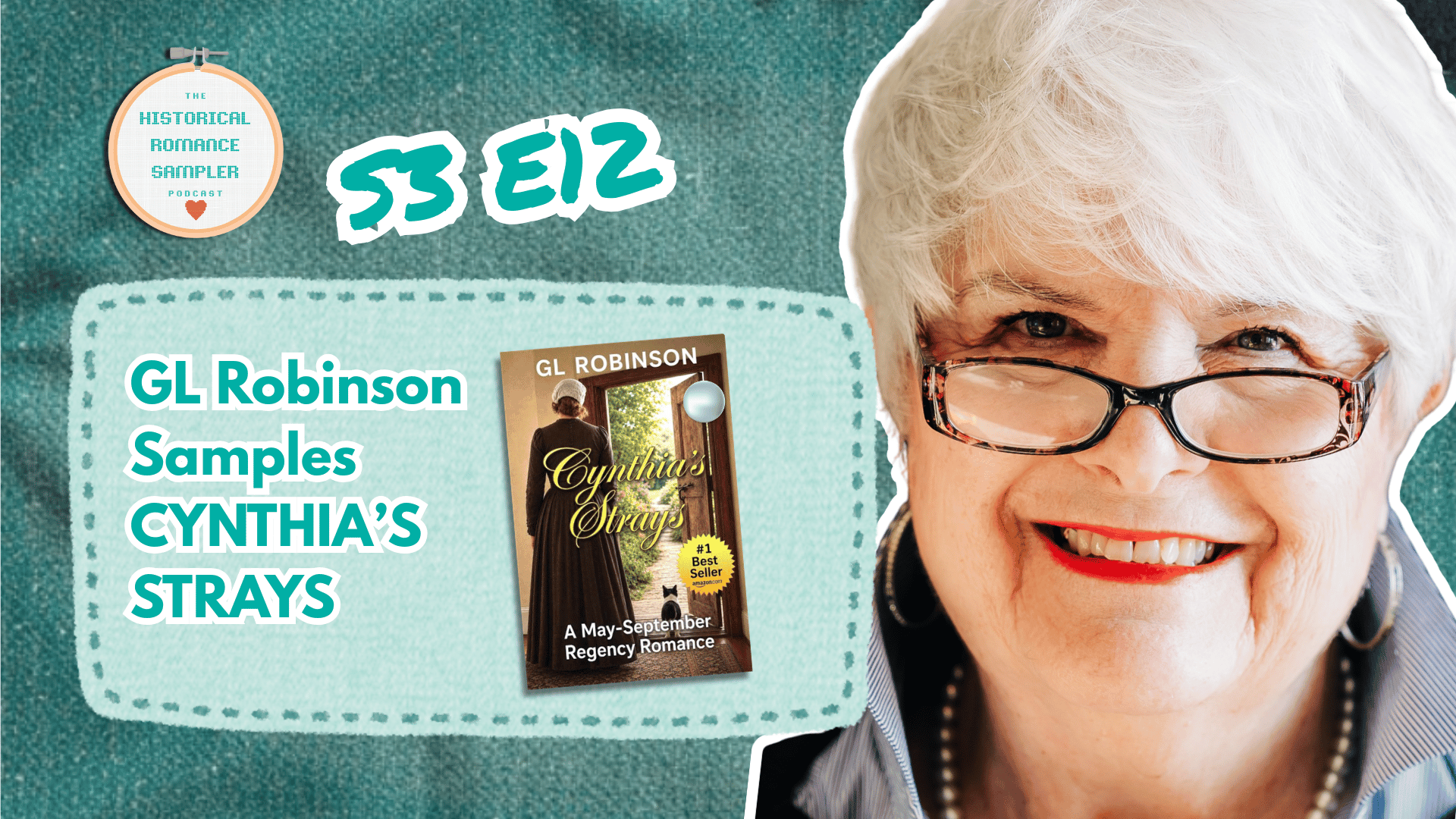
GL Robinson Samples Cynthia's Strays
Katherine Grant: Welcome back to the Historical Romance Sampler, where every week you get to meet a new historical romance author. I am very excited to be joined today by G.L. Robinson. G.L., or Glynis Louise for those of us in the know, is a retired French professor who began writing historical romances in 2018 in memory of her sister, who died that year.
They used to giggle at Regencies under the bed covers after lights out in their Southern England convent boarding school. She has lived with her American husband in the southern tier of New York for nearly 50 years, and thinks it is one of the most beautiful places on the earth, and she's traveled a lot, so she has a qualified opinion.
She has published 20 historical novels, including a Global Book Award winner, four Amazon bestsellers, and a top new release. She likes gardening, having tea with her grandchildren, and sitting by the fire with a good book, and yes, she still reads Georgette Heyer. G.L., thank you so much for coming on the podcast.
GL Robinson: Well, thank you very much too. I'm so excited to be here.
Katherine Grant: Absolutely. I'm happy to have you here. So what are you reading for us today?
GL Robinson: I'm going to read from my latest book, which is called Cynthia's Strays. Here's Cynthia. She's an older lady who is quite resigned to being an older lady. I guess we all get there in the end. And lives a quiet life in the country with a, a new cat that... Well, a cat that is halfway to being a cat.
Was a kitten when she found her, and under the rhubarb in the garden, half dead, more, more dead than alive, and has brought, brought her in, much to the disgust of, of the two people who are looking after her since her family has fallen on very hard times and she's been left practically penniless. But anyway, as you'll see well, you will if you read the book she takes in a penniless stranger who turns out to be, of course a handsome young man, and in spite of herself, she falls in love with him, and her future is quite different from the one she imagines it's going to be.
So I'm gonna read to you from the beginning of the book.
Katherine Grant: Lovely.
GL Robinson: When the knock came at the front door, Cynthia was repairing, yet again, the trim of her bed coverlet. It had belonged to her grandmother, who had tatted it nearly 100 years before as part of her dowry. Cynthia was the third woman in the family it had served, though not in her case as a dowry piece since, at 39, she had grown used to being described by everyone in the village as the Spinster Rowley As if to confirm this, she had taken to wearing a cap.
It had been something of a relief to do so, since it made dealing with her wayward curls easier. She braided them into tight bands, wrapped them around her head, and popped on the cap. But an errant curl tended to fall over her cheek as she worked. It had done so now as she worked on the coverlet. No, the coverlet did not anticipate a wedding.
It was just a much-loved piece of family history. The trouble was, the new kitten she had found abandoned under the rhubarb and foolishly brought into the house was, now that she could walk, constantly trying to climb up onto Cynthia's bed. The old tatting just couldn't take the sharp claws of the determined little thing.
Will had said at the time that she should let him drown it. As she carefully re-hooked the damaged lace, Cynthia half-wished she had. Knowing the kitten would make just as determined an attempt to t- climb into her lap and quickly undo the work she had completed, she had shut her out of the room. The dratted animal scratched at the door, uttering remarkably strong mews for a creature and still not much larger than the teacup in which she had spent her first days.
Blind and hairless as the kitten was when she found her, Cynthia had been sure she would die. Nevertheless, she had wrapped the tiny creature in a piece of flannel, nestled her in a warmed teacup, and fed her with a dropper every two hours. That's when the damage had been done, of course, for Cynthia had taken the scrap to bed with her so she could feed it overnight.
Ruby had told her she was mad. Probably she was, for what could possibly confirm her old maid status more than a cat? But apparently the kitten was as determined as she. She didn't die, and she formed a fierce attachment not only to her savior, but to her bed. In her half-asleep state those first nights, Cynthia found herself reaching to feed the little creature, saying, "Come on then, Teacup."
So that when the kitten had opened her eyes and looked as if she would survive, what other name could she possibly have? Ruby had thought that was mad, too. "You can't have a cat called Teacup," she protested. "Look, she's got two black paws. Why don't you call her Boots?"
"Because her name is Teacup," answered Cynthia mildly.
"She already knows it, and I know it, so that's that."
"Be quiet, Teacup," she had called through the door to the scratchy, mewing cat. "You can't come in because you'll just tear my bed cover again. Stay in the hall and reflect on your sins." But hearing her voice just made the kitten mew even louder. Cynthia ignored it and finished up her sewing.
She was just folding up the repaired coverlet to take it back upstairs when the knock came at the front door. She was startled. It was much too early for afternoon visits. Besides, she had very few of these. The vicar's wife had been in the previous afternoon, and Cynthia had made a cherry cake, of which her visitor was inordinately fond.
It was many years since there had been anyone to open the door. When her father was alive, he had insisted on a butler, though it had turned out they couldn't afford it. Her mother had made this and other discouraging discoveries only after his untimely death, caused by falling off a hay cart and breaking his neck.
They'd had so many debts, they'd had to sell the fields that grew the hay and the cart with them. The butler had gone, too, not that Cynthia had missed him. She'd never liked his supercilious way of looking down his nose at everyone he considered inferior, which was just about everyone, including her.
She knew her mother had missed having a maid much more than having a butler, but they hadn't been able to afford her either. They'd only kept Ruby and her husband, Will, because they'd simply refused to go. "We've been with the family since we was just married, and Miss Cynthia were a little one, madam," Ruby had declared to her mother, "so we ain't going nowhere now.
Our home is here with you, and if we can just use that butler's room along with our own, and you can afford to feed us, you don't need to give us no more." So it had been settled. Ruby was a magician in the kitchen, able to make a meal out of practically nothing, and Will was her equivalent in the garden.
So Cynthia had become accustomed to opening her own door, but unexpected visitors were rare. Tradesmen knew they had come down in the world and ceased stopping by. She now stuffed the bed cover behind the armchair cushion and went to see who it was. To do so, she had to go out into the hall, where Teacup gave a mew of relief at the sight of her savior and followed her to the front door.
She opened it timidly, expecting a soldier, one of the many who'd turned off from the army after Waterloo, and unable to find work, had taken to the roads looking for a meal or any job that would pay a few pence. She hated turning them away and usually gave them something to eat and a couple of coppers, which was more than she could really afford.
But standing on the step was no soldier. He was a complete stranger, and unlike anyone who'd ever knocked her door before. On the ground next to him was a heavy cloak and a large, square canvas knapsack with what looked like the legs of a folding stool or table jutting out of the top. Under the worn cap that the sun had faded to a dull gray, straggling blondish hair hung over his brow, and the bottom of his face was obscured by a bushy beard.
Between the two was a pair of unnaturally bright blue eyes. She saw at once that the man had a fever. He swayed slightly and gasped, "G- g- g- good m- morning, m- madam. M- may I trouble you for, for some wa..." Before he could finish, his eyes rolled back in his head, and to her horror, he crumpled at her feet.
That's it.
I'm not going any further. If you want to know what happens next, you have to read the book.
Katherine Grant: I want to know what happens next. Will he be saved or not?
GL Robinson: Well, I can tell you he will, of course, be saved, otherwise there wouldn't be a book.
Katherine Grant: Well, thank you so much for reading that excerpt. We're gonna take a quick break for sponsors, and then I have lots of questions for you.
Do you have a favorite bookstore? Mine is Kew and Willow. I was one of their original Kickstarter backers and I am always thrilled to have an excuse to go to Kew Gardens here in Queens to see what is new. Since I don't get there as much as I wish I did, I also love to use bookshop.org to support them. Bookshop.org is an online bookstore of print and eBooks. The magical thing is that when you check out, you get to choose a bookstore from their partners and a portion of your purchase goes straight into that bookstore's wallet. When I need to order a research book, you can bet I'm putting it towards the Kew and Willow account.
The Historical Romance Sampler is a proud affiliate of bookshop.org, which means if you make a purchase there after following the link in my link tree, the podcast also gets a slice of that money, which helps me do things like pay for my editing software.
Check out my link tree for official shopping lists of books featured on each season of the show and go book shopping to support your favorite indie bookstore and maybe your favorite indie Historical Romance podcast.
Do you love to read with your ears? I've got you covered. The Historical Romance Sampler is an official affiliate of Libro fm, the audio bookstore, where every dollar you spend helps support indie bookstores. They've got a great selection of romance audiobooks that you can purchase or listen to with credits as part of a monthly subscription.
Even better, I've created custom playlists featuring the Libro FM titles that you here first on the Historical Romance Sampler. Head on over via the link in my bio to shop the playlists.
And if you're signing up for the first time, use code HISTORICAL for an extra book credit.
Katherine Grant: I am back with G.L. Robinson, who just read us a sample from Cynthia's Strays, her latest book. You started writing your historical romances post-retirement. Mm-hmm. And most historical romances tend to be about pretty young people. Yeah. Even Cynthia Strays, you're writing about an older woman who's-
GL Robinson: Yeah ... 39. Who's 39 years old. Oh, yeah. Oh, gosh. How old is that? I mean- ... I'm, I'm pr- I'm nearly 80, and I'm writing about this old woman that's not even 40.
Katherine Grant: So h- The more so I know ... so how is it for you writing kind of young characters? How does it feel to do that?
GL Robinson: I think it's really fun, you know, because I don't think you're ever old in your head. You know? I, I feel 18 in my head. I really do. I don't think you're ever... Don't you feel 18? I mean, and you're obviously, you're, you're not, you're young.
I, I don't even dare to think how young you are. But I, you know, I'm sure you still feel younger than you are, don't you?
Katherine Grant: Yes. Yeah, I do.
GL Robinson: Yeah. Yeah. And that's, believe me, you're gonna be 80 one day, and you're gonna feel the same as you do now. And- Yeah, yeah ... and, and you will look at life, and you'll say, "Where did all those years go?
Because I don't remember any of them, and I still feel exactly the same. And look at all those young girls, they don't understand anything," because I can remember being just like that, but I understand everything. And so magically, although I'm still that same age, I understand everything. It's that-
Katherine Grant: Yes.
GL Robinson: really, it is. It's like, it's a sort of magic transformation. Somehow you're only 18, but you understand it all. Yes ... so that's why you can still be 18 or 30 and, and be 80 at the same time, and write about it, and be in love, and be, you know, crazily in love, and, and, and, and it can seem real to you.
Katherine Grant: Yeah
So in the scene that you read for us from Cynthia Strays, I noticed a lot of beautiful details. You know, she's talking about her cap.
She's talking about this coverlet that has been handed down through the generations, and that was just such a beautiful detail. Obviously, you grew up in England, as you mentioned, and then you haven't lived there as an adult. How do you think about your research historic- of the historical era, and also how do you think about your research of the culture and...
Or maybe not research, but how do you engage with your British heritage?
GL Robinson: Oh, okay. Oh, okay. Well, well, you see, I left England when I was about 20, but until then I ha- You got to bear in mind that I was born right after the war in England, and England had not changed dramatically for m- many years until really I think really until The '80s, I don't think England changed a great deal.
So that, for example, the house I grew up in, first of all, my parents were in Africa. So, so I, during the, the, the shorter holidays, the vacations, I stayed with my grandmother, and she lived in a house that had no bathroom. It only had an outside toilet. It had no bath, no... It had one tap of running water in the whole house, and that was in the kitchen, and it was cold water.
So if you wanted a bath, my grandfather would drag in this zinc bathtub from outside, and there was this copper boiler in the kitchen that he would fill with water, and it had a gas jet. Light the gas, and it would take ages. It would boil up though, and, and he would put about couple of inches of hot water in the bottom.
And then, you know, it was never very hot, this bath at the time. And the oldest person would get in first, which, which obviously was not us, the kids. And then a bit more water would get put in and da, da, da. And, and, and then you, you all use the same water and, and, put a bit more in and a bit more in and so on.
That's how I grew up. I grew up, really, it could've been the Middle Ages, right? Mm-hmm. I'm serious. And, and I grew up in a, in, in a, we had a f- a fireplace downstairs. There was no heating in the house but a fireplace. And we used handmade coverlets. We used things that had been tattered in the last century.
We used tablecloths that had been emb- been embroidered in the last century. We, that was the way it was. So that it wasn't history to me. It was, that's what it was. My grandmother wore corsets, you know, with, with, they weren't whalebones anymore, but they were, they could've been. They were the plastic bones with laces.
I, she wore those things, I remember. And so, it was, a- and if you went to jumble sales and things, you could, you could see The things that nowadays would be considered ancient antiques, they were, they were there and, and that's, that's what I grew up with. So plus, in the convent, as I said to you before, we we studied history, we studied the humanities.
I mean, sciences, forget it. The nuns, you know, I don't even think they knew the Earth was round. I mean, tru- truly, they were so sweet, but they, they lived in the 19th century. So, I n- knew an awful lot about history. I really did. We studied history to the nth degree, French history, European history, English history.
So when I started writing my books, I knew it all. I didn't have to look anything up. I, I look, I look up details still to this day if I wanted. I mean, I've ... This book I- I've just been wri- I wanted to know, Like, how far would it take with a carriage with two horses to get from Mayfair to Greenwich? I want to know exactly how far it'd take, how long it would take.
I can tell you it would take... If you had a racing curricle, it would take 45 minutes. If you had a normal carriage, it would take an hour. Okay. But-
Katherine Grant: Yeah.
GL Robinson: Okay. That, I had, I had to look it up, but at least I knew, and, but I knew you, for example, you, you, you couldn't go along the Thames because the Thames, you know, is not straight.
If you imagine that the Thames is straight between Mayfair and... Well, Thames doesn't go to Mayfair, but do you know what I mean? You, you I, I don't have to do a great deal of research at all-
Katherine Grant: Yeah ...
GL Robinson: to write my books. It's something I know. It's in my bones.
Katherine Grant: Yeah. I might- Well, it's really beautiful. It's, in a way, it's kind of being in touch with your-
GL Robinson: Yeah
Katherine Grant: your childhood and your heritage and what your family
GL Robinson: gave you. I could put a cap on and a Regency dress, and I could be it. Yeah. And I could just step right in. So- Yeah ... that
is an advantage of, of, I suppose, of being older and having, having been brought up that way. Mm. I mean, we used to toast crumpets over the fire with, with, you know, toasting fork, you know, when- Wow ... you don't see them anymore, but used to. Then- Yeah ... there was brass to- toasting forks, and you, you know, stick them on and toast them.
And, and then we'd have butter, and, and you'd put the bu- and the butter would, of course, melt immediately and run all down your arm, you know, because,
That's what, that's what we would do, and, and it was nowadays you can't really. Well, I suppose you can if you've got an open fire, but you're not allowed to have open fires anymore in most parts of England because of the, you know, air pollution, so.
Katherine Grant: Mm.
GL Robinson: But anyway, there you are. Yeah. That's a, a long answer to your question, but that's, that's-
Katherine Grant: Thank you.
Well, I think it's time to move to Katherine's quick questions.
GL Robinson: Okay.
Katherine Grant: So if you had to use one of these words to describe your writing, would you describe yourself as a realist, a comedian, or a fantasist?
GL Robinson: Oh, jeeps. I think a comedian. 'Cause I, I try... My, I can't be serious. Somebody was asking me yesterday that very question, and they said, "Oh, you know, you know, would you could you write a biography?"
And I said, "No, because I'd have to make a fu- I'd have to make a joke out of it, and then the person would be terribly, it would be terribly insulting to the person." I can't, I cannot be too serious about anything. So I have to make them... Okay My books are a bit, always a bit funny.
Katherine Grant: If you had to choose, would you add more real history or more romance scenes to a story?
GL Robinson: Oh, I think probably more real history, actually. I think as I'm writing more and more books, I think they are getting more, more history and less romance. That might, at the moment- And are
Katherine Grant: you mostly focused on Regency or do you expand your era?
GL Robinson: No, Regency. I like the Regency. I like it because it is exactly between two periods.
It's between the pre-industrial period and the post... well, the industrial period. It's, like, just the beginning of modern times, and it's so, so interesting.
Katherine Grant: Yes. Okay. If you were forced to do a genre blend story, what crossover genre would you choose? For example, mystery, fantasy, horror, sci-fi.
GL Robinson: Oh, you mean if I, if I were to do, like, a, a ge- a romance,
Katherine Grant: Historical romance plus mystery
yeah, yeah, yeah. So- Historical romance plus sci-fi. Oh, not sci-fi.
GL Robinson: I hate sci-fi with a passion. No. I would do mystery. I would have a mys- yeah. I could see doing a, a blend of Regency and mystery. I c- like, yeah. I've actually thought of doing that.
Katherine Grant: All right. Well, stay tuned and see if you do it.
GL Robinson: Yes, really.
Yeah, yeah, yeah. Okay. I think I could. I... Yes.
Katherine Grant: And what does escapism mean to you?
GL Robinson: Hmm. What does it mean to me? Well, it doesn't mean travel, for a start. I really don't like travel. I know a lot of people think I'm nuts, but I don't. I've traveled enough in my life, and I just want to stay in my own space. I like it.
I love to be at home. I love it. I love to sit in my own chair with my own cup, my own cup of tea. You never get a good cup of tea other than in your own home. And so escapism is to, honestly, really is just to sit and do what I want to do without all of the chores that you ha- inevitably crowd around you all the time.
That's escapism to me
Katherine Grant: Like Cinderella in her own little corner
GL Robinson: Really, yes. Yeah, with my... With, yes, I don't even have a dog or a cat, but if I had, I'd like to have them sitting and I'd like to be able to pat them on the head. Yeah, but you see, then it wouldn't be escapism, 'cause you'd have to feed them or, I don't know, brush their fur or something.
It would be a chore. No chores. That would be escapism. You know, I have a husband, and a husband is always a chore that you can't ... avoid for. And you know, they're always there like, you know, "Feed me, feed me." "When's dinner?"
Katherine Grant: I love that. Well, thank you for doing Katherine's Quick Questions, and thank you for reading Cynthia Strays. Where can listeners find you and your books?
GL Robinson: Okay. Well, I do have a website, which is romancenovelsbyglrobinson.com.
Katherine Grant: Great.
GL Robinson: All right. So romancenovelsbyglrobinson.com, very easy. And if you go on there, all of my books are on there.
Th- they are... 'Cause I have written a few books that are not Regency. I've written—I have actually written a trilogy of, of like, with this hunky I love him to death, this hunky detective type.
Katherine Grant: Oh.
GL Robinson: Really, I love him. I guess he's my ideal man. He must be, 'cause I really am in love with him. Anyway, he's in there, so I've got him as a...
But most of, all of my books are on there. And I've written one contemporary romance too, which is, I think is a good book, but it has had practically no attention from anybody, but it's my own fault. I haven't really promoted it. Anyway, they're all on there, and i- if, if you go to the Contact Me section I'll send you a free short story.
And also, I've done audiobooks, and I'll send you a code whereby you can download a free audiobook. So it's worth contacting me if you c- if you can plow through the, the, the webpage. And you'll see a picture of me looking very much better than I look at the moment which might, might be worth all in itself, I suppose.
So anyway, it's G.L. Robinson G... What is it?
Katherine Grant: Ro- Rom- romance novels by G.L. Robinson.com By G.L. Robinson I will put the link in the show notes.
GL Robinson: Oh, thank you.
Katherine Grant: Well, thank you so much for coming on the podcast.
I'm so glad we got a chance to do this.
GL Robinson: I am too. Thank you.
Katherine Grant: And to hear a little bit of Cynthia's Strays and to learn more about your process.
Thank you so much for coming on the Historical Romance Sampler. It's been a treat.
GL Robinson: Thank you very much indeed, Katherine.
That's it for this week! Don't forget to subscribe to the Historical Romance Sampler wherever you listen, and follow us on Instagram and YouTube. Until next week, happy reading!