

This podcast is a proud affiliate of Libro.fm. By clicking on this banner, we may earn a proceed of any purchases you make, in which case, we thank you very much!
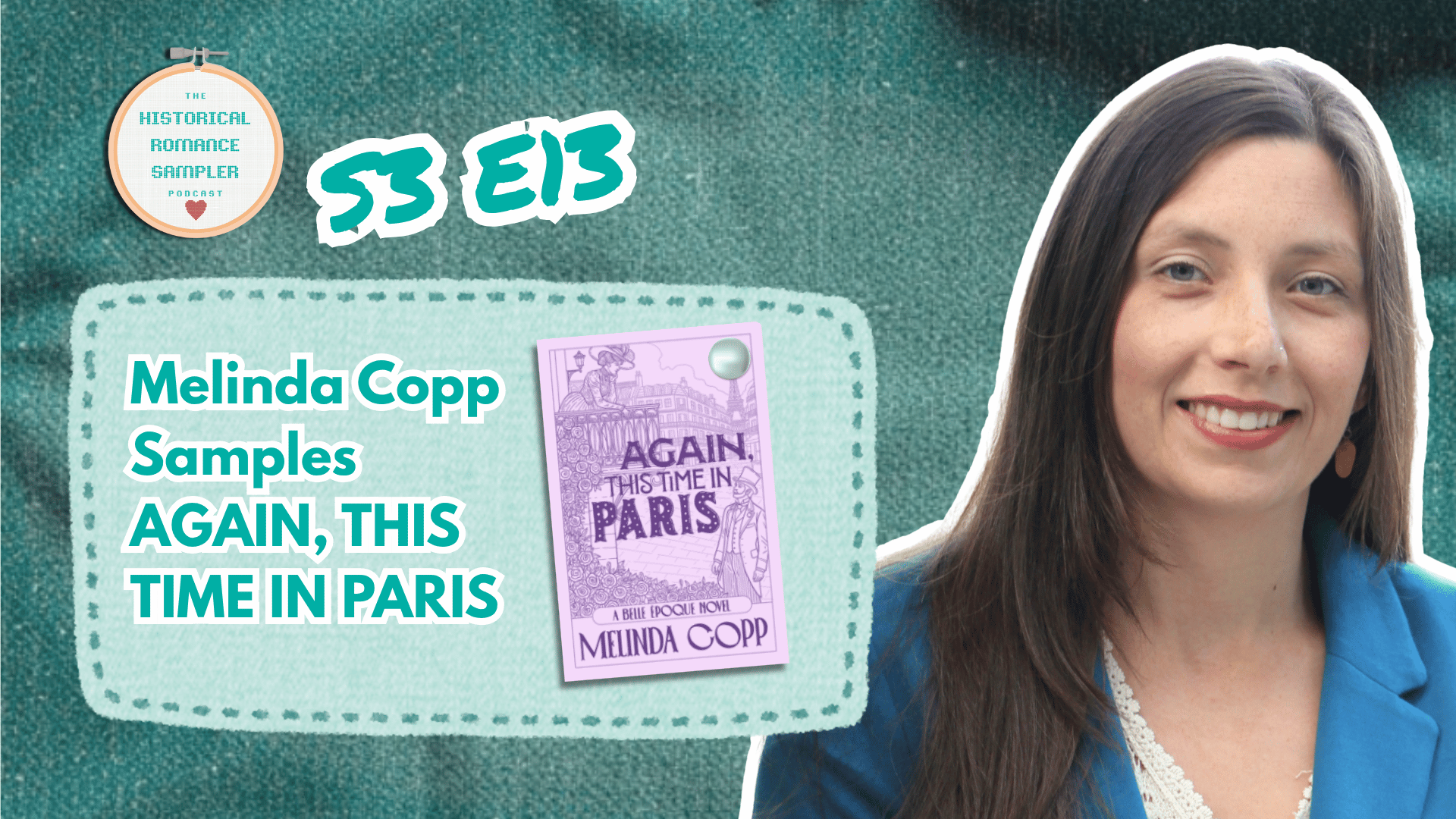
Melinda Copp Samples Again, This Time In Paris
Katherine Grant: Welcome to another episode of the Historical Romance Sampler, the weekly podcast where you get to meet a new historical romance author every Monday. This week, I'm very excited to be joined by Melinda Copp. Melinda is a writer based in the South Carolina Lowcountry.
Her work has been published in newspapers, magazines, and literary journals, including HuffPost, The Rumpus, and The Pedigree Review. She has an MFA in creative writing from Goucher College and a BS in journalism from West Virginia University.
She writes fun, flirty, historical romance, and is currently working on a series set in Belle Epoch Paris. Belle Epoch Paris, including Love and the Downfall of Society and Complications in Paris. Melinda writes romance because she believes people are never funnier than when they make fools of themselves in love.
Melinda, thanks so much for coming on the podcast.
Melinda Copp: Thank you.
Katherine Grant: I'm really excited. I don't think I've really encountered romances in the Belle Époque, or however you pronounce that in a French accent. And yeah, so I'm really excited. You're reading from your latest book, which just came out September 29th, Again, This Time in Paris.
What do we need to know about Again, This Time in Paris before we get into the reading?
Melinda Copp: This is the fourth book in my series, as you mentioned, the Belle Epoque novels. And the stories revolve around these five women who are young, professional women who are living in a boarding house in Paris.
So two of the women in this series are sisters who are, who came to Paris. They traveled from America, and they ended up staying and getting jobs and working and living in Paris. And so this particular book is about Katherine, who is the oldest sister, and in the story, her family is coming to Paris to try to get the sisters to come back to America. So, and the, one of the people who is coming to pick her up and, and take her back to America is her stepbrother, almost stepbrother, who she's had a crush on for her whole life almost, since she's met him.
So that's the, the story behind this one.
Katherine Grant: Ooh, exciting. And I will always root for a Katherine. So- ... let's, let's hear it.
Melinda Copp: Very good. Okay. And this is chapter, this is the very beginning, chapter one.
Katherine Talbot had been waiting weeks for this letter, and now here it was, lying on the parquet inside her door.
Even standing over it in dim light, she recognized her father's elegant, businesslike handwriting and the ivory white envelope from his desk stationery, this one battered around the edges from crossing the Atlantic Ocean. Finally, he'd written. Katherine bent to pick it up. She lit the lamp and collapsed on the settee, working the buckle on her cancan shoes loose.
She and her sister, Diane, shared a three-room suite in a women's pension on Rue de Fortuny in Paris. They had two bedrooms on either side of a small sitting area. The floral wallpaper was faded, the tabletops were scuffed from wear, but everything was clean and functional. One of Katherine's housemates must have slid her father's letter in while Katherine and Diane were out dancing.
When her aching feet were mercifully free, she tore open the envelope. Skimming the text, she registered her father's usual excuses. She'd been waiting to hear from him because after nearly a year in Paris, she was ready to go home and start the next chapter of her life. But Diane, who was two years younger than Katherine, wanted to stay in Paris, where she could seemingly never get on with anything. They'd been arguing about it for weeks.
Katherine couldn't leave her. It was out of the question. Their mother died when Diane was 12 and Katherine was 14, and Katherine had been looking after her sister ever since. She wasn't going to stop now. Convincing her to come home had not been going well. She'd tried hinting around, telling her outright, debating the pros and cons.
What was next? Blackmail maybe? Kidnapping? None of those options were realistic. This wasn't stuffing her into a carriage. It was getting her on a train to Le Havre, and then on a steamship. Her father wanted them to come home, too, so Katherine wrote to him for help. Telling Daddy was a strategy she'd employed many times in her life.
Her sister had as well. She'd even suggested that he come to Paris. Reading his letter now, it was not so surprising that he wasn't. Their father was always busy with work. She turned over the page. Ah, this was interesting. He was sending Ada Beale, his longtime fiancée. It had been such a long time that it seemed silly even referring to Ada as a fiancée, but that was how Daddy referred to her whenever he was forced to describe the attachment.
Daddy wasn't the sort of man who often had to explain himself. The ambiguity of this relationship extended into Katherine's regard for Ada. She was, for all intents and purposes, her stepmother, but she wasn't really. Almost, but not officially. Diane's feelings about Ada were even less favorable. In Katherine's endeavor to get her sister home, Ada would be exactly zero help.
Then Katherine's eyes landed on the postscript. Her heart bounced as she read her father's small, tight words. "No." Katherine gasped and read it again, wishing her eyes were deceiving her But there it was in a simple, plain, unmistakable sentence, Harry will be coming with Ada.
Harry Beale was Ada's stepson.
Her previous husband, Harry's father, died. Harry, even though he wasn't a blood relative of Ada's, was a child of a bitter divorce, and he liked spending time with Ada, which meant spending time with the Talbots. But Harry Beale was much more to Katherine than a stepbrother, or an almost stepbrother, as Diane liked to say.
Harry Beale was the tall boy with the green eyes who'd come into Katherine's life like a shooting star and stayed there, a beautiful and glimmering thing, passing through her orbit on occasion, but remaining largely out of reach. Harry was the boy she'd fallen for every summer since she was 15, the boy who'd left her at the end of the month filled with wonder.
He was what she yearned for. Then, for a brief time, he was hers, or she'd thought he was, and then he wasn't. Not at all. Harry Beale was the reason she'd stayed in Paris so long. Now, he was an ache that lingered in Katherine's soul. She ran the pad of her fingertip along the sharp edge of the letter.
Although going home meant eventually seeing Harry again at some point in the future, when she'd had months to prepare herself for the prospect with pep talks and deep breathing, the thought of him coming to Paris now made her want to bolt a second time. The letter was dated nearly three weeks earlier.
It must have been delayed en route somehow, as letters often could be. But that meant Ada and Harry were on their way now. Katherine counted the days on her fingers. That couldn't be. She recounted. They'd left New York five days ago. They'd be in Paris soon. Any day now. No. No. Katherine collapsed back on the setee.
This could not be happening.
" Cuckoo." Nadine, one of Katherine's housemates, peeked through her open door.
"Bonsoir," Katherine said.
"I thought I heard you coming in." Her eyes were bright and curious for details about Katherine's night out dancing. "I slid a letter under your door earlier. It ended up in my stack."
Katherine held the letter aloft.
"Ah, tres bien," Nadine smiled. Her auburn hair hung in heavy waves. She was wearing one of her silky, fluttery robes, which had fallen open above the tied belt to reveal a nightgown that was just as frilly. She was an actress and no stranger to fancy gowns. "Where's Diane?"
"She stayed at the cabaret. Charlotte was there with her viscount."
Until Katherine's letter, the viscount had been the most interesting thing to happen that night. "Oh, was she?" Nadine arched her neat brow, no doubt filing this piece of information for later. Charlotte was the newest resident of the house. She was a writer who'd come from a small town somewhere in northern France.
She'd hardly been in the city a month when the aristocrat started sending her gifts, quickly becoming a favorite topic of household gossip. "She was." Katherine was no longer in the mood to make anything of it.
"Is everything okay? You look like a ghost just floated through."
"Yes, it's just a letter from my father and some unexpected news."
"Bad news?"
" I don't know." Katherine hoisted herself upright. "It's a long story."
"I'm going down for tea if you want to talk."
Not one to divulge her secrets, Katherine hesitated a beat, but only a beat. Harry coming to Paris was too big a crisis to keep in. She needed advice. Katherine put the letter on her, the edge of her well-used escritoire and stood up.
"Let me find my slippers." Emerging from her room a moment later, her recovering feet in her silk slippers, Katherine followed Nadine into the dark hallway. Downstairs, the foyer, dining room, drawing room, and staircase that led down to the front door were all dark. So was everything through the arched doorway that led to Madame Tremblay's side of the house.
Madame owned the pension, which housed five resident women, plus Cook and Claire, whom she employed to help run the place. Navigating the darkness by feel, they passed through the foyer and went down the back stairs to the kitchen, which was also dark, save for blue pools of the palest moonlight coming in from the windows.
The stone floor was cool on Katherine's aching feet through her thin slippers. Cook kept the kitchen, which was most of the ground floor of the house, immaculately clean. Nadine lit a lamp and put a kettle of water on the wide cast iron stove. It had gone cold, but there were embers glowing orange in the hearth.
Nadine, who knew her way around a kitchen far better than Katherine, collected a few in the small shovel and quickly dropped them into one of the many hatches on the front of the stove. Katherine perched on the stool by Cook's work table while Nadine set out two cups. Coffee was the house warm beverage of choice, but Nadine liked tea before bed and liked sharing.
The kitchen had high stone walls and windows that looked out on the little garden and service yard behind the house. But in the lamps' glow, the windows showed only the women's reflections. The aroma of herbs and butter lingered in the air. Katherine loved this part of the house. All the residents did, and they often congregated here to help Cook, serve the meals, or to clean up at the end.
Katherine would miss the kitchen, the sense of belonging it gave her when she went home, where there were many more servants and absolutely no room for lingering hungry girls. She and Diane had been lucky to find such a lovely home away from home, filled with so many interesting women. But she was also struck with a faraway feeling.
She was here in the cozy belly of a house in Paris, France, while her father and everything Katherine understood to be home, except for Diane, was thousands of miles away in New York. She had been here for nearly a year and still wasn't used to the distance, and now Harry was traversing that distance, a fact that made her heart spin in her chest.
"So what was the news from your father?" The flickering lamplight cast Nadine's red hair in shadows.
"Can you keep a secret?"
"Ooh, what kind of secret?" Nadine sang, not promising a thing.
"The letter was from my father," Katherine said, fiddling with the corner of a dish towel. "I told him I was ready to come home, and I asked him to come help me convince Diane to leave, too."
"This is the secret?" Nadine's voice sank with disappointment. Moving deftly around the kitchen, she stuffed the tea ball with leaves and hung it on the side of the pot. She was an understudy actress at Comédie-Française, and she'd lived in the women's pension for longer than any of the others.
"Well, it's, is a secret from Diane, but now I'm not so sure how much it matters.
My father isn't coming. He's too busy at work, or so he says. He's sending the woman he's practically married to. I'm sure I've told you about her."
Nadine nodded. "The plain one, yes. She's coming to Paris?"
"Yes. She should arrive any day now."
"Oh, wow. Soon, then." The water on the kettle hissed. Nadine poured it into the teapot and put the lid on to steep.
"Yes, and she's bringing her stepson from her first marriage. This is the real secret part."
"I'm listening, darling, rapt."
"You remember when I told you about the man who stopped writing to me? The reason I agreed to stay in Paris after our father sept, stopped paying for it?" Katherine had thought of him often, however, she didn't talk about him much.
It was Harry, for goodness sake. She absolutely had to keep it a secret from Ada and her father, which meant keeping a lot of secrets from Diane, too. Besides, staying in Paris was an exercise in forgetting Harry Beale, not pining for him. Still, small pieces of her story had come out in conversation. "I do."
Nadine lined up two porcelain cups at the table near the pot.
"That's Harry Beale. I've basically been in love with him since I met him when I was 15, but my dad hates his mom because she's really a terrible person. We're secretly..." Katherine considered the word for what she and Harry had once been, attached, writing and making plans.
"Not even Diane knew the extent of it. She always suspected I had a crush on him, but not that we were actually together. Anyways, he's coming here. He'll be here soon. Tomorrow, maybe."
"Oh, my." Nadine clicked her tongue and watched Katherine. "And how do you feel about that?"
"I am not even sure how to feel." It was all still sinking in.
She'd been so mad at Harry, but that had been nearly nine months ago. She wasn't exactly mad anymore. She was resigned, or at least she thought she was. Now that he was on his way to Paris, she felt off-kilter, anxious, a little sick, anything but sure. "He stopped responding to my letters without explanation."
"And you haven't heard from him all this time?"
"Not a word."
Katherine Grant: Ooh there's so much. I can't wait to find out how it goes. So we're gonna take a quick break for our sponsors, and then I'll be back with questions for Melinda Copp.
This message is for anyone with a novel churning in your computer, not sure of what to do or where to go next. Writing a book is a journey. Revising it and knowing when it's done is a whole separate process. I am excited to share that I am now offering my services as a big picture editor to help you figure out how to get from early draft to a manuscript that is ready for publication. You'll get my feedback on plot, pacing, setting, character development, theme, and other big picture questions of, is this book doing what you want it to do? I'll send you a thorough editorial letter, plus offer you a one-hour video call to talk through my feedback and brainstorm your next steps. Louise Mayberry says, "I came away from Katherine's edit with a newfound sense of confidence in my book's worth and inspired with real, tangible ideas to make my novel as impactful as it could possibly be.
I couldn't be happier." If that sounds like the kind of help you are looking for, reach out via the link in show notes to get started.
I'm back with Melinda Copp, who just read from her latest release, Again, This Time in Paris. So like I said at the beginning, I've never encountered a Belle Époque historical romance, or at least a whole series set in the Belle Époque. So I'm curious what drew you to the era and what do you love about it?
Melinda Copp: Well, the Belle Époque is roughly s- it's very similar... It's Gilded Age, basically.
So, you know, post-Civil War era in America through the, through World War I is, the start of World War I is the b- end of the Belle Époque. And and, and that kind of corresponds with a time in, in Paris, in France history that there was the war between France, the Franco-Prussian War in 19, or 1871.
You know, so a very similar time period as Gilded Age. And I, you know, the setting really came to me. I never really thought that I would write historical romance, you know? I never, I didn't... And, you know, and I love it. I love the Regency. I love all the different time periods and things like that. But when I read In Search of Lost Time, Marcel Proust, I read that several years ago, and it's set in the Belle Époque era, and I just absolutely really fell in love with the setting, basically.
You know, that Paris was a place where a lot of various different things were happening in history at that time, and I just found it so compelling and so interesting that I just... When I read it, I was like, "I could easily set a ton of books in this time period," and, and so it kind of went from there.
Katherine Grant: Were you writing in other genres before that?
Melinda Copp: I was. I was writing contemporary romance.
Katherine Grant: Yeah.
Melinda Copp: And, you know, they weren't really great. These were my starter books, I guess, that I was playing around with. And like I said, I read these, I read Proust and, and there it was, and it was just kind of this idea came to me and and that's really what started it.
Katherine Grant: Do you feel like historical gives you something that contemporary doesn't creatively?
Melinda Copp: That's a good question. It gave me something, a world to explore, I think is a good way to describe it. That I can kinda go there myself and, and take readers there hopefully.
The other thing is that it feels very similar to modern times, in that a lot of things were happening as far as technological advances and it's often said that it's the birth of the modern world was happening at that time. You know, not only in, in France, but everywhere.
And so it felt very it felt like I could, you know, I just love the historical setting, and it allowed me to kind of explore issues that are maybe similar to what's happening today, but in that kind of different exotic, you know, different setting than what we have today, in contemporary anyways.
Katherine Grant: I totally know what you mean. It's like you're kind of using the parallels to hold up a mirror. Instead of saying, you know, "Look at your own self," you're saying, "Look at this mirror. What do you think about this mirror?"
Melinda Copp: Right. That's a good way to put it. I like that.
Katherine Grant: Yeah. And so it sounds like certainly you're very grounded in this period.
I'm curious, what's your research process? Do you do a lot of rabbit holes to build out this world?
Melinda Copp: I do, yeah. I mean, like I said, it started with reading, just classic literature. So I do read a lot of books from that time period. Henry James, I've been reading a ton of Henry James that, you know, I've never really been into him before, but, and Edith Wharton, you know, Emile Zola, a lot of French literature as well as American literature. And as far as research, I have... It's tricky because a lot of French history is in French, and so so I have
Katherine Grant: to- It's funny how that works.
Melinda Copp: Yeah, so I have to, you know, kind of put it all together and you know.
So that's part why I reli- rely so heavily on books that have, you know, fic- fiction and things like that. I have these old books, the old library copies of French history from, you know, mid-1800s to to World War II era that I have relied pretty heavily on just for, you know, the feeling of the era.
You know, like what were people thinking about, what were people concerned about? Because the French are different from the English, you know? And it's- it's definitely a different mindset and, you know, all of those fun things, so... And then I do a lot of, you know, I spend a lot of time in Paris on Google Maps.
Just, you know, looking at the the, the architecture and, and the streets and, and things like that.
Katherine Grant: This book, and you alluded to Diane has a book too, are clearly about American characters in Paris. Yes. And then I think I saw on your website you have at least one story that's about some French characters in Paris. Yes. Is that right? Mm-hmm. So how is it to write Americans versus French characters in France?
Melinda Copp: It was, it was fun. It was tricky. So most of the characters are French. These two, you know, the, this book is the first book that I've written that has the two main characters are American. And I spent a lot of time thinking in the very beginning, like, "Oh, I don't want them to sound like English people," which is, you know, a lot of historical romance is set in England.
It's you know, it... And so I didn't want them to sound that way. I had to really you know, be careful about that, you know, not slipping into, like, an old-timey, you know, British sort of voice. I think that reading a lot of books set in that time period helped me with that a l- as well.
Just to kind of get, you know, because I have to think about, you know, like what would a French person think of it, you know? Rather than... So it's like there's the window of, you know, not only a person set 100 years ago or more than that, but a person from a totally different country that speaks a different language and, and all of those things.
So it was fun. It was challenging. And y- and I did my best, for sure.
Katherine Grant: Yeah. And you've mentioned Proust, you've mentioned Henry James, Edith Wharton. How about romance authors? Who are some of your favorite romance authors?
Melinda Copp: My absolute favorite is Maya Rodale. She's and I don't believe she ha- she hasn't written a h- historical romance in, in a while, but she is my... She's one of my favorites. I also love Courtney Milan Julia Quinn, obviously. The Bridgerton novels I absolutely love.
Alexandra Vaste, I like her a lot. She's a lot of fun. I like you know, I like historical romances that typically the funnier ones. I like it a little silly, so.
Katherine Grant: I love that. Yeah. Well, that's a good segue into Katherine's Quick Questions.
Katherine Grant: So if you had to use one of these words to describe your writing sensibilities, would you describe yourself as a realist, a comedian, or a fantasist?
Melinda Copp: I would say comedian. I'm always trying to make it more funny.
Katherine Grant: Are you-
Melinda Copp: Whether I succeed or not.
Katherine Grant: Are you drawn to, like, physical comedy, situational comedy, dramatic irony?
Melinda Copp: Mm, dramatic irony, I would say. Situational comedy, for sure.
Katherine Grant: I love it. If you had to choose, would you add more real history or more romance scenes to a story?
Melinda Copp: This is such a good question. I guess I would choose more realistic history. I'm not a hu- you know, I love history, obviously. I'm a, a... But I'm, I don't know. That's a tough one. I do like, I do like history and setting and kind of transform, you know, transporting to a different world, for sure.
Katherine Grant: Yeah. So the world building of the history is important to you?
Melinda Copp: Yes.
Katherine Grant: If you were forced to do a genre blend story, what crossover genre would you choose?
Melinda Copp: I would choose probably fantasy, and I say this because I am the least fantasy, fantastical person. You know, I read a lot of realism and but I would say magic realism would be my crossover, I think.
Katherine Grant: Interesting. So just a little bit of magic here and there.
Melinda Copp: Yes.
Katherine Grant: I love that. Okay, and finally, what does escapism mean to you?
Melinda Copp: Escapism, to me, is something that just takes me out of my everyday life, I guess. You know, I have three kids, I've got a lot going on, and I enjoy reading about people, you know, different worlds and different people whose problems are not mine, I guess, that I can slip in and you know, not have to think about all the other things that I have to think about.
Katherine Grant: I love that. Melinda, thank you so much for taking Katherine's Quick Questions quiz, and for coming on and sharing again, this time in Paris. Obviously, Second Chance and Paris has a long resonance since, like, Casablanca at least- Yeah ... for us. So, I think it's really exciting for readers to get a chance to read Again, This Time in Paris and see Katherine and Harry presumably work things out.
So where can listeners find you and your books?
Melinda Copp: My books are widely available in all bookstores, both in e-book and paperback. You can also purchase them on my website. I have a new store, melindacopp.com. Is, there's links to it there. And as far as finding me online, I guess I spend the most time on Substack lately.
My newsletter is available there at melindacopp.substack.com.
Katherine Grant: And I saw there are some fun historical research tidbits on your Instagram, and also I think in your Substack. So-
Melinda Copp: Yes ...
Katherine Grant: check it out. I will put links in the show notes, so listeners, you can just click right on through.
Melinda Copp: Thank you.
Katherine Grant: Thank you, Melinda, so much for coming on.
Melinda Copp: This has been a lot of fun. Thank you so much, Katherine.
That's it for this week! Don't forget to subscribe to the Historical Romance Sampler wherever you listen, and follow us on Instagram and YouTube. Until next week, happy reading!