

This podcast is a proud affiliate of Libro.fm. By clicking on this banner, we may earn a proceed of any purchases you make, in which case, we thank you very much!
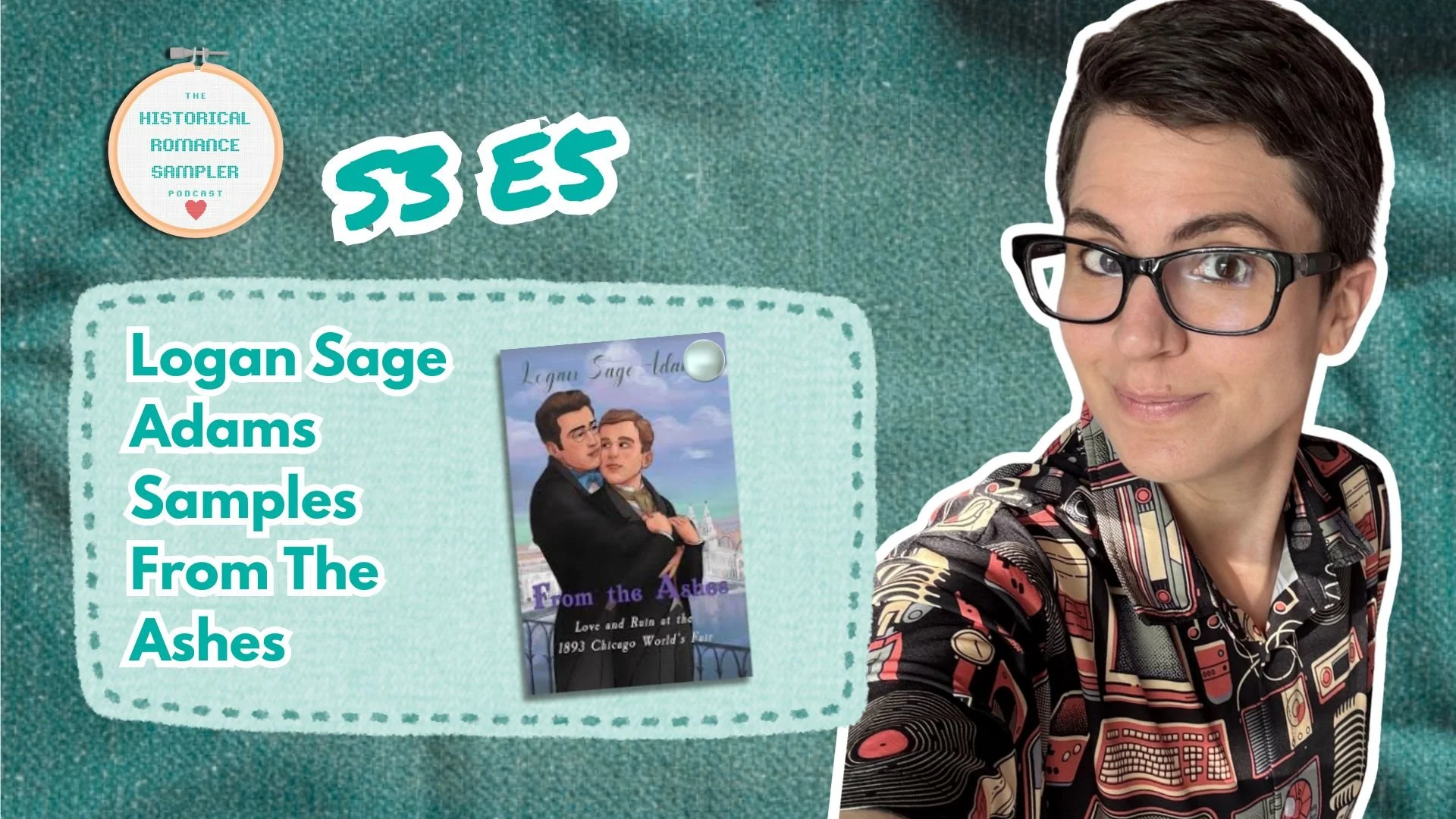
Logan Sage Adams Samples From The Ashes
Katherine Grant: Welcome to the Historical Romance sampler. Today I am joined by Logan Sage Adams. Logan Sage writes historical male male romance with plenty of sweetness, a little heartache, occasional humor, and hard earned happily ever afters. Her work explores themes like healing from loss, finding the courage to fall in love,
learning to love oneself, and overcoming trauma. They especially enjoy writing love stories between everyday people and typically set their stories in the 20th century, mostly in the United States, which you know I'm gonna ask about later. When she's not writing or reading, logan Sage enjoys cooking, chatting with friends, and spending time with her supportive family.
Logan Sage, thank you so much for joining.
Logan Sage Adams: Thank you. Thank you for having me.
Katherine Grant: I'm really excited to hear you read today. You're reading From the Ashes.
Logan Sage Adams: Mm-hmm.
Katherine Grant: And my understanding is this is set in Chicago. Yes. Tell us about it.
Logan Sage Adams: Yeah, sure. It is set in the Gilded Age in Chicago, so it is 1893. It starts right before, and then goes through the World's Fair that took place there in Chicago.
And it is a romance between a, like a high society man who is the son of a very prominent family, and a man who works in one of the print shops that he purchases.
Katherine Grant: Very exciting. I know so many people who are obsessed with that Chicago World's Fair because of the book Devil in the White City.
Logan Sage Adams: Yeah.
Katherine Grant: So it's really nice to have a story that might be a little more uplifting than about a serial killer.
Logan Sage Adams: Yes,
Katherine Grant: I hope
Logan Sage Adams: it is. It is, it has. I think that, you know, I wanted my work to be to serve as a partial criticism of the World's Fair and the Gilded Age as a whole, but have kind of an uplifting tone to it overall, of course, because it's a romance.
But just in general with the progress that we continue to make as society, and I feel like right now it's hard to find that positivity. So hopefully it'll be helpful for some.
Katherine Grant: Yeah, absolutely. All right. So is there anything we need to know about the scene before you jump into the reading?
Logan Sage Adams: I'm just going to, so I'll read from the first scene just 'cause it's one of my favorites. It introduces one of the main characters, Arthur, who is the, the one who's a, an industrialist and, a son of a very wealthy family. That's pretty much all you need to know. So I'll dive in and hope I can get through it.
Okay.
Flames flickered in the nearby fireplace while Arthur Hughes sat on the yellow and brown striped sofa. One foot resting atop its opposite knee, his thumb tap, tap, tapping his thigh. Musical notes filled the room. Arthur flinched at each of the occasional mistakes in the familiar sonata. Dammit. How many more times would Emma have to play this piece before he could even pretend that her performance had been satisfactory? He let his eyes wander to the mantle clock. Noon.
Arthur was scheduled to meet with Harry Putnam in less than one hour's time. He couldn't keep listening to Emma's half-hearted, unpracticed performances for much longer. Returning his focus to the piano, Arthur caught the eye of Emma's tutor, Charlotte, and forced a tightlipped smile. Charlotte simply crooked an eyebrow in response. Arthur had to then purse his lips to contain a very real smile that was threatening to burst forth.
Charlotte placed a hand on Emma's shoulder, signaling her to stop playing. "I think your father is running short on time," she said. "We'll practice more later." Emma heaved a sigh. Arthur could practically hear her eyes rolling. Biting back the urge to reprimand her, arthur uncrossed his legs and stood.
"You're playing is better," he said
simply, straightening his jacket. Definitely better. Still terrible, but better. Emma swung her legs over the bench, her fast movement so inelegant it had to have been purposeful. Arthur held back from commenting again. "I have no ear for music," Emma said with the overinflated sense of self than most other 16 year olds possessed, but typically kept better contained.
"I keep telling you."
Arthur replied, "I know piano isn't your favorite."
"No, it's not," emma clicked.
"Emma." Arthur said, leveling a look. "Your mother loved to play the piano, and I know for certain that she would've liked for you to learn. Can't you at least try to share this with her?"
"It's not like she's here,"
emma said bluntly. Arthur fought back a wince. Even though her callousness pained him, he tried to tell himself that his wife was more of a folktale, more a specter to Emma than a mother figure, as hard as that was to believe. It took Arthur an extra moment to collect himself enough to respond. "No, she's not,"
he finally said, "but I like to think that she-"
before Arthur could finish his sentence, Emma hopped to her feet. Rather than try to stop her, arthur watched her skulk off. Charlotte came up beside him and touched his forearm. "I'll talk to her," she said.
"Don't bother," arthur said wearily. "I had a temper myself when I was her age.
It'll pass eventually."
"I'm sure you were more respectful to your parents."
"Only to their faces. Did you forget the reason why Ella and I had to marry so young and in such haste?"
Charlotte had been friends with Ella. It was how Arthur had met her. He had even liked Charlotte for a little while before that ball where Ella had really caught his eye.
Thinking back on his exploits, Arthur ran hand over the lower half of his face. "I was a master manipulator," arthur said. "Deceitful. I was so cavalier, too eager to be the opposite of who my parents wanted me to be, but I realized eventually that I needed to change." His face fell as the weight of that statement settled into his brain.
"Now I'm exactly like my father, only i'm more miserable."
"You're nothing like him," charlotte said. "Trust me."
"How am I not? I live for my work. If you can even call my pitiful investments that. I have no real friends either." Charlotte reeled back, prompting Arthur to correct himself. "Alright. I have one real friend, but I pay her to be my friend, so I'm not sure if it counts."
"It counts. I'm not your friend because I work for you. Frankly, I could probably be better paid elsewhere."
Arthur huffed a barely there laugh. "I pay my staff poorly. Add that to the list."
"You pay me well. I was only trying to be funny."
"Can't recognize humor. Another similarity."
Now Charlotte was laughing. "Stop."
"Loves to hear himself talk."
"Alright, now you're spouting complete nonsense."
Arthur opened his mouth to say something in protest, but Charlotte's threatening look stopped him, and he held up his hands in mock surrender. She continued. "You are nothing like your father other than the fact that your offspring could stand to be better behaved."
Arthur sighed.
"I know she could be, but honestly, I'd rather her be rude to my face than try to sneak off behind my back. I'll take honest eye rolls over false smiles every time."
" I still want to talk to her. I want to make her see how lucky she is."
"Now you're starting to sound like my father."
"I'm not referring to your family's money, but the fact that you care for her."
"Oh, yes, and I know what she'll say. She'll say that I'm too busy. She'll tell you that if I really cared, I'd spend more time here at home. I'd spend more time with her. And the worst part is she'll be right."
Arthur paused to remove his spectacles, pinc nez style frames that pinched the bridge of his nose, and rubbed his eyes before putting them back on. "I am busy because when I'm not busy, I can't stop thinking about how miserable I am, and I'm only busying myself by either participating in events that I'm expected to participate in or tending to my investments and businesses I know I should set more time aside to be with her."
Charlotte's expression softened, her eyebrows lifting, her brown eyes shining with unbridled kindness. "She's still lucky. She's lucky that you never fault her for her honesty, whether over her opinions or her emotions, and I want her to see that."
"Best of luck to you then," arthur said, a teasing edge to his voice.
He took out his pocketwatch to check the time. "I need to head over to Putnam Press. Soon to be, well not to Hughes press because that's taken, but something else maybe."
"Good luck to you too then."
"None needed. I made an outlandish offer for his business last week and Mr. Putnam said that he would be happy to sell.
He'll have the papers ready today, so I better not be late." He bowed his head slightly and started toward the hall before stopping to turn back around. "I should be back by six, maybe seven. If you could tell Gertrude, that would be helpful. I'd rather not have her prepare dinner early only have the food grow cold."
Charlotte hooked her hands behind her back and nodded. "I'll tell her." Arthur threw her a wink and left.
Katherine Grant: What a interesting setup that's so centered in fatherhood and this feeling of not being enough. Like I just wanna find out more about Arthur.
Logan Sage Adams: Oh, yay. I love that. I just, yeah I adore his character so much.
And you really hit the nail on the head of, he just, he never feels like he's enough for his family because of just who he is and the mistakes he's made. And he, so he wants to be a good father to Emma. He wants to give her this. Amazing life, but he's so miserable. Mm-hmm. It's kind of, a push pull thing within himself for a lot of the book.
Katherine Grant: Mm. Well, I look forward to talking more about that. First, we're gonna take a quick break for our sponsors.
Do you have a favorite bookstore? Mine is Kew and Willow. I was one of their original Kickstarter backers and I am always thrilled to have an excuse to go to Kew Gardens here in Queens to see what is new. Since I don't get there as much as I wish I did, I also love to use bookshop.org to support them. Bookshop.org is an online bookstore of print and eBooks. The magical thing is that when you check out, you get to choose a bookstore from their partners and a portion of your purchase goes straight into that bookstore's wallet. When I need to order a research book, you can bet I'm putting it towards the Kew and Willow account.
The Historical Romance Sampler is a proud affiliate of bookshop.org, which means if you make a purchase there after following the link in my link tree, the podcast also gets a slice of that money, which helps me do things like pay for my editing software.
Check out my link tree for official shopping lists of books featured on each season of the show and go book shopping to support your favorite indie bookstore and maybe your favorite indie Historical Romance podcast.
Do you love to read with your ears? I've got you covered. The Historical Romance Sampler is an official affiliate of Libro fm, the audio bookstore, where every dollar you spend helps support indie bookstores. They've got a great selection of romance audiobooks that you can purchase or listen to with credits as part of a monthly subscription.
Even better, I've created custom playlists featuring the Libro FM titles that you here first on the Historical Romance Sampler. Head on over via the link in my bio to shop the playlists.
And if you're signing up for the first time, use code HISTORICAL for an extra book credit.
Katherine Grant: I am back with Logan Sage Adams, who just read from the book From the Ashes. And remind me, is this a new release? It's just recently come out.
Logan Sage Adams: Yeah, it came out January 22nd.
Katherine Grant: Awesome. So it's now available. You can go read it to find out what happens with Arthur and the soon to be
discovered Jesse. I wanna start with how you were setting it up. You said you want this to be a critique of the World's Fair. Can you tell us more about where you got the idea to set it in the World's Fair and what drew you to the World's Fair?
Logan Sage Adams: Well you mentioned the book earlier, devil in the White City.
I read that a long, long time ago. And I really enjoyed it, but obviously the tone was bleak for some of it, and it was also, it was very informative. I really enjoyed it. I just have always loved love stories. And so even back way before I thought of becoming a romance author, I wanted I thought like how great would it be to read a love story set
during the World's Fair? So I don't know. At some point the idea just popped into my head that it would be really cool setting. I didn't set out initially when I was like researching for it to be a critique. Everything I had heard about the fair other than the serial killer,
it was like very interesting. And I had forgotten a lot of the even criticism that Eric Larson included in his book and obviously there was stuff he didn't include. And as far as like how people were treated while it was being created, bipoc, people being left out of like the planning and important, being able to showcase their important achievements.
There was so much that I realized that my book couldn't just be a celebration of what it was, and also the more I learned about the fair and why they had it, why they had it in Chicago, why Chicago wanted to have it. After the Great Chicago fire in the 1870s, I just, I realized that I wanted to
bring those together and have my book be a criticism of both the World's Fair and the Gilded Age and exploration of that through the characters, through the relationships with each other and their, their families and society.
Katherine Grant: Mm-hmm. Yeah, because the World's Fair seems like this, like like really outlandish, fun idea of
all these countries coming together to exhibit the things that they have developed over the last, I don't know, 10, 20 years, whatever it was supposed to be. But I do remember reading about it probably in the devil in the White City, about how people were really mistreated as laborers, mistreated as being like put on display.
Like they built villages I think of like they were really exoticizing countries that are, were currently being exploited by the yeah. Colonial empirical powers. Tell me more about your research process. Do you start with the research and then come up with the story idea? How much do you dig into the research before writing or during writing?
Do you let the research just be on the side while you're doing the fun writing. How does that work for you?
Logan Sage Adams: I do a little bit upfront just because I wanna know kinda some basics to get the vibes of what I wanna go for when I'm writing the book, but the bulk of my research is like on the way, which then, obviously I might have to go back and fix something when you stumble across something that doesn't work for whatever reason.
But I can't hold that much in my head, I don't think to research it all ahead of time. And I also discover a little bit as I write, so I have a rough idea of what I want the story to be, but I'm not someone who plots everything out. So that would be difficult to research beforehand because I wouldn't even know and necessarily what I wanna research until I get there.
And then you realize, oh, what can I have them do at the fair now that they're finally there? And where are they in their relationship so far? What, what pieces of the fair should I use that could be like, symbolic of something that they're going through or whatever. And so that kind of drives where I go with the research.
Katherine Grant: Yeah. And something from the scene that you read, Arthur is so interested in being a good father, and I was wondering how much you explore or thought about this as you were writing the idea that we have an idea in our generation of what is a good father, and in the 1890s they probably had a very different idea of what is a good father.
How did you like balance that as you were writing this character?
Logan Sage Adams: Yeah, a lot of Arthur's arc is kind of what he feels a lot of pressure on what his parents wanted for him and what he was meant to be. And he doesn't fully recognize for a while that he's putting that pressure on Emma.
Because he's internalized that as almost as being a good parent, though he's never had that conscious thought. And he doesn't even necessarily consider his parents good parents, but he wants their love and approval and their love and approval hinges on him being a certain way and being a certain way includes being a certain kind of father.
So I think that it's even more about like, he can see that she's unhappy. He's always felt unhappy, but he's still telling himself, as you kind of see in the scene, that like it's a season, but he is not even recognizing that he's still miserable. Mm-hmm. It never passed for him. Yeah, he sees that.
He sees that Emma's miserable, but somehow it's not clicking. Why? And he doesn't even recognize that it's a mirror for himself too, and how he's always felt.
Katherine Grant: Hmm. Well, I'm trusting that by the end they both get a little less miserable.
Logan Sage Adams: Yes. It's such a big part of the story is fatherhood. And you know, I really enjoyed writing that.
I don't always write children in my books. It's just when the story calls for it. And I couldn't resist it for some reason. I don't know why.
Katherine Grant: Well, and so speaking of that, you have written several different novels and they're in different eras. And like you said in your bio, they tend to be the 20th century, tend to be the USA.
Do you have a sense of how you approach, how, do you choose an era? Are you called to an era? How do you end up writing a story in 1893 versus like a different era?
Logan Sage Adams: I will say that when I wrote that version of my bio, I realized I had to update it. And I updated it maybe like a week ago because I realized, oh, I guess I'm not only doing the 20th century now.
At first I was just, those were like you mentioned, being called to write a certain thing. There were just pieces of American history that I found very interesting and that I then wanted to write about. But now I've written a couple of books in the 1800s as well. I have this one. I'll have another one that'll come out later in the year, like I don't know what happened.
I think I just I like hopping around. I like exploring different things. Right now, I do really love this period from like the mid 1800s til through like the 1920s is just my favorite. I don't know why, but I've written outside of it. I wrote the 1930s and the eighties, so I don't know.
Katherine Grant: Well, the late 19th century in the US is a very tumultuous time with big changes in all spheres of life. So that can certainly be an exciting time to plunge in as a historian.
Logan Sage Adams: Yeah.
Katherine Grant: Would you say that you get your story ideas, like do they come to you through character, through plot, through setting?
What hooks you the most?
Logan Sage Adams: I think setting first and then character. The way that I seem to do it, and I don't know why, is picking either like a setting or an event that I wanna set something around and then I find my characters and the way I find them is really silly. I look at old photographs.
Like really old photographs that I find online and I just find them. I just find oh, there's this person, I think he's gonna be in this. He looks like he belongs in this era or in this, I don't know. And then another the same thing, and then I kind of work from there. To figure out who they are and figure out what the setting is, what the, I don't wanna say like the themes, but like the cultural milieu,
I don't know if I'm saying that right, of the time period. And that kind of informs them what the story should be. The Gilded age was, had so much tension between the different classes. So that's what drove this story versus like the 1930s in America with the Great Depression, and that's a completely different, you know, striving to, to survive kind of thing.
So that, I feel like it's, they just, the setting kind of helped me figure out where to go.
Katherine Grant: Yeah, that's really interesting. And looking at photographs, your covers are so beautiful and they're each a beautiful illustration of the main couple and they're very specific.
Like they look like they could be from photographs. There's one that looks very specifically like a photograph. It's clearly not a photograph. Yeah. But it's that's obviously the aesthetic. I guess I'm mostly just stating a compliment, which is, I love your book covers. And do you do, I guess, do you use your the photographs that you use as inspiration, do you give those to your cover designer?
Is that how you get to the covers?
Logan Sage Adams: Just for the faces of the people. But otherwise I kind of just come up with a pose. This world's Fair, there's a famous photograph, so I'll just show what this cover looks like. And you could see that there's like a, the fair in the background. There is a photograph of, I think it's a couple, and they are on a balcony like this, overlooking, but it's a farther away photograph and there's something in it.
I don't know if it's it's some piece of machinery that, I don't know exactly what it is. It might be like a spotlight or something like that. And so I sent that to my cover artist and I asked her, can we like zoom in, make it, you know, that the couple is the main thing, but I wanna have the fair in the background and I wanna have that,
that scene. And since it was like, I think it was dubbed the mauve mauve decade, I'm sorry. I'm really bad with pronunciation. Sometimes you can tell that I like learned words from reading them, not from hearing them, because I never know how to pronounce anything. So, but that's why I asked that there'd be like purples.
So I had like the, the spine and the, I just wanted to capture like that. It, there was some purple too.
Katherine Grant: Yeah.
Logan Sage Adams: Decade. I don't know.
Katherine Grant: I love that. I love that. Well, it's a good time to move to Katherine's quick Questions.
Katherine Grant: If you had to use one of these words to describe your writing sensibilities, would you describe yourself as a realist, a comedian, or a fantasist?
Logan Sage Adams: I would say a realist with a little asterisk and say that I'm an idealist because I try to put as much realism as I can into my books. I heard the term once rivet counter, which I really, I liked for myself because I will look up minutia, and I'm getting better at that. Meaning I'm getting like more obsessive about it with every book, which fine, but then I still, I always want there to be just a lot of queer joy in my stories.
And so that's where I say I'm an idealist because I know that not even maybe most queer people in history, especially in these time periods that I've written about, had their happily ever afters. But they obviously deserved to, and so I just want that for them in the book, so that's why I think it's like realist with a little, a little bit more.
Katherine Grant: Yeah. If you had to choose, would you add more real history to a story or more romance scenes?
Logan Sage Adams: Probably more real history and I don't know, sorry, readers. I just, I really like it. I don't know. I'm just really nerdy and it's so fun for me. I love romance, but I just, I don't know the history.
Katherine Grant: If you were forced, forced to do a genre blend story, what crossover genre would you choose?
Logan Sage Adams: I have thought about this and it is so hard. I don't know if I will say, can I pick two?
Katherine Grant: Sure.
Logan Sage Adams: All right. It would be either sci-fi, but it would be kind of like, almost like a time travel sci-fi so I can incorporate some historical stuff.
I think that would be really fun to do, or I would do a, like a noir kind of feel for romance. So noir, but with a nice happily ever after. But I would love to try to write that gritty.
Katherine Grant: Yeah,
Logan Sage Adams: and probably set it in like the 1920s or something.
Katherine Grant: I think about this relatively frequently, how much I love a noir sort of set up and feel, like the PI who's like against the world, but
I don't really love it because the rule is they can't actually be happy. If they get happy, something terrible is gonna happen. And I just, I think about that a lot. I'm like, I love it, but I hate it. Yeah. So please I'm gonna vote for you to give us a romance noir so that we can enjoy the setting without the the terror of knowing that as soon as they get some happiness, they're going to lose it all.
Logan Sage Adams: Yeah, exactly. But I like that too. So I have to work on it for sure. For sure.
Katherine Grant: All right. And the last question, what does escapism mean to you?
Logan Sage Adams: I think, I mean, just being able to be sucked into another world. And it's, you know, even though it's our world, it's the past and I think
historical has some similarities with fantasy in that way, that you're just transported to something completely unlike what you're used to. And that is what I think of as escapism. It's just being able to fall into another world.
Katherine Grant: Lovely. Logan Sage, thank you so much for playing Katherine's Quick questions and for coming on the podcast.
Where can readers find From The Ashes and your other books and also where can they find you on the internet?
Logan Sage Adams: You can find all of my books on Amazon. They're also on Kindle Unlimited. If you prefer, you could also purchase a paper back directly from me, I have on Etsy, so you can just search Logan Sage Adams.
And I sell signed paperbacks there. And for following me, you can subscribe to my newsletter at logan sage adams.com or you can follow me. Logan dot Sage Adams at. And Instagram.
Katherine Grant: Awesome. And I'm gonna put your website in the show notes so listeners can click right on through.
Logan Sage Adams: Thank
Katherine Grant: you. And From The Ashes is currently out so everyone can go read it.
That's all I have. Thank you so much, Logan Sage. I really have appreciated this.
Logan Sage Adams: Yes, thank you so much. This was great. It's so fun.
That's it for this week! Don't forget to subscribe to the Historical Romance Sampler wherever you listen, and follow us on Instagram and YouTube. Until next week, happy reading!