

This podcast is a proud affiliate of Libro.fm. By clicking on this banner, we may earn a proceed of any purchases you make, in which case, we thank you very much!
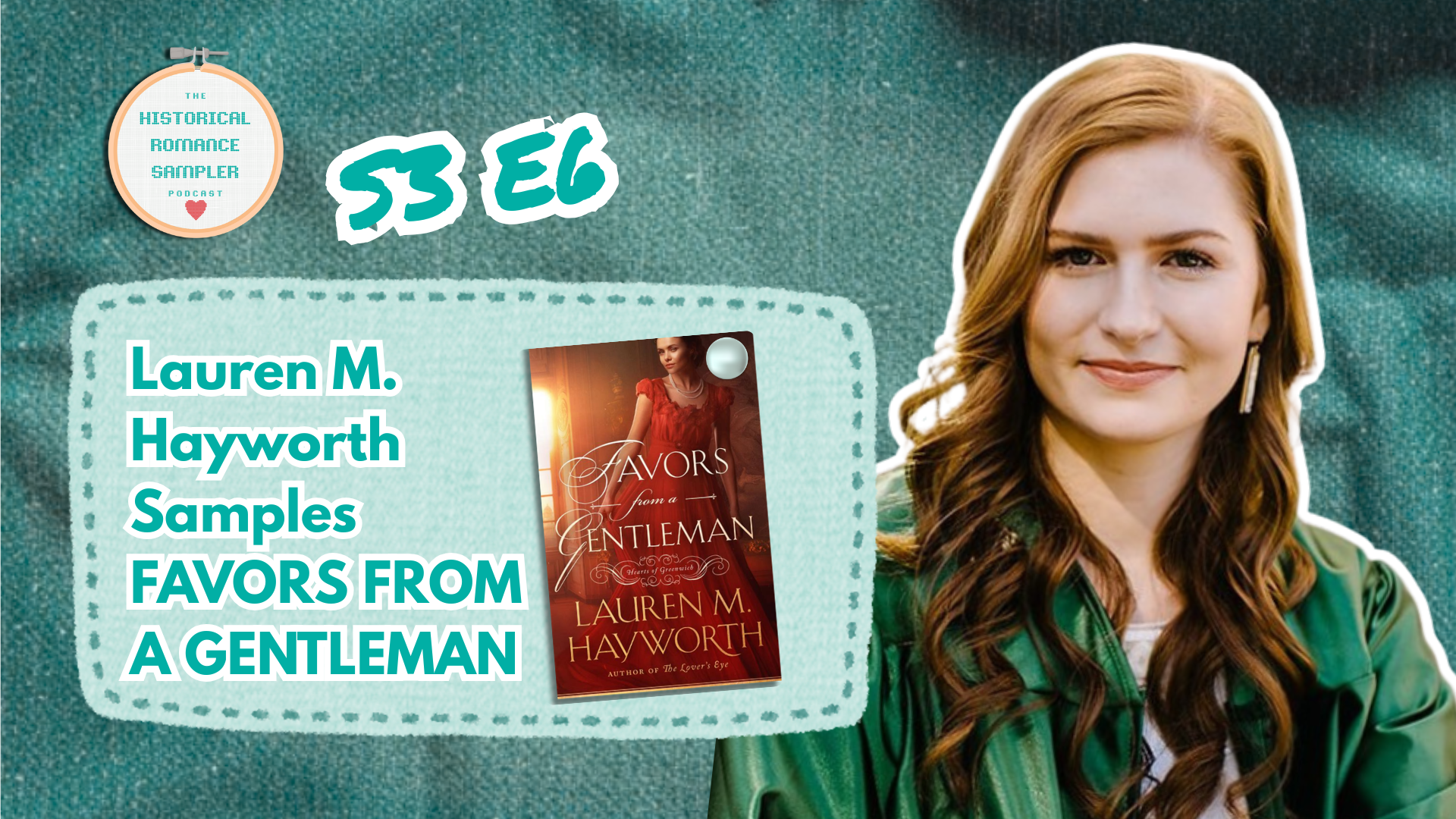
Lauren M Hayworth Samples Favors From a Gentleman
Katherine Grant: [00:00:00] Welcome back to another Historical Romance Sampler episode. Every week, you get to meet a new historical romance author, hear some of their work, and hear us chat about this craft we call historical romance. I am really excited to be joined this week by Lauren M. Haworth.
Lauren M. Hayworth: Mm-hmm.
Katherine Grant: Lauren is a 12th generation North Carolinian with an, an insatiable interest in history and literature.
As an author of historical romance, she makes the past vivid again with evocative prose and meticulously researched stories. When not living amongst the plot lines of her imagination, Lauren works as a dental hygienist. Hygienist? Mm-hmm. Dental hygienist and relishes time spent on her family's farm with her beloved husky.
Her debut novel, The Lover's Eye, was named a finalist for the 2025 Book Life Prize by [00:01:00] Publishers Weekly. That's very exciting. Congratulations.
Lauren M. Hayworth: Yeah. Thank you.
Katherine Grant: I'm excited- And thank you for having me ... to have you here. What are you reading for us today?
Lauren M. Hayworth: So I am reading from my latest release, Favours From a Gentleman, which is also the first in a new series that I'm writing.
So it is Regency, set in England, so British Regency, but I do like trying to, you know, pick maybe lesser talked about parts of history and kind of lean into the, the real life aspects.
Katherine Grant: Awesome. I love that. I also write in Regency, and I'm so aware of how deep the era is. Even though it's, like, technically only 10 years, there's so much there.
Lauren M. Hayworth: Yes.
Katherine Grant: So I'm excited to, to see what you do with it.
Lauren M. Hayworth: Thank you.
Katherine Grant: Is there anything we need to know about the scene before you start reading?
Lauren M. Hayworth: Right. So, sort of the premise of the whole book is that the female main character, Sophie, [00:02:00] and the male main character, Rafe, are both at a ball. He is a merchant's son and she is a viscount's daughter, so it is class difference, and they're both kind of looking to get away from the crowd and get some quiet space.
But when Rafe has a private conversation with some personal information he doesn't want anyone to know in a dark room, he doesn't realize that she's already in there and she has heard everything. So the scene I'm going to be picking up with is The first time they meet outside of, of that initial meeting and kind of where they pick, pick up after that initial meeting.
Katherine Grant: Awesome. Well, take it away whenever you're ready.
Lauren M. Hayworth: All right.
Winter still seized London with icicle fingers, and Rafe, well, Rafe hated the damned cold. Hated that what ought to have felt like a March evening instead mimicked a January night. [00:03:00] Hated that today his father, in a fit of rage over a missing shipment, had taken his ire out on the store's staff and turned out the pastry cook and the boy who swept the streets.
Rafe had walked more than 10 miles, but he'd restored relative calm. Advertisements for a new cook to work the tearoom would be printed in the papers later this week, and a street sweeper had been hired, prepared to start in the morning. Back to Pall Mall, or even the general vicinity of the detestable man and his detestable store, should have been the last thing Rafe wanted.
Yet, here he was. His toes were numb with cold inside his boots, a condition sure to put him in a foul temper, and he'd almost waited too long to do the one God-forsaken thing he'd hoped to do all day: visit the British Institution. Hopefully, he could find the necessary calm to enjoy the picture gallery.
It wasn't just today's events bothering him. There was the other irritant. He couldn't rid himself of the feeling that Miss Red Skirts of the darkened study knew [00:04:00] too much about him. She had met his eye again and again the night of the Milton's Ball while taking dignified sips of her dinner wine, while holding conversation with the snobbiest-looking men in attendance, and even when they passed near each other during a country dance.
Never another word spoken, and she never pulled any of the pennies aside for a good whispering. He'd have noticed. It would be just his good fortune for her to announce Rafe Balfour a cheat and a common workman fit for nothing but the gibbet. He was waiting for the rug to be yanked out from under him, for her to realize the significance of what she'd heard of his and Crofton's conversation, and ruin what little merit he had.
He'd curse merit if gaining his freedom didn't depend upon it. It's been two days. Two. Focus on your real problems. Just now, though, he wasn't going to focus on anything save the masterful artistry of Sir Joshua Reynolds. The institution was just ahead, and the number of patrons entering looked mercifully slim just [00:05:00] now.
Rafe wasn't an artist, far from it, but he certainly classed himself as an admirer of art, coveted an idealistic notion that one day perhaps he might receive instruction on how to put brush to canvas and somehow build worlds and emotions with the work of his hands. Thus far, they'd only succeeded in tasks of manual labor, oiling the machine that was his father's mercantile empire.
Rafe's eyes flashed to the imposing facade of Balfour's on the opposite side of the street. The three grand arches, which had been entirely glassed to display goods, were dark and flat. No light shone from inside, and the hulking indigo-painted doors had been shut and locked. For once, he hadn't been the one to complete the task.
A lady had stopped to peer into the windows. Her maid, an ill-tempered-looking sort, stood a few paces behind, frowning and stamping, her skirts kicking up around her heels. Balfour's had begun to garner [00:06:00] higher-bred clientele. The royal warrant and Queen Charlotte's patronage had seen to that, but it was mostly the gentry who shopped openly at the store.
This lady, with her gaudy hat and unshakable posture, was decidedly not their usual... Oh, hell. Rafe snapped his head forward, but it was too late, and the instant Miss St. Quinton had turned around, dark brow furrowed, she had met his eye. Dread settled in the pit of his stomach like a cast iron brick. He kept his expression neutral, his stride even, though he would have liked to race ahead to his destination and avoid whatever punishment he had coming.
Somehow, he thought she'd follow him wherever he went if he so much as tried to run. "Easy now." A horse whinnied, nearly drowning out the driver's yell. Rafe looked in time to see Miss St. Quinton crossing the street. A massive dray loaded down with barrels of beer halted for her, waiting. She smiled at the driver.
He continued scowling, but tipped his hat to her. [00:07:00] Un-bloody-believable. If that had been Rafe interrupting traffic, he'd have been cursed at, if he wasn't turned to pulp by the vehicle's wheels first. He was the smile's reci- recipient a moment later, when Miss Red Skirts- he'd have to stop with that moniker now, given she was clad in pristine white muslin and a bottle green spencer- mounted the pavement to greet him.
"Good evening, Mr. Balfour." The brick doubled in weight. He hadn't told her his name, nor his place of employ. She had been asking after him. "Good evening, Miss St. Quinton." She looked different from this closeness. The contrast afforded by her absurd black hat proved her hair was not entirely black, but the darkest of browns.
It flirted with the failing colors of daylight, and the silver, military-style frogging on her spencer, drawing out lustrous hints of gold and russet. The hat still looked ridiculous. A massive black feather was pinned across its front, swooping down [00:08:00] to conceal most of her right eye. "I didn't realize at the time of our introduction that we are neighbors."
She smiled, and he could read nothing of it. Concerning. "Yes. So it seems we are, miss." No use pointing out that he knew none of their Berkeley Square neighbors, that being classed as nouveau riche was enough to afford one a house in Mayfair, but not enough to make friends out of the people who lived a short measure of timber and plaster away.
It was a fact, and an old one at that. People largely ignored him and Thomas. She and her family had doubtless ignored him. "Are you headed there now?" Her elbow twitched in invitation, and she cast a look down the street. "No, actually, I am not." She stared at him full. A breeze lifted the obstructive feather, and he felt the strength of her eyes.
If they had been softer, not so keen and sharp and faintly mocking, he would have found it easier to hold her gaze.
Again, [00:09:00] he had left her too long without a reply. The gentle Cupid's bow curve of her mouth pinched, drawing his attention to a small mole he'd not noted on their first meeting. "I am visiting the picture gallery at the institution," he said.
"That sounds positively lovely. I had just been saying how well I'd like to see it."
She grinned at her dour-faced maid. "Had I not, Anne?" Rafe drew a deep breath and held it at the top of his lungs. She wasn't going to let him get away. It would be better to receive his sentencing inside the gallery than on the street. "Would you like to accompany me, Miss St. Quinton?"
"That," she said, placing her hand on his proffered arm, "would be excellent, Mr.
Balfour."
The silence of their walk kept his pulse level right until the moment they reached the institution's vestibule. "One shilling apiece," the money taker announced. Rafe reached for his pocketbook. Curse everything about this. He was going to be [00:10:00] surrendering precious coin, all so that this stranger could give him a good dressing down for something she could never understand.
His business with Crofton was essential. His slipping about to conduct it, also essential. Miss St. Quinton placed her own coin in the money taker's hand before Rafe could. His face stung, but he surrendered his own lone shilling. It shouldn't be this way. He ought to be breezily and unworriedly paying for her admittance, like a gentleman, which he was not one.
They mounted the stairs to the gallery above. He'd chosen the perfect time to come. The skylights captured the last of London's natural illumination, but an attendant was already milling about the room, lighting candles in anticipation of the evening opening. The crowds had yet to descend and turn the place into a social assembly.
It was just Sir Reynolds' portraits, framed in gilt and hung on every available surface. "A catalog for the lady?" On the landing, an attendant offered them a [00:11:00] printed guide. Miss St. Quentin reached for her reticule, but Rafe laid a staying hand over hers. "Do you wish to see the portraits or learn which lord loaned them to the exhibit?"
He asked. She held his gaze. "See them, I suppose." He removed his hand.
"Then don't waste your coin." Her maid had stayed below to wait, and Rafe was glad that the northernmost room, where they began, was already occupied by a few couples. The dark palette favored by Reynolds was stark against the mauve pink paint on the walls, and Rafe could almost rid himself of that foreboding feeling now that he was surrounded by the portraits that had so long prickled his curiosity.
Reynolds had been immensely talented, and never before had so many of his works been gathered in a central space. The exhibit was only to last a few months, and Rafe had been waiting for the moment he could enjoy it for himself. He approached the railing, getting as close as he could to the Death of Dido.
It was a much-talked-about piece for a reason. Smoke from the [00:12:00] funeral pyre clogged the air, and Dido lie upon it, the dagger she had inflicted upon herself still bloodied and abandoned beside her. In the distance, a ship sailed clear of the scene under blue, idyllic skies. Aeneas, her lover. Rafe had seen a depiction of the same scene by Henry Fuseli some years earlier.
A talented rendering, no doubt, and really, he was no painter himself. He hadn't the right to judge. But Fuseli's work had been all darkness. It had the same smoke and the same characters, but there was something indelible about Sir Reynolds' technique. The anguish that lingered on the face of the dead woman, the perfect distribution of space and light among all the scene's players and colors.
In Reynolds' work, there was still a larger world of sunlight and escape. Aeneas' world. It made the grief of Dido's fate all the more pronounced. "This one is a bit different from the others." Miss St. Quentin appeared beside him. [00:13:00] Rafe spared her a moment's glance. Her gaze was fixed on the portrait, her lips downturned at the corners.
"Yes, it's a scene from the Aeneid."
"It's rather, well, not vulgar, but..."
It was fantastic. "If it's made you uncomfortable, it's done its job." She huffed a laugh and met his eye.
He wanted immediately to look away.
"I will admit it captured my attention more than many of the others," she said.
"Reynolds excelled at establishing a sense of grandness. He grew popular enough to paint most of the peerage, but anyone he applied to canvas, he lent an air of reverence to." She was studying Dido again.
It didn't appear she'd even heard him. Damn, why was he going off about this with her in the first place? Making a fool of himself, to be sure. She didn't seem to care. "So he creates an illusion, then?" Each time she pulled her eyes from the art and to him, her expression underwent minute changes, as if someone held a [00:14:00] magnet over top of her outrageous hat.
Her eyes softened, her mouth altered from a faint frown to an equally obscure smile.
"I suppose you could say that, yes." Rafe placed his hands on the protective black railing, drumming his fingers.
"Who is this lady, just here?" She raised a gloved finger. "She looks quite like the subject, does she not? And so pitiful."
"That's Dido's sister. I believe her name is Anna." Anna crowded in protectively behind her sister, the width of her outstretched arms dominating nearly half the portrait's length. Miss St. Quentin had been right to draw attention to the sister. In Fuseli's work, she was present, but her back was to the viewer, her expression impossible to guess at.
Here, "You can almost feel her grief, can't you?" Rafe asked. "It's extravagant."
"I don't care for grandiosity or illusions for that matter." Her words came at a quick clip, interrupting his reverie. He realized the [00:15:00] room had emptied around them. She must have realized it too, for she scanned the periphery before settling her icy attention on him.
The brick rematerialized in his stomach. "Do you think it difficult, Mr. Balfour, to travel to Greenwich discreetly?"
The weight of dread turned molten. How many times had he played his and Crofton's conversation over again in his mind? Endlessly for two days and two nights. Even his worst reenactments hadn't foreseen she would know this much, that she could place him in Greenwich making nighttime deliveries, for he was certain the latter had been revealed.
She stared at him openly, almost daringly. He realized he must be gawping at her and straightened to full height. "What I think, Miss St. Quinton, is that your humor might be well-received in drawing rooms, but it isn't with me."
Whatever pleasantness she had looked on him with before vanished. "Is it so ridiculous to imagine my having business there?"[00:16:00]
"I think it ridiculous that you're taking up this sham."
"Sham?" She spoke the word loudly. He hadn't much noticed her voice until now. It was slightly deep for a woman, idling where the lower register of a flute would play, resonant and fast. She took a step nearer. "Just what do you think I'm about?"
Rafe swallowed.
"I think," he said slowly, "that you're preparing to blackmail me. You're just taking the long way about it."
Katherine Grant: Dun, dun, dun. Wow, that was such a scene. I have a lot of questions for a lot of different directions. But first-
Lauren M. Hayworth: Yeah ...
Katherine Grant: we're gonna take a quick break for our sponsors.
Katherine Grant: I'm back with Lauren M. Haworth, who just read from her latest book, Favors From a Gentleman.
This scene had a lot going [00:17:00] on. Like you said, we were learning about, you know, kind of the, the business that Rafe is dealing with. He's got a lot of anxiety because he thinks he's about to be blackmailed. But then also, there's this beautiful exploration of the art, of this moment, the contemporary art of Sir, uh, Joshua Reynolds?
Lauren M. Hayworth: Mm-hmm. Yeah.
Katherine Grant: Yeah. I suddenly was like, is it Jonathan? Joshua? Jason? Yeah. Um, so I think my first question for you is I'm struck by the historical detail in your writing, the clear connection to this painting that's real, plus an allusion to another painting that I imagine is real.
And then of course, there's the story of it all. So how, how does your creativity... Like, which came first? Did you want to write about the painting and that led into [00:18:00] this scene? Or were you in this museum and you were like, "Well, I've got to have them look at a painting," and that led you to the painting?
Lauren M. Hayworth: Yeah, so I would say probably the very first thing that came to me was knowing that Rafe loved art, and was very much an observer of it at, at this point more than anything else.
And- You know, that exhibit was a real exhibit. I believe it was the year after. This is set in 1812. I believe it was a real exhibit in 1813 maybe. I have it in my notes. And actually the University of Texas at Austin, I believe it is, created, recreated this exhibit, and you can walk through it online and, like, engage with different pictures, and it's really fascinating.
Katherine Grant: That's so cool ... and so...
Lauren M. Hayworth: Yeah, it's amazing, and I think it's because Jane Austen actually attended that exhibit- Mm ... and so there's more focus on it. But I wanted to show [00:19:00] that even though Rafe, his main focus is work, he doesn't really believe in himself at this point in the story that he was still taking time away to view art and to appreciate it.
And, and comparing it to, Fuseli's work of Dido was my way of, of showing, like, well, he would potentially know that because this isn't just a passing, like, "Oh, let me go in here." He loves this and studies this, and so that was my way of, of kind of trying to show that. And I knew they were gonna be in this exhibit, so I basically went to that recreation online, and I spent hours.
I drove myself nuts. I was clicking on all these pictures. I was like, "Which one would have some meaning? Like, where could they be?" I, like, considered so many options, and I was like, "This is getting ridiculous. I wanna go back to this one that was standing out to me in the first place and just make it work."
And it was The Death of Dido And [00:20:00] when I actually got to looking into it and I figured out about the sister, and her grief and everything like that, what's not represented in what I read is that Sophie is deeply grieving her brother's death. So she herself is a grieving sister, and that's why, you know, that dynamic shifts as soon as he says, "Oh, that's her sister," and her grief is extravagant.
You know, she, she's back to business. And a lot of her reason, without revealing too much, but, hoping to get some, some closure and some healing with her grief is a big part of the reason why she's considering engaging in blackmail in the first place. So I think it all kind of fits together. But I, I would say I had kind of the characters first and then put them into place, and then the, the portrait coming into it was a little bit of serendipity, I guess.
Katherine Grant: Yeah. Okay, and [00:21:00] to the blackmail of it all, I read that you were originally writing a lot of mystery, and then with The Lover's Eye decided to, like, kind of center it in romance, and that's when you got to the romance genre of it all. So I'm really curious, how did adding romance into your story and deciding to, like, center the romance change your creative process?
Lauren M. Hayworth: Yeah. I think I just love, and I still, like, I want to revisit mystery and hopefully have mysteries published at some point. Still historical, of course with a romance subplot, 'cause who doesn't love
that? Amazing. I
mean, like all the great things. But I think what I found is, you know, when you're writing mystery, you s- you want to meet the expectations of that genre.
And, and a lot of people that pick it up, they may be more concerned with clues and motives and detective work, and the romance is kind of like a [00:22:00] secondary bonus. And I found that when I was working on mysteries, the scenes that I often was most excited to work on were the ones that developed the relationship, and I just love the connection of it all.
I love- people working through, like, their internal conflicts and, and seeing the character growth. And I thought, "Wouldn't it be so great to write a romance where all I get to focus on is that element?" And so I think it was freeing in the sense of, okay, I can put aside all of the clues and all of the kind of logistics of that, and just focus on the people and their own sort of problems and, and growth.
So- Yeah ... I think it was freeing in that way.
Katherine Grant: Yeah. I love that. I've talked before about how I tried writing a mystery, 'cause I love mysteries. I love reading mysteries. And so I tried with one of my romance books to add a lot [00:23:00] of mystery to it, and I discovered that it was so incredibly difficult because there are all these other motivations you have to layer in about, like, well, why would that person want to be an amateur sleuth?
Yeah. Because it's kind of crazy to be an amateur sleuth. You're putting yourself in danger.
Lauren M. Hayworth: No.
Katherine Grant: Why would you do that? I know.
Lauren M. Hayworth: And you want it to feel believable, too. You don't want it to feel contrived. And you do just have to... And I think oftentimes, like, you have to go back and, and, like, you'll, you'll write and then you'll run into another problem, and you're like, "Ugh."
And so I think that was the great thing, is just like, yay, I can only worry about romance. But I'd, I'd love to do both, hopefully, so.
Katherine Grant: Yeah. Now- In many ways, Regency is an obvious era to write into. I know when I started writing, I was like, "Well, that's what everyone's writing in, so I'm gonna research Regency and that's what I'm gonna do."
More recently, it's like, oh, historical romance is dead. No one wants to read [00:24:00] Regency anymore. And you've kind of entered in between me being like, "I'm gonna write Regency 'cause that's what everyone's doing" and this conversation. So I'm curious what pulled you into Regency and, you know, you mentioned you're kind of, like, staying in Regency for now, so, like, what's keeping you in the Regency era?
Lauren M. Hayworth: I just find it fascinating. I kind of find the Georgian era as a whole really fascinating, and I think it was a time where so much was changing. I mean, you know, the conflict, obviously the war. Everybody talks about the wars that were going on. But just also in terms of, like, even the book I'm researching for now even in terms of farms and estates being enclosed just more people having to go work in a city like kind of the beginnings of the Industrial Revolution.
And I just think- You know, there was a lot going on. I'm, I'm endlessly [00:25:00] fascinated by it. And because I want to consume information about it, then I want to use that information. And I think, you know, I, I have personally loved books from all different time periods, and I'm hoping that, you know, people will, will stay even if it's for the way that I write or the fact that I, I am at least trying to kind of do a deep dive in a, a little different direction, maybe something that's not been done too many times before or my take on something different.
So yeah, I honestly just think it's... I am one of those people who very much I can only write the things that really interest me and the things that I love, and so I'm gonna honor that first and, and hope that things fall into place around that. But I'm totally open to writing in other genres too.
Actually, the, the mysteries that I [00:26:00] was working on are Victorian, and they're set in America. So, you know, like, I'm- Mm ... I would love to jump around. But that's... Yeah.
Katherine Grant: Yeah.
Lauren M. Hayworth: Kind of how I got into Regency.
Katherine Grant: Well, as a Regency researcher myself, I'm so aware, like, we kind of enter... readers enter in, like, this realm of, like, oh, you're at Almacks, and you're going to Vauxhall Garden, and, like, there's this, like, really, like, superficial layer that everyone's kind of familiar with. And then y- you learn about that, and you're like, "Okay, well, now I need to understand, like, what were the maids doing? How were they, like, making their dresses and stuff?"
And then you begin to peel back, like, urban versus country life, and then you begin to figure out like, oh, and there was the... these revolutions going on and the Napoleonic Wars going on. And then you see, like, all the radicals and the reformers and the technological advancements, and it's just like, wait a second, in this, like, 10 years, or if you expand it to, like, 30 years, like, it was a crazy time of growth-
Lauren M. Hayworth: Crazy time
Katherine Grant: for Britain [00:27:00] specifically, and the world. But, like, Britain- Yeah ... was like... It was a pressure cooker.
Lauren M. Hayworth: Yeah. And I think the, the massive gap, too, between the wealthy and their, I mean, genuinely frivolous things that the- Yeah ... most upper class people would do, or, or that even, you know, people would, would rack up insane debts to compared to the way other people were suffering and not being heard, and it was so difficult for them to...
You know, if they, if they couldn't afford to be represented by a lawyer, they couldn't even go through the process of, of, you know, using their rights to appeal things that were being done to them. And I think that massive gap- you know, I, I mean, I think we live in a world where there's a, a growing gap in wealth disparity now too, and I think it's, it's good to explore and to remember and to, you know...
I, I, I think if you do enough research on any [00:28:00] time period and the way that individual lives could have looked, I mean, there will always be parallels and there will always be things to learn, and I think it matters less about the label or the specific year, and more about what you do with it and how you represent it.
I think that's the most important thing.
Katherine Grant: Preach.
Lauren M. Hayworth: Yeah.
Katherine Grant: Well, it's time to do Katherine's Quick Questions.
Katherine Grant: Okay. If you had to use one of these words to describe your writing, to describe your writing sensibilities, would you describe yourself as a realist, a comedian, or a fantasist?
Lauren M. Hayworth: A realist. I like the gritty. I like the... I feel like that's not a surprising answer after my previous answers, but a realist.
Katherine Grant: I love it. I'm a realist as well, so it's like, yes, [00:29:00] please, get detailed. Tell me all the little details.
Lauren M. Hayworth: Yes.
Katherine Grant: Okay. If you had to choose, would you add more real history or more romance scenes to a story?
Lauren M. Hayworth: That's such a hard question 'cause I love both, but I'm gonna say romance because, again, I think connection, like human connection trumps all, and there's tons of fun ways to, to weave in bits of history. But I think that being able to relate to a character is the most valuable thing, and history can be woven into, into that journey, so...
Katherine Grant: Absolutely. If you were forced to do a genre blend story, what crossover genre would you choose?
Lauren M. Hayworth: First of all, you wouldn't have to force me And second of all, definitely mystery and/or Gothic. I love both of those so much.
Katherine Grant: Love it. And [00:30:00] finally, what does escapism mean to you?
Lauren M. Hayworth: Hmm. I think particularly in the romance genre, being able to...
And I know I'm not the first person to say this, but it's so true, be able to learn about history and explore difficult things like, you know, grief representation or complicated family dynamics or all these different struggles sort of to self-love and self-acceptance with that safety net of knowing there's a happily ever after.
So I think particularly in romance, that's kind of the beauty of the escapism. You... It's easier to go through some of those things with the characters knowing there's a happily ever after. But on a broader scope, I would just say being able to just open a book and experience things through another character's eyes, you know, experience the [00:31:00] journey that the author is taking you on I think is, is a beautiful thing, so...
Katherine Grant: I love that. Thank you.
Lauren M. Hayworth: Mm-hmm. Thank you.
Katherine Grant: Well, unfortunately, our conversation must come to an end, but listeners, you can go read Favors From a Gentleman right now. Lauren, where can listeners find you and your books?
Lauren M. Hayworth: So I am wide. They're pretty much available everywhere. And I do sell direct from my website, too, so laurenmhaworth.com.
I sell signed paperbacks with bookmarks, and the e-book's there as well. So yeah.
Katherine Grant: Awesome. Thank you so much for coming on. This has been a really interesting, fascinating, wonderful conversation, and I'm glad we've had a chance to talk.
Lauren M. Hayworth: Yes, me too. Thank you so much for having me.